Skip to content

Choosing between a manual juicer and an electric juicer is not only a product decision. For a business, it is a workflow decision.
A manual juicer often looks attractive because it is simple, quiet, compact, and affordable. An electric juicer usually costs more, but it can save time, reduce staff effort, improve output speed, and support a more consistent fresh juice service.
For home use, the question may be simple: “Which juicer is easier for me?”
For commercial use, the better question is:
Which juicer helps your business control labor cost, service speed, juice yield, cleaning time, and long-term operating efficiency?
A manual juicer can be practical for low-volume citrus tasks, cocktail bars, occasional lemon or lime juice, and small cafés testing fresh juice demand. An electric juicer is usually more practical when juice becomes part of daily service, especially in juice bars, cafés, restaurants, hotel breakfast stations, supermarket juice counters, and catering operations.
This guide compares manual juicers and electric juicers from a commercial buyer’s point of view. If you are comparing beverage equipment for business use, you can also explore the ElectMix Knowledge Center and our Product Comparisons section for related buyer guides.
Quick Answer: Manual Juicers Save Money Upfront, Electric Juicers Save Time at Volume
A manual juicer usually wins on upfront cost and simplicity. It has fewer parts, needs no electricity, and can work well for small citrus tasks.
An electric juicer usually wins when volume increases. It reduces manual labor, improves service speed, and can support more repeatable workflow during busy hours.
| Business Need | Better Choice | Why |
| Occasional lemon or lime juice | Manual juicer | Low cost and simple operation |
| Small cocktail citrus prep | Manual or electric | Depends on prep volume |
| Daily orange juice service | Electric juicer | Faster and less labor-intensive |
| Juice bar menu | Electric juicer | Better for high-volume output |
| Hotel breakfast buffet | Electric juicer | Handles repeated use and faster service |
| Low-budget small café | Manual juicer | Lower upfront cost if volume is low |
| High-volume commercial juicing | Electric juicer | Better long-term labor efficiency |
| Distributor or OEM product line | Depends on target market | Choose by end-user volume and positioning |
The decision comes down to volume.
If your business juices a few lemons or limes per day, a manual citrus press may be enough. If your team prepares dozens or hundreds of servings daily, the lower purchase price of a manual juicer can quickly be offset by labor time, staff fatigue, slower service, and inconsistent output.
What Is a Manual Juicer?
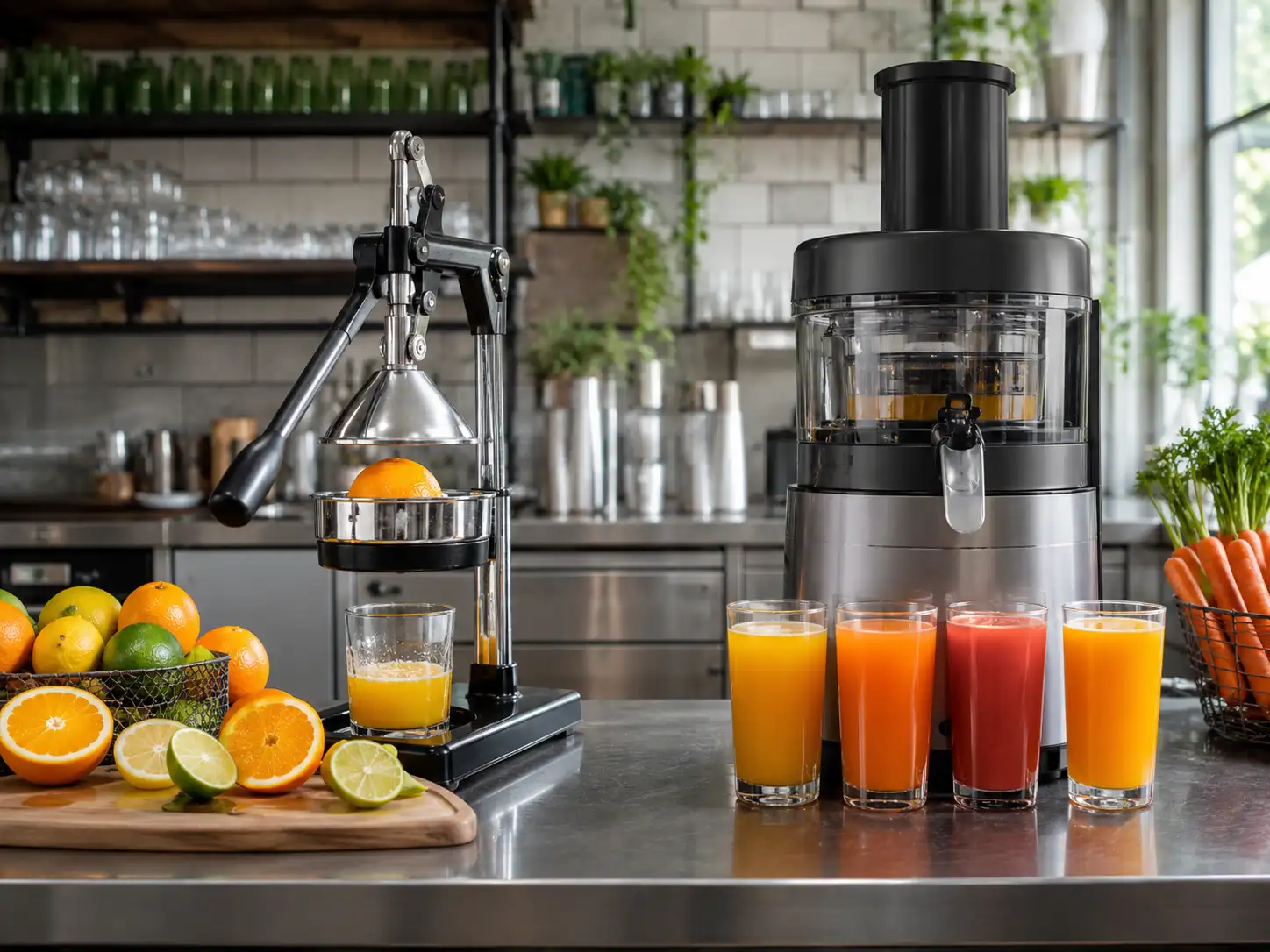
A manual juicer extracts juice without an electric motor. It relies on hand pressure, twisting, pressing, squeezing, or a lever mechanism.
Manual juicers are most commonly used for citrus fruits such as:
- Lemons
- Limes
- Oranges
- Grapefruits
- Small citrus batches
Common types include:
- Handheld citrus squeezer
- Manual reamer
- Lever-style citrus press
- Tabletop manual press
- Commercial manual citrus press
- Hand press juicer
In commercial settings, manual juicers are often used in:
- Cocktail bars
- Small cafés
- Low-volume breakfast service
- Garnish preparation
- Recipe prep
- Occasional fresh juice orders
- Backup juice stations

The strengths are clear. Manual juicers are simple, inexpensive, quiet, compact, and easy to understand. They do not need electricity. They usually have fewer parts to maintain. For small citrus tasks, that simplicity can be useful.
But manual juicers also have limits. They are slower at higher volume, require repeated staff effort, and may produce inconsistent results depending on the operator. A manual citrus press may work well for a bartender preparing lemon and lime juice before service. It is much less practical for a juice bar that needs fast, repeatable output during peak hours.
What Is an Electric Juicer?
An electric juicer uses a motor to extract juice with less manual effort. The exact design depends on the juicer type.
Electric juicers may include:
- Electric citrus juicers
- Centrifugal juicers
- Slow juicers
- Cold press juicers
- Commercial juice extractors
- Automatic orange juicers
- Fresh orange juice machines
In commercial use, electric juicers are common in:
- Juice bars
- Cafés
- Hotels
- Breakfast buffets
- Restaurants
- Health drink shops
- Supermarket juice counters
- Catering operations
- Commercial beverage stations
The main advantage of an electric juicer is efficiency. It can process fruit faster, reduce operator fatigue, and support a more repeatable workflow.
An electric juicer is usually a better fit when juice is part of daily service. If a café sells fresh orange juice every morning, or a hotel breakfast station serves juice to many guests, speed and consistency matter more than the lowest upfront cost.
The trade-off is that electric juicers usually cost more, require electricity, have more parts to clean, and need more attention to maintenance, spare parts, and after-sales support.
If your business is comparing different electric juicer technologies, ElectMix’s article Cold Press Juicer vs Centrifugal Juicer for Business: ROI, Yield & Maintenance Compared is a useful next step.
The Core Difference: Labor Effort vs Motorized Efficiency
The simplest way to compare manual juicers and electric juicers is this:
Manual juicers reduce equipment cost. Electric juicers reduce labor effort.
In low-volume use, manual effort may be acceptable. A bartender squeezing several limes, or a small café making occasional citrus juice, may not need a motorized juicer.
In higher-volume use, manual effort becomes a cost.
A few examples make this clear:
- A cocktail bar preparing moderate lemon and lime juice may use a manual citrus press.
- A hotel breakfast station serving fresh orange juice every morning needs faster output.
- A juice bar cannot rely on slow hand squeezing during peak hours.
- A small café may start with a manual juicer, then upgrade when juice sales increase.
- A catering business preparing juice for large events may need electric speed during prep.
The right decision is not manual versus electric in general. It is manual versus electric at your expected daily volume.
For commercial buyers, the real question is not “Which product is cheaper?”
It is:
How much staff time does each serving require, and how does that affect total operating cost?
Upfront Cost: Why Manual Juicers Look Attractive
Manual juicers often look like the safer first purchase because the upfront cost is lower. They are simple, compact, and easy to place on a bar, prep table, or small counter.
Manual juicers may fit:
- New cafés testing fresh juice demand
- Bars with limited citrus prep
- Small restaurants with occasional juice needs
- Budget-conscious operators
- Backup juice preparation
- Low-volume fresh juice service
- Businesses with limited counter space
For a small operator, this can be reasonable. If you only need a few lemons, limes, or oranges per day, paying more for an electric juicer may not make sense.
But upfront cost is only one part of the equation.
A cheaper juicer can become expensive if it slows staff, wastes fruit, creates fatigue, increases prep time, or cannot keep up with customer orders. In a business setting, time is part of cost. So is waiting time. So is inconsistent juice output.
A manual juicer is not automatically the low-cost option. It is the low-cost option only when volume stays low.
Labor Cost and Service Speed: Where Electric Juicers Start to Win

Labor is one of the biggest hidden costs in commercial juicing.
Manual juicing takes physical effort. That may be fine for occasional citrus prep. It becomes a problem when staff must squeeze fruit repeatedly throughout the day.
Electric juicers can reduce:
- Time per serving
- Staff effort
- Operator fatigue
- Customer waiting time
- Prep bottlenecks
- Inconsistent output between staff
- Service interruptions during peak hours
Imagine a hotel breakfast station preparing fresh orange juice every morning. If staff must manually squeeze fruit for a long queue of guests, the process becomes slow and tiring. An electric orange juicer or commercial citrus juicer can improve flow and reduce manual work.
The same applies to juice bars. If juice is a core menu item, customers expect speed. A manual juicer may create a charming handmade impression, but it rarely supports serious volume efficiently.
This is where electric juicers become more valuable. The purchase price is higher, but the machine can help protect service speed and labor efficiency.
Juice Yield and Ingredient Cost
Juice yield matters because produce is an ongoing cost.
Juice yield depends on:
- Fruit quality
- Fruit size and ripeness
- Juicer type
- Extraction pressure
- Filter or reamer design
- Operator technique
- Pulp control
- Machine consistency
A manual citrus press can work well for citrus fruits when operated properly. But results may vary between staff. One person may press thoroughly, while another may leave more juice behind.
Electric juicers may provide more consistent extraction in repeated service, especially when the machine is properly matched to the fruit and use case.
This matters most when volume is high.
If your business juices 100 oranges per day, even a small difference in extraction efficiency can affect weekly ingredient cost. If your business juices only a few lemons per day, the yield difference may not matter as much.
For commercial operations, the goal is not only “more juice.” The goal is predictable output, controlled waste, and consistent cost per serving.
A good commercial juicer evaluation should include real produce testing. Do not judge only by product photos or catalog descriptions. Test the fruit your customers actually use.
Menu Type: Citrus Only or Broader Juice Program?
Manual versus electric is also a menu decision.
Manual juicers usually make the most sense for citrus-focused tasks:
- Fresh lemon juice
- Fresh lime juice
- Orange juice
- Grapefruit juice
- Cocktail citrus prep
- Small citrus batches
- Garnish or recipe prep
If your menu is limited to lemon, lime, or orange juice in small quantities, a manual citrus press may be enough.
Electric juicers are more practical when the menu expands beyond occasional citrus.
Depending on the machine type, electric juicers can support:
- Fresh orange juice
- Apple juice
- Carrot juice
- Celery juice
- Green juice
- Ginger shots
- Mixed fruit juice
- Vegetable juice
- Cold-pressed style beverages
- Breakfast juice service
- Bottled juice programs
A cocktail bar and a juice bar do not need the same juicer strategy.
A bar may need a reliable citrus press for lemons and limes. A juice bar needs a system that can handle repeated orders, different produce types, and consistent service speed.
A hotel breakfast area may prioritize orange juice speed and guest experience. A health café may need more variety, including vegetable and green juices.
If the menu includes celery, carrot, apple, leafy greens, ginger, or bottled juice, you should also compare juicer technologies such as centrifugal and cold press systems. That is where the ElectMix Juicer & Cold Press Guides section can support broader research.
Cleaning and Maintenance
Cleaning is one of the easiest factors to underestimate.
Manual juicers usually have fewer parts. Many are easy to rinse and clean after citrus use. Their simple structure means less mechanical maintenance.
Manual juicer cleaning advantages include:
- Fewer removable parts
- No motor base cleaning risk
- Simple rinsing after light use
- Lower maintenance complexity
- Easy storage
But manual juicers are not cleaning-free. Citrus pulp, seeds, and sticky residue still need proper cleaning. If residue dries on a press or reamer, hygiene and usability can suffer.
Electric juicers have more parts. Depending on the design, you may need to clean:
- Reamers
- Filter baskets
- Strainers
- Pulp containers
- Juice chambers
- Augers
- Feed chutes
- Lids
- Drip trays
- Food-contact seals
Cleaning time depends heavily on design. A fast juicer that takes too long to clean may still slow the business down.
Food safety should also be part of daily cleaning routines. USDA FSIS emphasizes that cleanliness helps prevent foodborne illness and includes cleaning food preparation surfaces, utensils, and equipment that contact food. For juicer buyers, this means cleanability is not just a convenience feature; it is part of the operating process. See USDA FSIS guidance on cleanliness and foodborne illness prevention. (Food Safety and Inspection Service)
For commercial buyers, cleaning should be judged by the real daily routine:
- How many times will the juicer be cleaned per day?
- Can staff disassemble it quickly?
- Are small pulp areas easy to access?
- Are food-contact surfaces visible and reachable?
- Does the design support fast cleaning during service?
- Are replacement parts available if seals or filters wear out?
A juicer is not efficient if it saves five minutes during extraction but adds fifteen minutes to cleaning.
Noise, Space, and Front-of-House Experience
Manual juicers are quiet. This is a real advantage for cocktail bars, open cafés, and small front-of-house counters.
They are also compact. A manual citrus press can fit on a bar counter, prep table, or small storage shelf. It does not need a power outlet.
Electric juicers are faster, but they need more planning. They may require:
- Counter space
- Power access
- Splash control
- Pulp container space
- Cleaning area nearby
- Noise consideration
- Staff training
Noise matters when juicing happens near customers. A loud electric juicer may be acceptable in a back-of-house prep area but less suitable at a quiet café counter or premium hotel breakfast area.
For a juice bar, noise may be expected. For a luxury hotel breakfast station, it may be less acceptable. The right equipment depends on where the juicer will sit and how guests experience the service.
Manual juicers fit low-volume front-of-house citrus work. Electric juicers fit structured juice stations where speed matters more than quiet operation.
Manual Juicer vs Electric Juicer: Commercial Comparison Table
| Factor | Manual Juicer | Electric Juicer |
| Upfront cost | Lower | Higher |
| Labor effort | Higher | Lower |
| Service speed | Slower | Faster |
| Best use | Low-volume citrus | Daily or high-volume juice service |
| Juice yield | Depends on operator and press design | More consistent with proper machine selection |
| Staff fatigue | Higher in repeated use | Lower |
| Cleaning | Usually simpler | More parts to clean |
| Maintenance | Minimal mechanical maintenance | Requires parts and service planning |
| Noise | Very quiet | Depends on motor and machine type |
| Space | Compact | Requires counter or juice station |
| Menu range | Mostly citrus | Wider options depending on juicer type |
| Best fit | Bars, small cafés, occasional use | Juice bars, hotels, cafés, restaurants |
| Long-term ROI | Strong when volume is low | Strong when volume is medium to high |
This comparison shows why purchase price alone is not enough. A manual juicer can be economical at low volume. An electric juicer can become more economical when labor savings, service speed, and output consistency matter.
Business Scenarios: Which Juicer Fits Which Operation?
Different businesses need different juicing setups.
Cocktail Bars
Cocktail bars often use fresh lemon and lime juice. If prep volume is moderate, a manual citrus press may be enough. It is quiet, compact, and simple.
But if the bar prepares large batches before service, an electric citrus juicer may save time. This is especially true for high-volume cocktail programs, event bars, or venues with heavy citrus use.
Small Cafés
Small cafés may start with a manual juicer if fresh juice is only an occasional menu item. This keeps upfront cost low while the café tests demand.
If customers begin ordering fresh orange juice, lemonade, brunch juice, or wellness drinks daily, the café may need to upgrade to an electric juicer.
A manual juicer is a low-risk start. An electric juicer is better when juice becomes part of the revenue model.
Juice Bars
Juice bars usually need electric juicers.
Manual juicers are too slow for serious juice service. A juice bar must handle repeated orders, different produce types, customer wait times, staff workflow, and consistent output.
For juice bars, the better question is not manual or electric. It is which type of electric juicer fits the menu: citrus, centrifugal, cold press, slow juicer, or commercial extractor.
Restaurants
Restaurants should choose based on menu.
A restaurant that only needs occasional lemon juice for recipes may use a manual juicer. A restaurant that offers brunch juice, fresh orange juice, health drinks, or daily beverage service may need an electric juicer.
Restaurants should also consider where juicing happens. Back-of-house prep may allow more noise and space. Front-of-house juice service may require a cleaner, quieter, more guest-friendly setup.
Hotels and Breakfast Buffets
Hotels and breakfast buffets usually benefit from electric juicers.
Morning breakfast service can create repeated demand in a short time window. Guests expect speed and freshness. Staff need equipment that can keep up without constant manual squeezing.
For hotels, the juicer also affects guest perception. A slow process creates queues. A poor setup creates mess. A suitable electric juicer can support a cleaner, faster breakfast experience.
Catering Businesses
Catering operations often prepare beverages before events. Electric juicers can save prep time when volume is predictable.
Manual juicers may still work as backup tools or for small citrus tasks. But for large event preparation, electric juicers usually reduce labor pressure.
Distributors and OEM Buyers
For distributors, the choice depends on sales channel.
Manual juicers may sell well in:
- Price-sensitive markets
- Bar supply channels
- Small café equipment lines
- Simple citrus prep categories
- Low-maintenance kitchen tool segments
Electric juicers may fit better in:
- Juice bar equipment lines
- Café appliance channels
- Hotel breakfast equipment
- Restaurant equipment supply
- Commercial beverage equipment
- OEM and private-label appliance programs
ElectMix focuses on electric and commercial beverage equipment because these products better match B2B appliance sourcing, OEM customization, export packaging, spare parts planning, and distributor product-line development.
Cost vs Efficiency: How to Calculate the Real ROI
To compare manual and electric juicers properly, calculate more than the purchase price.
A practical ROI review should include:
- How many servings per day?
- How many fruits per serving?
- How many minutes per serving?
- What is staff labor cost?
- How much juice is extracted per fruit?
- How much produce is wasted?
- How long does cleaning take?
- How often will parts need replacement?
- How much downtime can the business tolerate?
- Does the juicer affect customer waiting time?
A simple way to think about it:
Real juicer cost = equipment cost + labor time + produce waste + cleaning time + maintenance + downtime risk.
Manual juicers often win when volume is low.
Electric juicers usually win when volume is high enough for labor savings and faster output to matter.
For example, a small café serving a few fresh orange juices per week may not justify a commercial electric juicer. A hotel breakfast station serving juice every morning likely should not depend on manual squeezing.
A distributor should think the same way. The right product is not always the cheapest model. It is the one that fits the customer’s volume, service speed, cleaning routine, and price expectations.
Food-Contact Materials, Sanitation, and Supplier Evaluation
For commercial juicers, materials and sanitation should not be treated as minor details.
Juicers contact acidic liquids, pulp, seeds, fruit oils, sugars, and sometimes fibrous produce. Food-contact parts may include:
- Reamers
- Filters
- Strainers
- Juice bowls
- Pulp containers
- Feed chutes
- Lids
- Seals
- Gaskets
- Spouts
- Collection cups
FDA explains that food-contact substances can include materials used in food packaging, cookware, food preparation surfaces, and food-processing equipment. For juicer buyers, this means supplier evaluation should include the materials used in food-contact components, not only the motor and appearance. See FDA information on food packaging and other substances that come in contact with food. (U.S. Food and Drug Administration)
NSF also notes that commercial food equipment standards cover areas such as material safety, design, construction, and product performance. For buyers sourcing commercial juicers or beverage equipment, this reinforces the need to review cleanability, material safety, and design quality. See NSF’s overview of food equipment standards. (NSF)
For distributors and OEM buyers, this section is especially important. A product that looks good in a catalog may still create problems if food-contact parts are difficult to clean, if filters clog quickly, or if replacement parts are unavailable.
For OEM and Distributor Buyers: Which Juicer Type Is Easier to Sell?
Manual juicers and electric juicers can both be viable products, but they fit different markets.
Manual juicers may be easier to sell when:
- The market is price-sensitive
- Customers need simple citrus prep
- The channel focuses on bars or small cafés
- Buyers want compact, quiet tools
- Maintenance simplicity is a selling point
- The product is used occasionally
Electric juicers may be easier to sell when:
- Target customers include juice bars, cafés, hotels, and restaurants
- Buyers value speed and efficiency
- The product line focuses on commercial kitchen appliances
- OEM/private-label buyers want higher perceived value
- The market expects modern electric beverage equipment
- After-sales support can be part of the product offer
For B2B sourcing, electric juicers usually create a broader commercial story. They connect with efficiency, service speed, beverage menus, hotel breakfast service, café operations, and commercial appliance channels.
Before sourcing electric juicers, OEM and distributor buyers should evaluate:
- Motor power
- Juicing mechanism
- Yield stability
- Pulp control
- Food-contact materials
- Cleaning design
- Noise level
- Spare parts
- Voltage and plug options
- Packaging customization
- Certification requirements
- Target market price level
- User manual and labeling
- After-sales support
A good supplier should not simply recommend the highest-priced machine. The better supplier helps match juicer design to market use: citrus bar prep, café juice menus, hotel breakfast service, or high-volume juice bar operations.
ElectMix supports commercial juicer and beverage equipment sourcing for B2B buyers, distributors, and private-label projects. You can explore available solutions through the ElectMix Products page or contact the team through Contact Us for sourcing support.

Common Mistakes Buyers Make
Many juicer purchasing problems start with an incomplete cost view.
Here are common mistakes to avoid:
1. Buying Only by Lowest Upfront Cost
A manual juicer may be cheaper at purchase, but if it slows service or increases labor time, the real cost can be higher.
2. Ignoring Labor Time
Manual juicing takes staff effort. At higher volume, labor cost can become more important than equipment cost.
3. Underestimating Staff Fatigue
Repeated citrus pressing can tire staff, especially during prep rushes or breakfast service.
4. Choosing Manual Juicers for High-Volume Service
Manual juicers are practical for low-volume citrus tasks. They are usually not suitable as the main machine for juice bars or hotel breakfast stations.
5. Choosing Electric Juicers Without Checking Cleaning Time
An electric juicer that is hard to clean may slow workflow, even if extraction speed is fast.
6. Ignoring Juice Yield
Produce cost adds up. High-volume buyers should test yield, pulp dryness, and extraction consistency before placing bulk orders.
7. Forgetting Noise and Placement
A noisy juicer may be acceptable in the prep kitchen but not in a quiet café or hotel breakfast area.
8. Not Checking Spare Parts
Filters, reamers, seals, strainers, and pulp containers may need replacement. Spare parts support matters for distributors.
9. Buying a Home-Use Juicer for Commercial Service
A home-use juicer may not handle repeated business use. Commercial buyers should match the machine to workload.
10. Not Testing Real Menu Volume
A juicer should be tested with the fruit, serving size, cleaning routine, and daily volume the business actually expects.
How This Comparison Connects With Other Juicer and Blender Decisions
Manual juicer vs electric juicer is only one part of a larger beverage equipment strategy.
If you are building a commercial beverage line or comparing products for foodservice customers, you may also need to compare:
- Cold press juicer vs centrifugal juicer
- Commercial blender vs smoothie blender
- Heavy-duty blender vs standard blender
- High-speed blender vs low-speed blender
- Commercial blender vs food processor
- OEM blenders vs branded blenders
ElectMix has already covered several related topics:
- Cold Press Juicer vs Centrifugal Juicer for Business: ROI, Yield & Maintenance Compared
- Commercial Blender vs Smoothie Blender: What’s the Real Difference for Businesses?
- High-Speed Blender vs Low-Speed Blender: Which Is Better for Commercial Kitchens?
- Heavy-Duty Blender vs Standard Blender: When Does Power Really Matter?
- Commercial Blender vs Food Processor: Which One Do You Really Need?
- Vitamix vs Blendtec vs OEM Blenders: What Distributors Should Know
Together, these guides help buyers move from basic product comparison to practical commercial sourcing decisions.
Final Recommendation: Choose by Volume, Not by Product Type
Manual juicers are practical for low-volume citrus prep, cocktail bars, occasional juice service, and businesses that need simple, low-cost tools.
Electric juicers are more practical for juice bars, cafés, hotels, restaurants, and businesses where juice is part of daily service.
The key is volume.
If your team only prepares a few lemons or limes per day, a manual juicer may be enough. If juice is part of your daily menu, customer service, or revenue model, an electric juicer will usually provide better long-term efficiency.
For commercial use, cost should not mean purchase price only. The real cost includes labor time, juice yield, cleaning time, maintenance, produce waste, downtime risk, and customer waiting time.
For distributors and OEM buyers, electric juicers usually offer stronger positioning in commercial beverage equipment channels because they support efficiency, modern appliance value, and broader foodservice applications.
If you are sourcing electric juicers or commercial beverage equipment for cafés, juice bars, hotels, restaurants, or distribution channels, ElectMix can support product selection, OEM customization, packaging solutions, and sourcing guidance for your target market.
Visit the ElectMix Knowledge Center, browse Juicer & Cold Press Guides, or contact ElectMix to discuss your commercial juicer sourcing needs.
Frequently Asked Questions
Is a manual juicer better than an electric juicer?
A manual juicer can be better for low-volume citrus tasks, cocktail prep, and businesses that need simple low-cost equipment. An electric juicer is usually better for daily commercial service, faster output, and reduced staff effort.
Which juicer is better for commercial use?
For most commercial use cases with regular juice service, an electric juicer is more practical because it improves speed, reduces labor effort, and supports repeatable workflow. A manual juicer may still work for occasional citrus prep.
Are manual juicers cheaper to operate?
Manual juicers have lower upfront cost and minimal mechanical maintenance, but they require more labor. At higher volumes, labor time and staff fatigue can make manual juicing less efficient.
Do electric juicers produce more juice?
Electric juicers can provide more consistent extraction in repeated use, but yield depends on juicer type, fruit quality, machine design, and operator handling. Commercial buyers should test yield before purchasing in bulk.
Is a manual juicer good for a cocktail bar?
Yes, a manual juicer can work well for cocktail bars that prepare moderate amounts of lemon or lime juice. If the bar handles high-volume citrus prep, an electric citrus juicer may save time.
What type of juicer is best for a juice bar?
A juice bar usually needs an electric juicer because speed, yield consistency, staff efficiency, and daily output are critical. Manual juicers are too slow for most serious juice bar operations.
What should distributors check before sourcing electric juicers?
Distributors should check motor power, juicing mechanism, yield stability, cleaning design, food-contact materials, spare parts, voltage options, certification requirements, packaging customization, and target market positioning.

Marketing & Product Lead at ElectMix | Innovating Commercial Blenders & Home Appliances | Driving Growth & Development