Skip to content

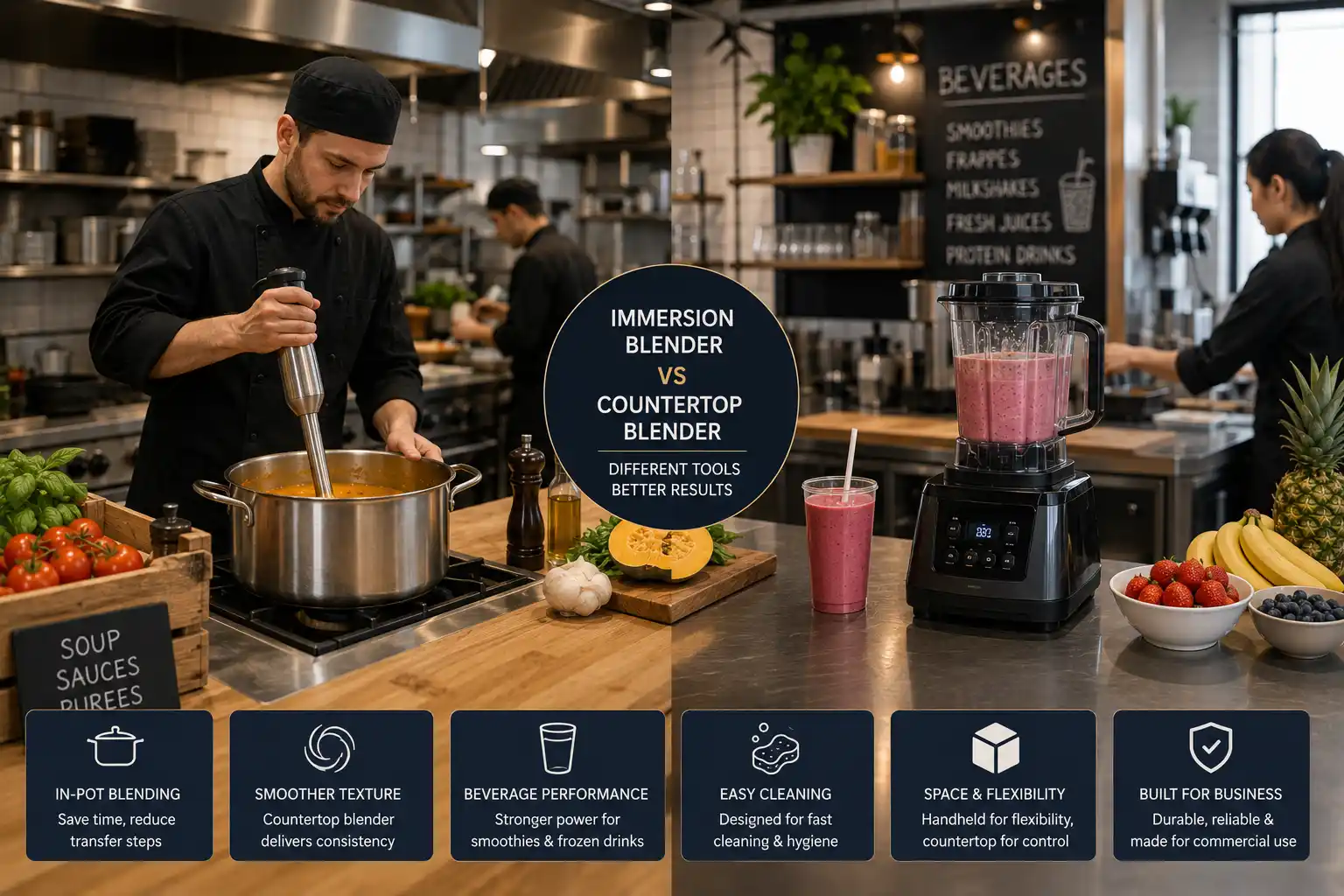
Choosing between an immersion blender and a countertop blender sounds like a simple equipment question. Both can blend soup. Both can handle sauces. Both can help a kitchen turn cooked ingredients into smoother textures.
In a restaurant, however, the better choice depends less on the appliance name and more on the workflow.
An immersion blender is practical when you need to blend directly inside a pot, reduce transfer steps, adjust sauces quickly, or process soups without moving hot liquid into a jar. A countertop blender is practical when you need smoother texture, stronger blending power, frozen drink capability, controlled batch results, and repeatable consistency.
For home users, the question may be “Which blender is more convenient?”
For restaurants, cafés, hotels, smoothie bars, catering teams, and foodservice buyers, the question is more specific:
Which blender fits the menu, station layout, batch size, staff workflow, and texture standard of the business?
This guide compares immersion blenders and countertop blenders from a restaurant and B2B sourcing point of view. If you are comparing multiple commercial blending options, you can also explore the ElectMix Knowledge Center and our Product Comparisons section for related buyer guides.
Quick Answer: Immersion Blenders Save Steps, Countertop Blenders Improve Control
An immersion blender is the more practical choice when your restaurant needs flexibility. It works well for in-pot blending, soup finishing, sauce adjustments, emulsions, and large open containers.
A countertop blender is the stronger choice when your kitchen needs smooth texture, controlled blending, frozen drink performance, repeatable batches, and higher load handling.
| Restaurant Need | Better Choice | Why |
| Blend soup directly in a stockpot | Immersion blender | No need to transfer hot liquid |
| Make silky sauces or fine purées | Countertop blender | Better vortex and texture control |
| Prepare smoothies or frozen drinks | Countertop blender | Stronger power and jar design |
| Adjust sauce texture during service | Immersion blender | Fast, flexible, and portable |
| Blend thick or frozen ingredients | Countertop blender | Better load handling |
| Save counter space | Immersion blender | Easier to store |
| Repeat the same drink texture | Countertop blender | More consistent batch control |
| Large open-container blending | Immersion blender | Can blend directly in larger vessels |
Many restaurants benefit from both tools. They are not enemies. They solve different problems.
The immersion blender is often a prep tool.
The countertop blender is often a texture, beverage, and consistency tool.
For ElectMix buyers, this distinction matters because most commercial blender inquiries are not only about “blending.” They are about smooth drink output, sauce quality, frozen ingredient handling, durability, and repeatable results in business settings.
What Is an Immersion Blender?

An immersion blender, also called a hand blender, stick blender, or handheld blender, is a motorized blending tool with a long shaft and blade guard at the end. Instead of placing ingredients inside a blender jar, the operator places the blender directly into a pot, bowl, pitcher, or container.
This is the main advantage:
The blender goes to the food, instead of the food going to the blender.
In restaurants, immersion blenders are commonly used for:
- Blending soups directly in pots
- Finishing sauces
- Emulsifying dressings
- Adjusting purées
- Mixing soft cooked vegetables
- Blending small batches
- Handling quick corrections during service
- Reducing transfer steps
For example, if a chef has a large pot of cooked tomato soup, it may be easier to blend the soup directly in the pot rather than ladling hot liquid into a countertop blender in several batches.
This is why many kitchens like immersion blenders for soup stations and sauce work. They save movement. They reduce extra containers. They are easy to pick up, use, rinse, and store.
But convenience does not mean they are the best tool for every job. An immersion blender usually depends more on operator technique, container size, ingredient depth, and blade position. It may not create the same smooth, controlled vortex as a countertop blender.
What Is a Countertop Blender?
A countertop blender is a base-mounted blender with a jar or pitcher. Ingredients are placed into the jar, the lid is secured, and the motor drives the blade from the base.
In a restaurant or foodservice setting, a countertop blender is commonly used for:
- Smooth sauces
- Fine purées
- Smooth soups
- Smoothies
- Milkshakes
- Frozen drinks
- Ice crushing
- Nut drinks
- Dressings
- Emulsions
- Bar beverages
- Controlled batch recipes
The key advantage of a countertop blender is control. The jar shape, blade structure, lid, motor speed, and ingredient circulation all work together to produce a more consistent result.
A countertop blender is often better when the kitchen needs:
- Smoother texture
- Stronger power
- Better frozen ingredient handling
- More repeatable batches
- Customer-facing beverage consistency
- More predictable results across different operators
This is why cafés, smoothie shops, juice bars, hotels, and restaurants often depend on countertop commercial blenders for drinks and smooth finished textures.
If you want to understand how countertop blender performance changes under real workload, ElectMix’s article Heavy-Duty Blender vs Standard Blender: When Does Power Really Matter? explains how power, torque, cooling, and duty cycle affect commercial use.
The Core Difference: Bring the Blender to the Food, or Bring the Food to the Blender
The simplest way to compare the two tools is this:
An immersion blender brings the blender to the food. A countertop blender brings the food to the blender.
That difference changes the entire workflow.
With an immersion blender, the chef can blend directly in a stockpot, saucepan, mixing bowl, or container. This can save time when working with hot soup, large sauce batches, or soft cooked ingredients.
With a countertop blender, the chef transfers ingredients into a jar. That extra step may take more time, but the machine creates a controlled blending environment. The jar design helps ingredients circulate through the blades, which usually produces smoother and more repeatable results.
A practical rule works well:
Choose an immersion blender when flexibility, speed, and in-pot blending matter most. Choose a countertop blender when smooth texture, stronger load handling, frozen drink performance, and repeatable batch output matter most.
This is where many restaurants make mistakes. They buy one tool and expect it to do everything. In reality, a soup station and a beverage station do not have the same needs.
Texture Quality: Rough Blend vs Smooth Finish

Texture is one of the biggest differences between an immersion blender and a countertop blender.
An immersion blender can produce good results for:
- Rustic soups
- Soft vegetable purées
- Quick sauces
- Dressings
- Emulsions
- Medium-smooth textures
- In-pot blending tasks
But the result often depends on how the operator moves the tool. The blender must stay submerged. The angle matters. The container shape matters. The amount of liquid matters. If the blade guard does not pull ingredients evenly, the texture can vary.
A countertop blender usually produces:
- Smoother sauces
- Finer purées
- More uniform soups
- Better smoothie texture
- Better frozen drink consistency
- More repeatable results across batches
The reason is circulation. A countertop blender jar is designed to move ingredients through a blending path. A good jar creates a vortex that pulls ingredients down toward the blade and pushes them back upward. This controlled movement helps reduce chunks and improve smoothness.
In a restaurant, texture affects customer perception. A rustic soup can have body and character. A bisque, sauce, smoothie, or purée usually needs a more controlled finish.
For drink-based businesses, countertop blending is even more important. Customers expect the same smoothie texture every time. If one cup is smooth and the next has ice chunks or fibrous pieces, the equipment is not supporting the menu properly.
ElectMix has discussed this texture issue in other comparison guides, including Commercial Blender vs Food Processor: Which One Do You Really Need?, where smooth liquid output is separated from chopping and prep work.
Batch Size and Container Flexibility
Batch size is one reason restaurants like immersion blenders.
If your kitchen makes a large pot of soup, it may not be practical to transfer the liquid into a countertop blender jar in small batches. An immersion blender allows the team to blend directly inside the pot.
This is useful for:
- Soup kettles
- Stockpots
- Sauce pans
- Large prep containers
- Hotel and catering batches
- Back-of-house production work
An immersion blender can reduce handling time and help avoid unnecessary transfer steps.
But large batch size does not always mean an immersion blender is better. It depends on the texture requirement.
A large batch of rustic lentil soup may be fine with immersion blending.
A fine carrot purée, silky bisque, premium sauce, or smooth beverage base may need countertop blender finishing.
A countertop blender offers controlled batch size. This is useful when the kitchen needs exact portions, repeatable results, and predictable texture.
For example:
- A smoothie bar may use the same jar size and recipe ratio for every drink.
- A café may prepare frappes in controlled batches.
- A restaurant may finish sauces in smaller batches to ensure a smoother texture.
- A hotel breakfast station may use countertop blenders for consistent beverage service.
The best choice depends on whether the kitchen values open-container flexibility or controlled batch repeatability.
Safety: Hot Liquids, Transfers, Lids, and Operator Control
Safety is another practical factor.
An immersion blender can reduce the need to transfer hot soup or sauce into a blender jar. This is one reason it is popular in restaurant kitchens. Moving hot liquid from a large pot into a jar creates spill and burn risk if staff are rushed or inexperienced.
However, immersion blenders also require care.
The operator must:
- Keep the blade head submerged
- Avoid blending too close to the liquid surface
- Control the angle of the tool
- Avoid splashing
- Use a container with enough depth
- Follow cleaning and handling procedures
A countertop blender has different safety considerations.
The operator must:
- Secure the lid
- Avoid overfilling the jar
- Handle hot liquids carefully
- Manage steam according to product instructions
- Transfer ingredients without spills
- Use the correct speed and fill level
For hot soups, an immersion blender can be more convenient. For frozen drinks, smoothies, and controlled batches, a countertop blender is safer and more predictable because the ingredients are contained inside a jar with a lid.
In commercial kitchens, equipment safety is not only about the machine. It is about training, station layout, speed of service, and how often the task is repeated.
Cleaning and Workflow Efficiency
Cleaning is not a small issue in restaurants. It affects labor time, station speed, hygiene, and daily workflow.
An immersion blender can be fast to rinse after a simple soup or sauce task. It may also reduce the number of large containers used, because the food stays in the original pot.
Its cleaning advantages include:
- Fewer transfer containers
- Fast rinsing after simple tasks
- Easy storage
- Useful for quick adjustments
- Less counter setup
But the blade guard and shaft need careful cleaning. Food can collect around the guard, and staff must avoid treating it as a quick rinse-only tool when it has been used with thick or oily mixtures.
A countertop blender requires cleaning of the jar, lid, blade area, and sometimes tamper or accessories. This may sound like more work, but it can be efficient in a beverage station.
For example, a smoothie bar can operate with multiple jars. One jar can be used while another is rinsed. Staff can follow the same cleaning process after each drink. The workflow becomes standardized.
Cleaning routines also matter for food safety. USDA FSIS emphasizes cleanliness as part of preventing foodborne illness, including clean hands, surfaces, utensils, and equipment during food preparation. For restaurant operators and equipment buyers, this means blender design should support practical cleaning, not make it harder. See USDA FSIS guidance on cleanliness and foodborne illness prevention.
Cleaning efficiency depends on the station:
- Soup station: immersion blender may be faster.
- Sauce station: depends on texture and batch size.
- Beverage station: countertop blender is usually better.
- Hotel breakfast counter: countertop blender is easier to standardize.
- Catering prep: both may be useful.
For business buyers, the question is not “Which is easier to clean?”
The better question is:
Which tool fits the cleaning routine of the station where it will actually be used?
Power and Ingredient Load
Power is where countertop blenders usually have the advantage.
Immersion blenders are useful for liquid, soft, or cooked ingredients. They can work well for soups, sauces, dressings, and soft purées.
But they are usually less suitable for:
- Ice
- Frozen fruit
- Thick smoothies
- Nut drinks
- Dry grinding
- Dense purées
- Hard ingredients
- High-volume frozen beverage service
Countertop blenders are better for these difficult loads because they combine motor power, jar geometry, blade structure, and closed-container circulation.
This matters for restaurants that serve smoothies, milkshakes, frozen drinks, or thick sauces. It also matters for cafés, juice bars, hotel breakfast areas, and beverage counters.
A hand blender can mix a soft soup. It should not be expected to perform like a heavy-duty countertop blender under frozen drink conditions.
This point connects directly with ElectMix’s guide on High-Speed Blender vs Low-Speed Blender: Which Is Better for Commercial Kitchens?. Speed is important, but power under load, torque, and recipe type are just as important in commercial use.
Space, Storage, and Station Layout
Restaurant space is expensive. Every piece of equipment must earn its place.
An immersion blender is easy to store. It can hang on a rack, sit in a drawer, or stay near the prep station. It does not require permanent counter space.
This makes it useful for:
- Small kitchens
- Prep stations
- Soup stations
- Catering kitchens
- Kitchens with limited counter area
A countertop blender needs a stable base, counter space, nearby power, and enough room above and around the jar. If the blender has a sound enclosure, it may require even more vertical clearance.
But countertop space is justified when the blender supports revenue-generating items such as smoothies, frappes, milkshakes, frozen drinks, sauces, or consistent beverage service.
A restaurant that rarely blends may prefer an immersion blender for flexibility.
A café or smoothie bar should usually create a dedicated countertop blender station.
The decision should follow the workflow:
- Where will the blender be used?
- Who will use it?
- How often will it run?
- Does it need to stay ready during service?
- Is it used for prep or customer-facing output?
- Does the station need multiple jars?
- Is noise a concern?
These questions usually reveal the better equipment choice.
Noise and Front-of-House Use
Noise matters when blending happens near customers.
Immersion blenders are usually used back-of-house and for shorter tasks. Their noise may be less noticeable because they are often used in prep areas.
Countertop blenders can be loud, especially when crushing ice or blending frozen fruit. In cafés, hotel breakfast areas, smoothie bars, and open kitchens, this can affect customer experience.
For front-of-house beverage service, buyers should consider:
- Sound enclosure options
- Motor noise
- Ice-crushing noise
- Counter placement
- Customer distance
- Staff communication
- Peak-hour usage
A countertop blender with a sound enclosure may be worth considering if the machine is used near customers.
For distributors and OEM buyers, noise control can become a selling point. A blender that performs well but sounds too aggressive in a café may be harder to position in premium foodservice channels.
Restaurant Use Cases: Which Blender Fits Which Task?
The best way to compare immersion blender vs countertop blender is by task.
Soups
For soups, an immersion blender is often the practical first choice. It can blend directly in a pot, reduce transfer steps, and make large-batch soup preparation easier.
It works especially well for:
- Tomato soup
- Lentil soup
- Vegetable soup
- Bean soup
- Rustic creamy soups
- Soft cooked vegetables
A countertop blender is better when the soup needs a very smooth, silky finish. Fine bisques, premium purées, and smooth restaurant-style soups often benefit from countertop blending.
Sauces
Both tools can work for sauces.
An immersion blender is useful when a chef needs to adjust a sauce quickly in a pot or container. It can help with emulsions, small corrections, and soft ingredient blending.
A countertop blender is better when the sauce must be extremely smooth, consistent, or repeatable. It is also better for thicker sauces that need strong circulation.
For example, a quick herb sauce may work well with an immersion blender. A smooth pepper sauce, nut-based sauce, or fine restaurant purée may be better finished in a countertop blender.
Purées
Countertop blenders usually produce finer purées because they create stronger and more controlled circulation.
Immersion blenders can make rustic or medium-smooth purées, especially from soft cooked vegetables. But they may leave small pieces depending on the container, blade position, and operator technique.
If the menu requires fine purée consistency across many plates, a countertop blender is usually safer.
Dressings and Emulsions
Both immersion blenders and countertop blenders can be used for dressings and emulsions.
An immersion blender is practical for small containers and quick emulsions. It is flexible and easy to control when the volume is moderate.
A countertop blender is better for larger controlled batches, especially if the recipe needs stable texture and repeatability across service.
Smoothies and Frozen Drinks

This is where the countertop blender clearly wins.
Smoothies and frozen drinks need:
- Stronger motor power
- Good jar circulation
- Ice handling
- Frozen fruit performance
- Smooth texture
- Repeatable results
- Fast service cycles
An immersion blender is not the right primary tool for smoothie shops, cafés, frozen drink menus, or high-volume beverage stations.
If smoothies or frozen beverages are part of your business, a countertop commercial blender should usually be the priority.
For related beverage-equipment decisions, see ElectMix’s guide Commercial Blender vs Smoothie Blender: What’s the Real Difference for Businesses?.
Prep Kitchen Adjustments
Immersion blenders are excellent for quick prep adjustments.
They allow kitchen staff to:
- Smooth out a sauce
- Adjust a soup texture
- Blend soft vegetables
- Finish a dressing
- Work directly in prep containers
- Avoid extra transfer steps
This makes them valuable in back-of-house work, even if the restaurant still uses countertop blenders for final texture or drinks.
Can an Immersion Blender Replace a Countertop Blender in a Restaurant?
An immersion blender can replace a countertop blender for some tasks, but not all.
It can often handle:
- Basic soups
- Soft cooked vegetable purées
- Some sauces
- Quick emulsions
- Small adjustments
- In-pot blending
- Prep corrections
But it usually cannot fully replace a countertop blender for:
- Smoothies
- Frozen drinks
- Ice crushing
- Thick smoothies
- Nut drinks
- Ultra-smooth sauces
- Fine purées
- Repeatable batch recipes
- Customer-facing beverage menus
This is the key difference.
An immersion blender is practical.
A countertop blender is more controlled.
If a restaurant mainly makes rustic soups and sauces, an immersion blender may cover many needs. If the restaurant serves smoothies, milkshakes, frozen drinks, premium sauces, or smooth purées, a countertop blender becomes much more important.
Can a Countertop Blender Replace an Immersion Blender?
A countertop blender can produce smoother results, but it cannot always replace the convenience of an immersion blender.
To use a countertop blender, staff must transfer ingredients into the jar. For hot soup or large-batch sauce, this can mean extra time, extra dishes, and more careful handling.
A countertop blender may require:
- Blending in several batches
- Moving hot liquid from pot to jar
- Cleaning jars between batches
- More counter space
- More setup time
- Staff training for hot liquids
For large soup pots, an immersion blender can be more practical.
This is why many restaurants use both:
- Immersion blender for direct-in-pot prep
- Countertop blender for smooth texture and beverage service
The two tools are complementary. The better question is not always “Which one replaces the other?” It is often “Which station needs which tool?”
Cost and ROI: Which One Pays Off Faster?
The answer depends on your menu.
An immersion blender can create ROI by saving time in prep work. It reduces transfer steps, helps with large pots, speeds up soup and sauce work, and takes less space.
Its ROI is strongest when the kitchen regularly prepares:
- Soups
- Sauces
- Large pot recipes
- Soft cooked vegetables
- Simple emulsions
- Back-of-house prep items
A countertop blender creates ROI in a different way. It improves texture quality, supports beverage revenue, handles frozen drinks, delivers repeatable results, and can become a key machine for customer-facing menu items.
Its ROI is strongest when the business sells:
- Smoothies
- Frappes
- Milkshakes
- Frozen drinks
- Fine sauces
- Purées
- Nut drinks
- Beverage bases
- Consistent high-margin drinks
For a soup-focused restaurant, an immersion blender may pay off quickly.
For a smoothie bar, café, hotel breakfast station, or drink-focused restaurant, a countertop commercial blender is usually the stronger investment.
For distributors, ROI also includes product positioning. A countertop commercial blender can often be positioned across cafés, restaurants, hotels, smoothie shops, juice bars, and foodservice channels. This gives it broader sales potential in many B2B markets.
For Distributors and OEM Buyers: Which Product Is Easier to Position?

Distributors and OEM buyers should not evaluate immersion blenders and countertop blenders only by kitchen convenience. They should evaluate market demand.
Countertop commercial blenders are often easier to position for:
- Smoothie bars
- Cafés
- Juice bars
- Hotels
- Restaurants
- Beverage chains
- Commercial kitchen equipment dealers
- Foodservice distributors
- Private-label appliance brands
Immersion blenders are easier to position for:
- Restaurant prep kitchens
- Catering kitchens
- Soup production
- Institutional kitchens
- Back-of-house users
- Culinary prep suppliers
Both products have a place. But ElectMix focuses on countertop commercial blender and juicer solutions because they connect strongly with beverage preparation, foodservice equipment, OEM customization, and distributor channels.
If you are sourcing countertop commercial blenders, evaluate:
- Motor power
- Torque
- Jar material
- Blade design
- Speed control
- Sound enclosure options
- Spare parts
- Certification requirements
- Packaging customization
- Voltage and plug options
- Target market price level
- Recipe testing needs
- After-sales support
For foodservice equipment buyers, sanitation and material safety should also be part of supplier evaluation. NSF explains that food equipment standards include requirements related to material safety, design, construction, and product performance. For blender buyers, this is relevant when evaluating jars, lids, seals, blades, and other food-contact parts. See NSF’s overview of food equipment standards.
Food-contact materials are another important checkpoint, especially for blender jars, lids, seals, gaskets, and components that may touch ingredients during preparation. FDA explains that food-contact substances can include materials used in packaging, cookware, food preparation surfaces, and food-processing equipment. For export buyers, this makes food-contact material review an important part of blender sourcing. See FDA’s consumer information on food packaging and other substances that come in contact with food.
A good supplier should help you match blender specifications to your target market. A smoothie shop, hotel breakfast station, café chain, and budget restaurant supplier may not need the same model.
ElectMix supports commercial blender sourcing, OEM customization, packaging solutions, and product selection for B2B buyers. You can explore current options through the ElectMix Products page or contact the team through Contact Us for sourcing discussion.
How This Comparison Connects With Other Blender Decisions
Immersion blender vs countertop blender is only one part of a broader equipment decision.
If you are building a restaurant equipment line or comparing appliances for a commercial kitchen, you may also need to compare:
- Commercial blender vs smoothie blender
- Heavy-duty blender vs standard blender
- High-speed blender vs low-speed blender
- Commercial blender vs food processor
- Cold press juicer vs centrifugal juicer
- OEM blenders vs branded blenders
ElectMix has already covered several related topics:
- Commercial Blender vs Smoothie Blender: What’s the Real Difference for Businesses?
- High-Speed Blender vs Low-Speed Blender: Which Is Better for Commercial Kitchens?
- Heavy-Duty Blender vs Standard Blender: When Does Power Really Matter?
- Commercial Blender vs Food Processor: Which One Do You Really Need?
- Cold Press Juicer vs Centrifugal Juicer for Business: ROI, Yield & Maintenance Compared
- Vitamix vs Blendtec vs OEM Blenders: What Distributors Should Know
Together, these guides help buyers move from basic product comparison to more practical commercial sourcing decisions.
Final Recommendation: Restaurants Often Need Both, But Not for the Same Reason

An immersion blender is more practical when restaurants need flexibility. It is useful for direct-in-pot blending, soups, sauces, soft purées, emulsions, easy storage, and fewer transfer steps.
A countertop blender is more practical when restaurants need smooth texture, strong power, ice handling, frozen drink capability, consistent batches, and repeatable results.
For many restaurants, the best setup is both:
- Use an immersion blender for flexible prep and in-pot blending.
- Use a countertop blender for smooth texture, beverages, frozen drinks, and controlled batches.
If your business is beverage-focused, the countertop commercial blender should usually come first. If your kitchen is mainly soup- and sauce-focused, an immersion blender may provide immediate workflow value.
For distributors and OEM buyers, countertop commercial blenders often offer stronger positioning across cafés, smoothie shops, juice bars, hotels, restaurants, and foodservice channels.
If you are sourcing countertop commercial blenders for restaurants, cafés, hotels, smoothie shops, or distribution channels, ElectMix can support model selection, OEM customization, packaging, and product specification guidance for your target market.
Visit the ElectMix Knowledge Center, browse Product Comparisons, or contact ElectMix to discuss your commercial blender sourcing needs.
Frequently Asked Questions
What is the difference between an immersion blender and a countertop blender?
An immersion blender is handheld and blends directly in a pot, bowl, or container. A countertop blender has a motor base and jar, offering better control, stronger power, and smoother results for many restaurant and beverage applications.
Is an immersion blender better for restaurants?
An immersion blender is very practical for restaurants that make soups, sauces, and large pot preparations. It is not always better for smoothies, frozen drinks, ice crushing, or ultra-smooth textures.
Can an immersion blender replace a countertop blender?
It can replace a countertop blender for some soups, sauces, soft purées, and quick adjustments. It usually cannot replace a countertop blender for frozen drinks, thick smoothies, ice, nut drinks, and repeatable smooth results.
Can a countertop blender replace an immersion blender?
A countertop blender can create smoother results, but it cannot blend directly inside a large pot. For hot soups and large containers, an immersion blender may still be more practical.
Which blender is better for smoothies in a restaurant?
A countertop blender is better for smoothies because it offers stronger power, better jar circulation, more consistent texture, and better performance with frozen fruit and ice.
Which blender is better for soup?
For large pots of rustic soup, an immersion blender is often more practical because it blends directly in the pot. For very smooth soups or fine purées, a countertop blender usually creates a better finish.
Which blender is easier to clean?
An immersion blender can be easier for quick soup or sauce tasks because it avoids transferring food into a jar. A countertop blender may be more efficient for repeated beverage service, especially when using multiple jars and a standard cleaning process.
Do restaurants need both an immersion blender and a countertop blender?
Many restaurants benefit from both. The immersion blender is useful for flexible prep and in-pot blending, while the countertop blender is better for smooth texture, beverages, frozen drinks, and repeatable batch results.

Marketing & Product Lead at ElectMix | Innovating Commercial Blenders & Home Appliances | Driving Growth & Development