Skip to content

Key Takeaways
- The biggest difference is not whether both machines can make smoothies. It is whether the blender is built for business workload, durability, and repeatable daily output.
- A commercial blender is usually designed for heavier use, broader menu flexibility, and longer service life. A smoothie blender is often positioned around beverage applications and may range from light-duty to commercial-grade.
- The right choice depends on your daily volume, recipe thickness, menu range, operating environment, and growth plan.
- For light, beverage-focused operations, a smoothie-oriented blender may be enough. For busy cafés, restaurants, bars, hotels, and scaling brands, a true commercial blender is usually the safer long-term investment.
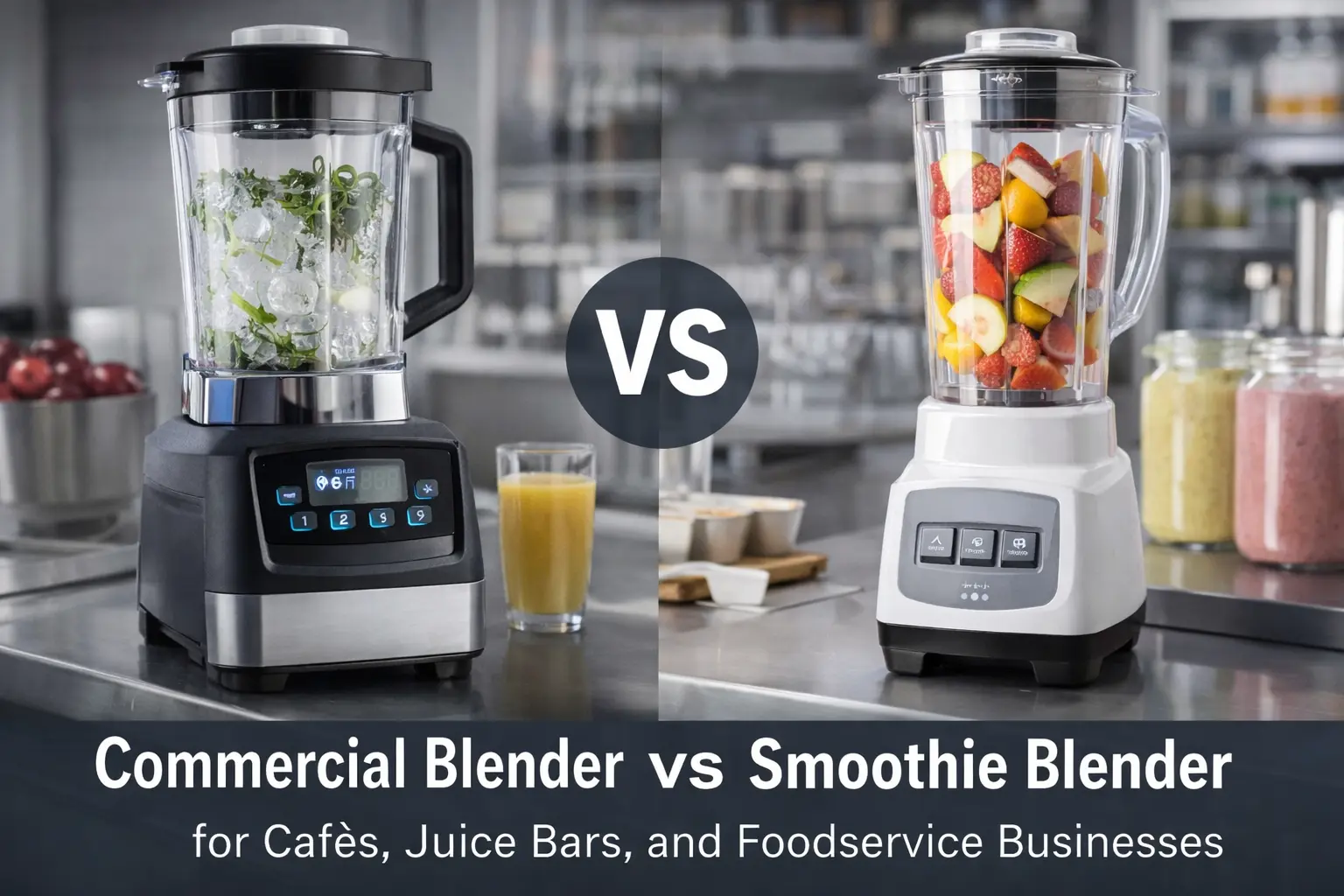
When buyers compare a commercial blender with a smoothie blender, the two categories can look similar in product listings. Both are shown making frozen drinks, fruit blends, and milk-based beverages. For businesses, however, the real difference becomes much clearer once you look at workload, durability, menu flexibility, cleaning efficiency, noise, and long-term operating cost.
A café, juice bar, hotel breakfast station, restaurant, or distributor should not choose a blender based on marketing labels alone. The better question is simple: Can this machine support the way your business actually operates day after day?
This guide breaks down the real differences so business buyers can choose the right blender for their menu, service pace, and growth plans. For readers comparing broader equipment options, it also pairs well with ElectMix resources such as Commercial Blender Solutions, Knowledge Center, and Cold Press Juicer vs High-Speed Blender.
Why This Comparison Matters for Business Buyers
For business buyers, a blender is not just a countertop appliance. It affects drink consistency, ticket time, staff workflow, cleaning labor, customer experience, and replacement cost.
A machine that is too light for the job may still blend well during the first few orders. The problem appears when demand rises. Under real service conditions, an undersized blender may struggle with thicker recipes, slow down during peak hours, overheat, or wear out earlier than expected. This creates operational friction: slower output, inconsistent texture, more staff frustration, and more downtime.
A blender that is properly matched to the business does the opposite. It supports faster production, more consistent beverages, easier training, and a more stable service rhythm. This is especially important in cafés, smoothie bars, restaurants, hotels, and multi-location brands where consistency matters.
For B2B buyers, the discussion is also about platform thinking. A blender may need to support not only today’s smoothie menu, but tomorrow’s milkshakes, frozen coffee drinks, dessert bases, sauces, or prep work. That is why choosing the right category from the start often saves more money than choosing the cheapest unit first.
What Is a Commercial Blender?
A commercial blender is a blender built for repeated use in business environments. It is usually designed with stronger motor systems, heavier-duty construction, more durable drive components, and better support for repeated blending cycles throughout the day.
In practical terms, a commercial blender is meant to handle more than occasional smoothie making. Depending on model class and intended use, it may be expected to process ice, frozen fruit, nut butters, thick purees, sauces, dressings, soups, or mixed-ingredient beverage recipes with more consistent performance under load.
Commercial blenders also tend to offer features that matter in professional settings, such as:
- more durable jars and couplings
- multiple speed controls or programmable presets
- easier repeatability across shifts
- replacement-part availability
- options for sound enclosures in customer-facing areas
This is why a commercial blender is often the more suitable platform for businesses that need dependable daily output rather than occasional convenience. Buyers evaluating this category may also want to explore OEM/ODM Blender Manufacturing Support and relevant standards such as [NSF/ANSI food equipment standards.
What Is a Smoothie Blender?
A smoothie blender is a blender mainly positioned around smoothies, shakes, frozen drinks, and similar beverage applications. In the market, the term is often usage-based rather than engineering-based. In other words, “smoothie blender” describes what the blender is promoted for, but not always how robust it is.
This is where buyers often get confused.
Some smoothie blenders are clearly light-duty machines aimed at home or occasional use. Others are designed for smoothie shops, cafés, and beverage counters and can be fully commercial in build quality. Because of that overlap, buyers should not assume that every smoothie blender is light-duty, and they should not assume that every blender shown making smoothies is suitable for business use.
The better approach is to look beyond the label and evaluate the actual machine in terms of:
- motor stability under thicker loads
- intended daily workload
- jar size and batch style
- cooling and durability design
- control options
- cleaning speed
- service and replacement support
For business buyers, “smoothie blender” is best understood as a menu-oriented label, while “commercial blender” is more often a workload and durability category.
Commercial Blender vs Smoothie Blender: The Core Differences

At a glance, both machines may appear capable of handling similar drink recipes. The difference becomes clearer when you compare how they perform in real business use.
Motor Power and Torque
Motor strength matters because beverages are not all equally easy to blend. Soft fruit, milk, yogurt, and light ice use are one thing. Frozen fruit, thick smoothie bowls, nut-based drinks, dense protein mixes, and multi-ingredient recipes are another.
Commercial blenders are generally designed to maintain more stable blending performance when recipes become thicker or when the machine is used repeatedly throughout the day. A smoothie blender may still perform very well for standard beverage recipes, but lighter-duty models are more likely to struggle once the menu becomes denser or more varied.
For businesses, the key question is not simply “Can it blend this?” but rather “Can it blend this consistently during real service hours?”
Duty Cycle and Workload Capacity
Duty cycle is one of the clearest dividing lines between the two categories. A blender used in a quiet wellness corner faces a very different workload from one used in a busy café during a morning rush.
Commercial blenders are usually the better fit when the machine is expected to run frequently, back-to-back, or across extended service periods. Smoothie blenders may be enough for lighter or more predictable use, especially when the menu is narrow and order volume is moderate.
This is where many buying mistakes begin. A blender that looks powerful on paper can still be the wrong choice if it was not designed for repeated commercial use.
Jar Size and Batch Flexibility
Jar size affects more than serving volume. It also influences labor efficiency, speed of service, and menu flexibility.
A smoothie-focused setup may be built around single-serve drinks or smaller beverage batches. A commercial platform, by contrast, is often better suited to larger batch production, back-of-house prep, or a broader mix of beverage and food applications.
For businesses, this matters because batch flexibility supports smoother operations. A blender that works only for one type of drink may become limiting once the menu expands.
Blade Design and Ingredient Handling
Blade and jar design strongly affect texture and blending efficiency. Commercial blenders are often built to manage a wider ingredient range, including harder, thicker, or less uniform inputs. Smoothie blenders may be optimized more narrowly for beverage texture and fast drink preparation.
This does not make one automatically better than the other. It means the buyer should match the machine to the intended use. If the menu includes only fruit smoothies and protein shakes, a smoothie-oriented blender may be enough. If the business also blends frozen cocktails, soups, sauces, purees, or nut-based recipes, a more robust commercial design is usually the safer choice.
Speed Control and Program Settings
Consistency matters in business. Staff turnover, training time, and service pressure all increase the value of machines that are easy to repeat accurately.
Commercial blenders often provide more control through variable speeds, timers, or preset programs that help standardize output across shifts. Some smoothie blenders also offer useful presets, especially in beverage-focused environments, but simpler models may be more limited when recipe variety grows.
For operators serving the same drinks all day, simplicity can be an advantage. For operators running broader menus, extra control usually pays off.
Noise Level and Front-of-House Suitability
Noise is often underestimated during purchasing. In a customer-facing setting, the wrong blender can disrupt the experience even if it performs well technically.
Cafés, hotel breakfast stations, open counters, lounges, and coworking spaces usually benefit from quieter systems or sound-enclosed designs. Some commercial blenders are specifically configured for this type of environment. Other blenders may be more suitable for back-of-house use where noise is less of a concern.
For businesses placing blenders near guests, it is worth reviewing occupational and environmental noise guidance and thinking about customer comfort, not just output speed.
Durability and Service Life
Durability is one of the strongest arguments for a true commercial blender. Business use places more stress on housings, drive systems, lids, jars, and motor assemblies than home-style use ever will.
A blender with a lower upfront cost may seem attractive, but if it wears out early, replacement cost, downtime, and staff disruption can quickly erase the savings. A stronger commercial platform often delivers better long-term value because it is built for repeat use and is more likely to offer access to spare parts, replacement jars, and service support.
For distributors and private label buyers, serviceability matters almost as much as performance.
Cleaning and Daily Maintenance
Cleaning efficiency has a direct effect on workflow. The more often a blender is used, the more important jar design, lid design, rinse cycles, and ease of maintenance become.
Commercial environments benefit from blenders that support quick turnaround between orders and predictable daily cleaning routines. A machine that traps seeds, powders, or sticky residue in difficult areas can slow staff down and create hygiene issues during busy service windows.
This is especially relevant for operators working under formal sanitation expectations or internal QA systems. Useful supporting context can be found in FDA Food Code guidance.
Menu Flexibility
This is where many businesses outgrow their first blender.
A smoothie blender may be perfectly suitable when the menu stays focused on smoothies, shakes, and simple frozen beverages. A commercial blender is usually the better choice when the business needs more room to expand into sauces, soups, dressings, dessert bases, crushed-ice drinks, nut milks, or prep work beyond beverages.
For brands thinking beyond a single menu format, flexibility is often more valuable than a lower entry price.
Cost of Ownership
The real cost of a blender is not just the purchase price. It includes downtime, replacement frequency, labor inefficiency, consistency issues, consumable parts, and the risk of failure during busy periods.
For low-volume operations, a smoothie blender may offer acceptable value. For more demanding environments, a commercial blender often delivers a better return because it reduces operational friction and lasts longer under real business conditions.
This is the difference between buying for launch week and buying for the next several years.
Which Businesses Can Use a Smoothie Blender?
A smoothie blender can make good business sense in the right context. It may be suitable for:
- low-volume beverage kiosks
- office or wellness drink stations
- hotel or hospitality corners with limited drink output
- cafés where smoothies are a minor menu category
- businesses with narrow menus and moderate traffic
In these cases, the blender does not need to support heavy all-day production or broad food-prep use. What matters is that the machine’s actual specifications match the workload.
This is an important distinction. A smoothie blender is not automatically the wrong choice for business. It is simply the wrong choice when the business expects more from it than it was designed to handle.
When a Commercial Blender Is the Better Choice
A commercial blender becomes the better investment when blending is central to the operation rather than occasional.
This usually includes businesses such as:
- busy smoothie bars and juice shops
- cafés with strong blended beverage demand
- bars serving frozen cocktails
- hotels with high breakfast or beverage volume
- restaurants using blenders for both drinks and prep
- distributors and OEM/private label brands targeting serious commercial buyers
In these environments, the blender needs to support more than recipe completion. It must deliver repeatable texture, survive peak periods, tolerate tougher ingredients, and reduce the risk of breakdowns during service.
For businesses planning growth, standardization across multiple locations, or a broader product line, a commercial blender is often the more future-proof decision. Buyers in this stage may also want to review commercial blender product range and Contact ElectMix for model matching and OEM discussions.
Common Mistakes Businesses Make When Choosing Between the Two
One common mistake is buying based on headline power numbers alone. Wattage or peak power claims do not tell the full story. Daily workload, thermal stability, drive design, and build quality often matter more.
Another mistake is assuming that all smoothie blenders are commercial-grade because the product photography looks professional. Many machines marketed for smoothies are designed for lighter use and may not be covered for continuous business operation.
Noise is another overlooked issue. A blender that is acceptable in a back kitchen may be a poor fit for a premium front-of-house environment.
Cleaning time is also underestimated. Businesses often focus on what happens during blending and forget what happens between orders and at closing time.
Finally, many buyers choose only for current volume and ignore future growth. A blender that works for a launch menu may become a bottleneck once traffic increases or the menu expands.
How to Choose the Right Blender for Your Business

A simple buying framework makes the decision easier.
First, look at daily order volume. How often will the blender run, and how concentrated is that demand during peak periods?
Second, evaluate recipe thickness. Are you blending mostly fruit and liquid, or also frozen ingredients, nut butters, thicker bowls, sauces, and mixed textures?
Third, consider menu range. Will the blender only make smoothies, or will it support multiple drink styles and prep applications?
Fourth, think about the operating environment. Is the blender placed in front of customers, in a hotel self-serve area, or in a back-of-house prep station?
Fifth, plan for growth. Will the business remain a small beverage corner, or is it likely to expand in volume, locations, or menu complexity?
Once these five questions are answered honestly, the choice usually becomes clearer. For many buyers, this article will also work well alongside Commercial Blender Buying Guides and OEM blender project support.
Final Verdict: Which One Should You Buy?
For business buyers, the real question is not whether a blender can make smoothies. The real question is whether it can support your workload, menu demands, and service pace without creating avoidable downtime or replacement cost.
A smoothie-oriented blender may be enough for light, beverage-focused operations with predictable traffic and a narrow menu. In that setting, it can be a practical and cost-conscious choice.
For most serious commercial environments, however, a true commercial blender is the safer long-term investment. It usually offers stronger durability, broader menu capability, better consistency under repeated use, and a more reliable operating platform for growth.
Conclusion
The difference between a commercial blender and a smoothie blender is not just about naming. It is about how the machine is built, how it performs under business conditions, and how well it supports long-term operations.
If your business needs only light smoothie production, a smoothie-focused blender may do the job well. If your operation depends on frequent blending, tougher ingredients, broader menu flexibility, or scalable daily output, a commercial blender is usually the better choice.
For business owners, distributors, and OEM buyers, the smartest purchase decision is the one that matches real workload, not just marketing language. To continue evaluating the right platform, readers can explore ElectMix commercial blender solutions, ElectMix Knowledge Center, or Contact ElectMix.
Frequently Asked Questions
Can you use a smoothie blender in a commercial setting?
Yes, in some cases. A smoothie blender can work in a commercial setting when output is moderate, recipes are relatively standard, and the machine is genuinely rated for business use. The key is to verify the workload expectations instead of relying on the product label alone.
What makes a blender commercial-grade?
A commercial-grade blender is generally built for repeated daily use, thicker ingredient handling, stronger durability, and more predictable long-term performance. Features such as better cooling, stronger drive components, more durable jars, and replacement-part support are usually part of that difference.
Do you really need a commercial blender for smoothies?
Not always. If the operation is light and the menu is narrow, a smoothie-oriented blender may be enough. If smoothies are a major revenue category, if demand is high, or if recipes are thicker and more varied, a commercial blender is usually the safer option.
How long should a commercial blender last in a busy shop?
Service life depends on model quality, ingredient difficulty, cleaning routines, and daily workload. In general, a well-matched commercial blender should provide a much longer and more stable service life than a light-duty unit used beyond its intended range.
Are commercial blenders worth the higher price?
For many businesses, yes. The higher upfront price is often justified by better durability, more stable performance, less downtime, better consistency, and lower long-term replacement risk.
Can one commercial blender replace several smoothie blenders?
In some operations, yes. A properly selected commercial blender may handle a wider range of recipes and heavier daily use more efficiently than several lighter-duty units. The answer depends on workflow design, menu style, and whether simultaneous blending is required.
What safety and compliance factors should you look for in a business blender?
Business buyers should review lid security, base stability, overload protection, cleaning practicality, material suitability, replacement-part availability, and whether the machine aligns with the hygiene and operational expectations of the intended setting. Reviewing NSF/ANSI commercial food equipment standards and FDA food safety guidance can help support internal evaluation.

Marketing & Product Lead at ElectMix | Innovating Commercial Blenders & Home Appliances | Driving Growth & Development