Skip to content

Introduction
Distributors do not compare commercial blenders the way end users do.
An end user may ask which machine blends faster, runs quieter, or makes smoother drinks. A distributor has to ask a more strategic set of questions: Which option fits the target channel? Which one allows better margin control? Which one is easier to differentiate? Which one creates more dependence on another company’s brand, and which one helps build your own? Those are not product-only questions. They are business-model questions.
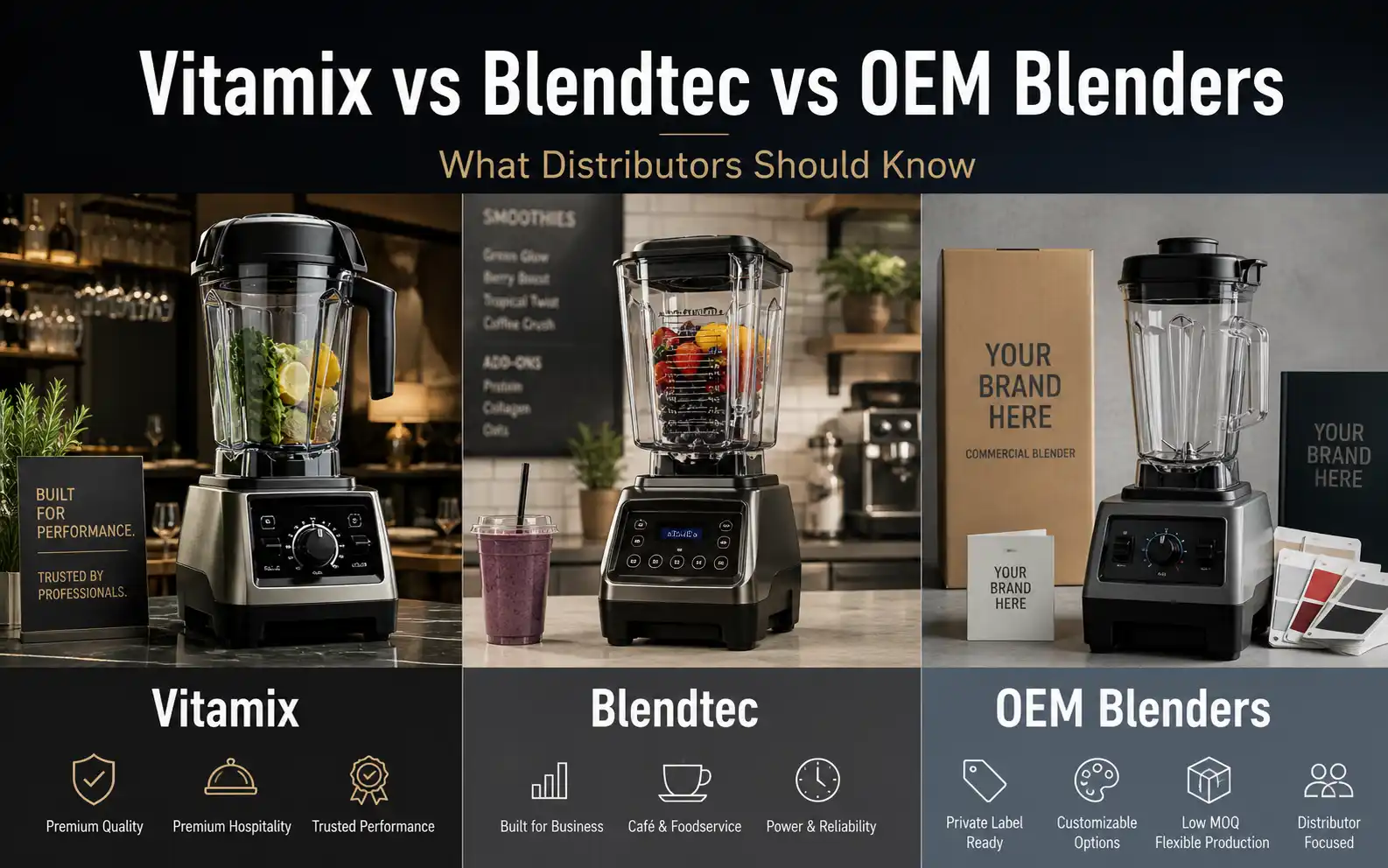
This is why Vitamix vs Blendtec vs OEM blenders should not be treated as a simple brand showdown. Vitamix and Blendtec represent two established commercial brand-distribution paths. OEM blenders represent a different route, one built around private-label ownership, customization, sourcing flexibility, and long-term brand equity. If you want to place this comparison inside ElectMix’s rebuilt content structure, the best starting points are the Knowledge Center and the Product Comparisons section, which already frame comparison content for distributors, importers, and professional buyers.
For some distributors, a known premium brand makes sense because it reduces customer hesitation and shortens the sales cycle. For others, OEM is strategically stronger because it creates pricing flexibility, private-label ownership, and more room to shape a differentiated regional offering. If your interest leans more toward custom programs and private-label thinking, ElectMix’s OEM & Manufacturing Insights and OEM Blender Customization Process are the natural follow-up pages after this article.
This guide compares Vitamix, Blendtec, and OEM blenders from a distributor’s perspective. The goal is not to crown a universal winner. The goal is to help you choose the path that fits your margin structure, channel strategy, service capacity, and long-term market ambition.
Why This Comparison Matters for Distributors

A distributor is not only choosing a blender. A distributor is choosing a commercial strategy.
If you distribute an established brand, you benefit from existing market recognition, but you usually have less control over brand story, price architecture, and product differentiation. If you choose OEM, you gain more control over branding, packaging, features, and channel fit, but you also take on greater responsibility for product strategy, service planning, and brand building.
This is exactly why ElectMix’s current content structure separates product education, Commercial Blender Guides, Product Comparisons, and OEM & Manufacturing Insights. The choice is not simply technical. It is strategic.
This matters because the same distributor can look at the same three options and reach three very different conclusions depending on channel. A premium hospitality dealer may benefit from carrying an established brand with recognized foodservice credibility. A regional importer building a house brand may care more about price control, product labeling, voltage configuration, and packaging. An e-commerce-focused distributor may want a product line that can be differentiated and defended on listing pages rather than competing head-to-head against widely distributed premium brands. ElectMix’s Best Commercial Blenders for E-Commerce Sellers in 2025 is especially useful if that is part of your route.
Another reason this comparison matters is that “premium” does not automatically mean “best business outcome.” A recognized brand may help close sales faster, but it may also compress margin or reduce room for private-label growth. OEM may create stronger long-term upside, but only if the distributor is willing to invest in product positioning, after-sales support, and channel development. This is where distributors often make mistakes: they compare product prestige instead of comparing business fit.
What Does Vitamix Represent in the Market?
Vitamix represents an established premium commercial blending path. On its official commercial site, the company describes itself around commercial blending products and makes clear that its commercial products are sold through foodservice dealers. For a distributor, that matters because it signals existing channel legitimacy, existing market trust, and a sales story that many foodservice buyers already understand.
From a distributor’s point of view, that matters for three reasons.
First, it signals existing market trust.
Second, it suggests brand equity that the distributor does not have to create from zero.
Third, it indicates that a distributor working with such a brand is usually participating in an established ecosystem rather than inventing a market narrative from scratch.
Vitamix’s official commercial positioning emphasizes versatility, reliability, and performance. For some distributors, that is valuable because the sales message is already familiar to dealers, consultants, and end users in foodservice. In practice, this can shorten the education cycle in channels where buyers already understand the brand. It can also make the brand easier to place in premium hospitality, café, smoothie bar, and restaurant channels where a recognized commercial name reduces resistance.
At the same time, distributors should be realistic about what that brand strength means. When you distribute a known brand, you benefit from trust, but you are also helping build someone else’s brand equity. Your pricing flexibility, product-roadmap influence, and packaging differentiation are often more limited than in an OEM/private-label model. For some companies, that trade-off is acceptable. For others, it becomes a strategic ceiling.
If you want to contextualize Vitamix inside the wider category before pushing customers toward a sourcing decision, ElectMix’s Top 7 High-Performance Blender Brands in 2026 and Best Vitamix Alternatives for Restaurants & Juice Bars are useful internal follow-ups.
What Does Blendtec Represent in the Market?
Blendtec represents another established commercial route, but with slightly different brand cues. Its official commercial dealers page and commercial blender collection position the brand around commercial business use, dealer access, durability, reliability, and high-demand environments.
For distributors, Blendtec’s market role is not identical to Vitamix’s. Even where the two brands compete directly, the perceived selling story can differ. Blendtec’s official commercial messaging places more visible emphasis on business use, durability, speed, controls, and, in some parts of its commercial positioning, noise-conscious design. That can matter if your channel prioritizes programmability, countertop integration, or a commercial story centered on service workflow.
Neutral third-party comparison pages also reinforce that the two brands are not interchangeable in how they are perceived. The RTINGS Vitamix vs Blendtec comparison does not treat the brands as universally identical; it compares them by practical characteristics like build, performance, capacity, and usability depending on model category. That is a useful reminder for distributors: even when two brands occupy the same premium commercial space, they may still support different sales conversations.
For a distributor, the real question is not “Is Blendtec better than Vitamix?” The real question is whether Blendtec’s channel story fits your market better than Vitamix’s—and whether either branded path fits better than building a differentiated OEM line.
What Are OEM Blenders in a Distributor Business Model?
OEM blenders are not simply “unbranded alternatives.” In a distributor business model, OEM means you work with a manufacturing partner to sell products under your own brand or under a more customized specification set. The appeal is not just lower factory cost. The appeal is control.
ElectMix’s own OEM Blender Customization Process, Custom Blender Development Guide, and How B2B Buyers Evaluate OEM Blender Manufacturers already frame OEM this way: as a route for distributors, importers, and private-label buyers who want to control product identity, packaging, technical fit, and market positioning.
From a distributor’s perspective, OEM becomes attractive when you want to control:
- brand name
- visual identity
- packaging
- compliance labeling
- model differentiation
- channel-specific product positioning
- regional electrical or packaging requirements
- long-term portfolio architecture
ElectMix’s Commercial Blender Certifications is also directly relevant here, because serious OEM/private-label planning is not only about logos and cartons. It is also about CE, UL, NSF, compliance logic, labeling, and market-entry readiness.
There is also a planning side to OEM that distributors have to take seriously. MOQ, lead time, packaging setup, inventory planning, and after-sales structure all become more important. That does not make OEM less attractive. It makes OEM more strategic.
So the distributor question is not “OEM or brand?” in the abstract. It is:
Are you trying to resell trust, or are you trying to build an owned commercial product line?
Vitamix vs Blendtec vs OEM Blenders: The Core Differences
At a practical level, Vitamix and Blendtec represent established branded distribution paths, while OEM blenders represent a brand-building and margin-control path. The better route depends on whether the distributor values immediate market trust, specific channel fit, or long-term ownership of a differentiated portfolio.

1) Brand Recognition and Market Trust
Brand recognition is often the strongest short-term advantage of selling Vitamix or Blendtec. Both brands maintain official commercial channels and dealer-facing business positioning. That means some commercial buyers will already know the names, trust the category, or be more willing to consider the line without as much education. In practical sales terms, that can shorten the conversation.
OEM blenders do not give you that automatically. If you sell under your own brand, you usually have to earn trust through:
- product presentation
- sample quality
- certifications
- local support
- clear positioning
- consistent after-sales handling
The upside is that the trust you build can become your own asset instead of feeding a manufacturer-owned premium brand.
2) Pricing Power and Margin Structure
This is where the distributor lens becomes much more useful than the end-user lens.
An established brand may command premium resale positioning, but that does not automatically mean the distributor has better pricing power. In many cases, branded distribution gives you less room to shape the market because brand positioning and channel expectations already exist. OEM, by contrast, can allow more flexibility in how you structure price ladders, packaging levels, feature sets, and channel-specific offers.
ElectMix’s OEM pages strongly support this reading because they repeatedly frame customization, branding, packaging, and technical tailoring as value levers for B2B buyers. If margin control matters as much as sell-through, OEM becomes much harder to dismiss.
3) Product Positioning and Channel Fit
Channel fit matters more than abstract brand prestige. Some customers want a known branded machine, especially in premium foodservice or replacement buying. Other channels may prioritize price-performance, private label, local support, or tailored features.
This is why distributors should think in terms of channel-first strategy. A premium hospitality dealer may benefit from an established global name. A regional e-commerce seller may benefit more from a differentiated private-label program. ElectMix’s Best Commercial Blenders for E-Commerce Sellers in 2025 is especially relevant if your distribution logic depends on listings, catalog breadth, and product differentiation in online channels.
4) Customization and Private Label Potential

This is where OEM blenders usually become commercially attractive.
If your strategy depends on housing design, controls, jar style, voltage, plug type, packaging, logo branding, and market-specific configuration, OEM is usually the only path that gives meaningful flexibility. That is why this section should naturally connect to:
- OEM Blender Customization Process
- Custom Blender Development Guide
- How B2B Buyers Evaluate OEM Blender Manufacturers
Established brands typically offer less flexibility here than OEM/private-label sourcing models.
5) MOQ, Inventory, and Sourcing Flexibility
Compare how established branded distribution may depend on dealer structures, regional rules, or fixed portfolio constraints, while OEM sourcing may involve MOQ, production lead times, and inventory planning trade-offs.
In other words:
- branded distribution may reduce launch complexity
- OEM may increase strategic control but require stronger forecasting discipline
That is not automatically a downside. It simply means the distributor must compare capital commitment, speed to market, and inventory risk honestly.
6) Warranty, Service, and Replacement Parts
After-sales support is a major strategic issue.
Established brands may come with recognized service expectations, while OEM/private-label programs may require the distributor to build their own warranty handling, spare-parts logic, and service process. This is not a downside or upside by default; it depends on the distributor’s capabilities.
If you lack the capacity to manage service, branded routes may feel safer. If you do have that capacity, OEM can offer much greater control over the post-sale experience.
7) Product Differentiation and Market Control
Brand distribution can be easier to start but harder to differentiate. OEM programs may offer stronger product and market control.
A distributor selling the same brand as many others often competes more on channel, price, or availability. A distributor selling an OEM/private-label line can build a more defensible offer if the product story, packaging, and target segment are designed well.
That is one reason OEM becomes more attractive as distributors move from short-term turnover to long-term market control.
8) Sales Cycle and Customer Education
Known brands may shorten the education process in some channels because customers already recognize the name. OEM lines may require more explanation and stronger sales materials, but may also give distributors more freedom to tailor the story to a specific regional market or customer segment.
This is one reason OEM works especially well for distributors who already understand their channel deeply. They do not need a global brand to do all the persuasive work for them.
9) Long-Term Brand Building
This is one of the biggest strategic differences.
Distributing an established brand can create shorter-term revenue opportunities, while OEM/private-label building can create longer-term brand equity for the distributor if they are willing to invest in positioning, service, and channel development.
That is the real long-term trade-off:
- resell an asset someone else owns
- or build one that your company owns
10) Cost of Ownership and Strategic ROI
Distributors should not evaluate ROI only through initial pricing. Strategic ROI includes:
- margin control
- inventory burden
- service obligations
- customer acquisition efficiency
- differentiation
- brand ownership
- compliance readiness
This section should also link naturally to ElectMix’s Commercial Blender Certifications because compliance, certification, and labeling become part of the commercial cost structure in private-label and export programs.
The best option depends on whether the distributor is optimizing for faster sales, premium-channel access, or long-term private-label asset building.
When Distributing Vitamix Makes Sense
Distributing Vitamix may make sense when the channel values premium brand recognition, trusted commercial positioning, and faster customer acceptance. If your customers already know the brand and already buy through foodservice channels, Vitamix can shorten the path to trust.
This may fit well when:
- the channel already asks for the brand
- premium hospitality positioning matters
- faster sell-through is a priority
- the distributor is comfortable building around another company’s brand asset
This logic matches Vitamix’s own official commercial positioning through dealer channels.
When Distributing Blendtec Makes Sense
Distributing Blendtec may make sense when the channel values commercial reliability, business-facing messaging, and a recognized product line built for foodservice use. This may fit especially well when:
- the channel responds to Blendtec’s brand story
- the distributor wants a known commercial route
- the buyers value strong foodservice identity and business-use positioning
Again, the decision is not about abstract superiority. It is about fit.
When OEM Blenders Are the Better Strategic Choice
OEM/private-label blenders are often the better choice when the distributor wants stronger control over branding, margin, customization, and long-term market ownership.
This path is especially relevant for distributors building their own regional brand, targeting specific verticals, or seeking more defensible channel differentiation.
If that is the route you are considering, this section should naturally point readers toward:
- OEM & Manufacturing Insights
- OEM Blender Customization Process
- How B2B Buyers Evaluate OEM Blender Manufacturers
That way the article feeds directly into the OEM side of the site structure rather than sitting alone.
Common Mistakes Distributors Make
Commercial buyers tend to approach “Vitamix vs Blendtec vs OEM” too much like a brand-prestige race, and that is where many problems begin.
One mistake is to assume that the most recognized name must be the best commercial route. That ignores margin structure, channel fit, and brand ownership.
Another is to underestimate after-sales obligations. A distributor that chooses OEM without a realistic plan for parts, service, warranty handling, and replacement logic may create problems that erase the benefits of private label.
A third mistake is to treat OEM as shorthand for cheap. Serious OEM/private-label programs are not about bargain-only positioning. They are about control, customization, and brand-building.
Another common mistake is choosing the product path before defining the channel.
Distributor Warning Box
Do not choose a blender strategy before you choose a channel strategy.
Brand recognition, private-label upside, warranty burden, MOQ discipline, and inventory logic only make sense relative to the channel you want to win.
How to Choose the Right Blender Strategy for Your Distribution Business

Use this five-factor framework.
1) Define the target channel
Are you selling into premium hospitality, general foodservice, e-commerce, private-label retail, or regional wholesale?
2) Decide how much margin control you need
If the strategy depends on tight pricing control and brand ownership, OEM usually deserves stronger consideration.
3) Audit your service capacity
If you do not have the structure to support spare parts, warranty logic, and after-sales handling, branded distribution may be safer operationally.
4) Measure your customization need
If your market wants localized voltage, packaging, certifications, colorways, logo programs, or tailored feature sets, OEM is usually the stronger match.
5) Be honest about long-term ambition
Do you want to be a reseller of strong brands, or do you want to build a commercial blender brand that your business owns over time?
Strategy Summary
Choose a branded distribution path when market trust and faster sell-through matter most.
Choose OEM when differentiation, private-label ownership, and margin control matter more.
Final Verdict: Brand Distribution or OEM Ownership?
Vitamix and Blendtec represent established brand-distribution routes. OEM blenders represent a brand-ownership route. Neither is universally superior.
If your business needs immediate credibility, easier channel acceptance, and the leverage of a known premium name, branded distribution can be the stronger choice. If your business wants stronger control over pricing, customization, long-term differentiation, and owned brand equity, OEM can be the more strategic route.
The smartest distributors do not compare these options like retail shoppers. They compare them like portfolio builders.
That is the real question:
Are you trying to sell a blender, or are you trying to build a business model around a blender line?
Conclusion
Vitamix, Blendtec, and OEM blenders are not just three product options. They are three different commercial paths.
Vitamix offers the strength of an established premium commercial brand sold through foodservice dealers. Blendtec offers another established path with business-facing messaging around durability, speed, controls, and commercial workflow. OEM offers something different: ownership, customization, private-label flexibility, and the chance to build a more defensible long-term market asset.
If you want the cleanest next step from this article into the rest of ElectMix’s rebuilt structure, the most natural path is:
- browse Commercial Blender Guides
- continue through OEM & Manufacturing Insights
- review All Products
- or go straight to Contact Us for OEM, sourcing, or private-label discussion
The best option is not the most famous one. It is the one that best matches the business you are actually trying to build.
FAQ
What is the main difference between distributing Vitamix or Blendtec and selling OEM blenders?
The main difference is business model. Distributing Vitamix or Blendtec means selling an established brand with existing market recognition, while OEM blenders allow the distributor to build a private-label line with more control over branding, customization, pricing, and long-term brand ownership.
When does distributing an established blender brand make more sense?
Distributing an established brand often makes more sense when the target channel values strong market recognition, faster customer trust, and easier sell-through. This can be especially useful in foodservice, hospitality, and premium commercial channels.
When are OEM blenders the better choice for distributors?
OEM blenders are often the better choice when a distributor wants stronger control over branding, product differentiation, packaging, specifications, and margin structure. They are especially relevant for private-label programs, regional brands, and distributors building a long-term owned product line.
Do OEM blenders always mean lower quality?
No. OEM does not automatically mean low quality. OEM can range from commodity products to highly customized, commercially capable blender programs. Quality depends on the manufacturer, quality control, compliance planning, component selection, and after-sales structure.
What should distributors compare besides brand reputation?
Distributors should compare margin control, MOQ, lead time, after-sales burden, replacement parts planning, service capability, channel fit, customization options, and long-term brand strategy instead of relying only on brand prestige.
Is private label better than selling a premium blender brand?
Not always. Private label is better when the distributor wants ownership, differentiation, and stronger control. Selling a premium brand may be better when faster trust, simpler sales, and known market demand matter more.
How important are certifications in an OEM blender program?
They are very important. Certifications, labeling standards, and compliance documents affect market access, buyer confidence, and long-term risk. For distributors, they are part of the commercial strategy, not just paperwork.
What is the biggest mistake distributors make in this category?
One of the biggest mistakes is comparing these options like retail shoppers rather than like channel builders. The right choice depends on the distributor’s target market, service ability, inventory planning, and long-term business model.

Marketing & Product Lead at ElectMix | Innovating Commercial Blenders & Home Appliances | Driving Growth & Development