 Skip to content

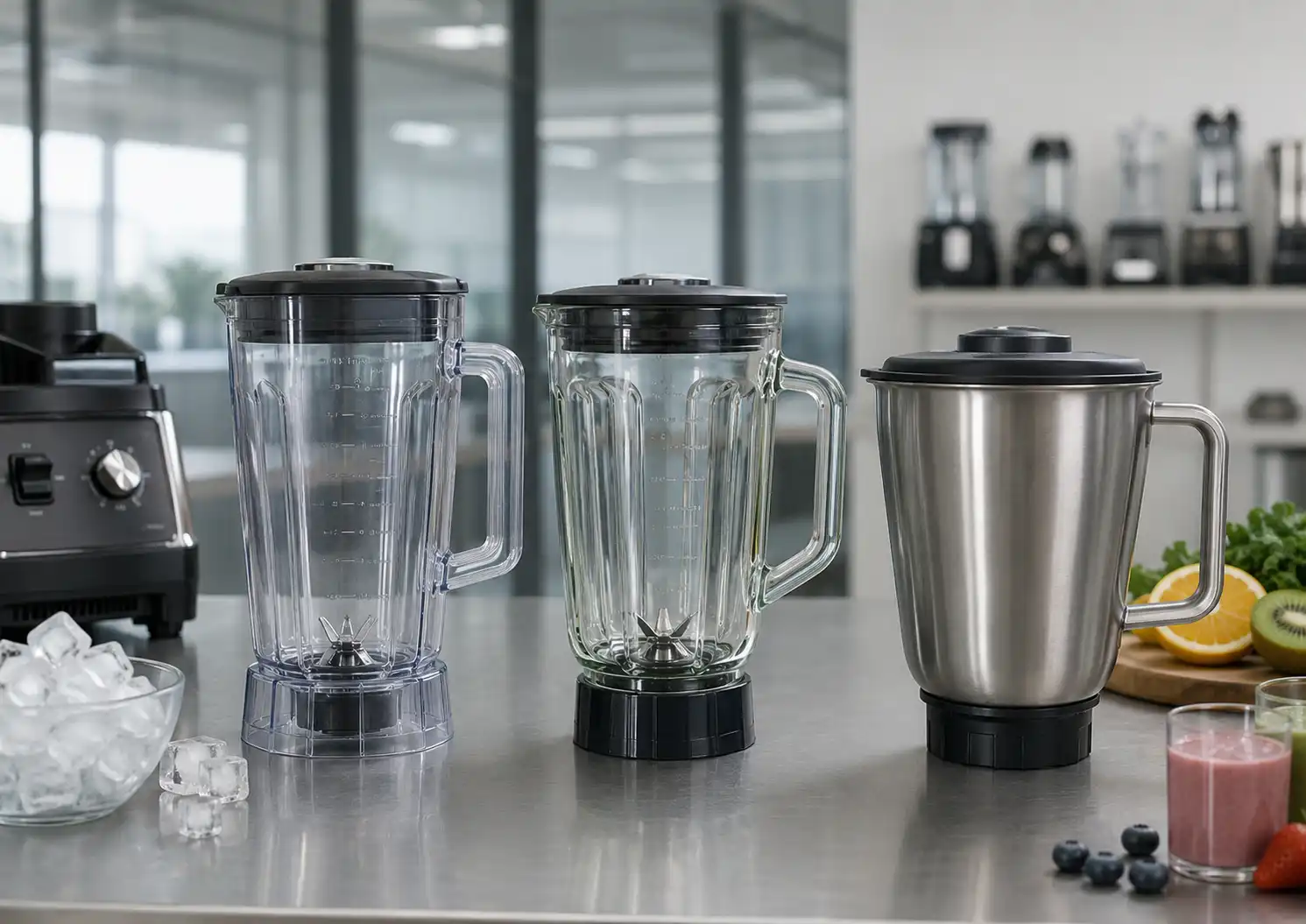
When buyers compare commercial blenders, they often start with motor power, speed settings, blade design, capacity, and price. Those are important. But one part is often underestimated: the blender jar material.
The jar is not just a container. It affects daily handling, breakage risk, cleaning, visibility, shipping cost, food-contact requirements, staff comfort, replacement parts, and long-term customer satisfaction.
For a smoothie bar, a jar may be filled, emptied, rinsed, and reused dozens of times a day. For a restaurant, the jar may handle sauces, purées, soups, and prep liquids. For a distributor, jar material can affect warranty claims, packaging protection, replacement jar strategy, and market positioning.
So the question is not simply:
Which blender jar material looks better?
The better question is:
Which jar material fits your workload, your users, your menu, and your target market?
Tritan, glass, and stainless steel all have a place. Tritan is often the most practical choice for many commercial blender applications because it is lightweight, transparent, impact-resistant, and easy for staff to handle. Glass offers a premium look, strong scratch resistance, and good odor resistance, but it is heavier and more breakable. Stainless steel is highly durable and useful for certain back-of-house or heavy-duty applications, but it does not allow operators to see the blending process.
This guide compares Tritan, glass, and stainless steel blender jars from a commercial buyer’s point of view. If you are comparing blender specifications for foodservice or OEM projects, you can also explore the ElectMix Knowledge Center and our Commercial Blender Guides section.
Quick Answer: Choose Jar Material Based on Use Case, Not Only Appearance
There is no single best blender jar material for every business.
A smoothie bar that blends frozen drinks all day has different needs from a restaurant prep kitchen. A hotel buffet station has different concerns from an OEM distributor building a product line for export markets.
Here is a practical starting point:
| Use Case | Often Practical Jar Material | Why |
| Smoothie bar or café | Tritan | Lightweight, clear, durable, easy for repeated handling |
| Front-of-house drink station | Tritan | Transparent, lighter than glass, good customer-facing visibility |
| Premium retail positioning | Glass | Clear, solid, premium look and feel |
| Low-volume home-style display | Glass | Good clarity and scratch resistance |
| Back-of-house prep | Stainless steel | Durable, less breakage concern |
| Hot prep or rough handling | Stainless steel | Strong durability and impact resistance |
| High-volume commercial service | Tritan or stainless steel | Better durability than glass in busy environments |
| Distributor product line | Depends on target market | Material should match price, channel, and service model |
For most commercial blender buyers, Tritan is a strong default because it balances visibility, weight, durability, and shipping practicality. Glass can work when premium appearance matters more than breakage risk. Stainless steel can work when durability matters more than visibility.
Why Blender Jar Material Matters in Commercial Use
In home kitchens, a blender jar may be used a few times a week. In commercial use, the jar works much harder.
A commercial blender jar may be:
- Filled many times per day
- Used with ice and frozen fruit
- Washed repeatedly
- Handled by different staff
- Dropped or bumped during service
- Stored with other kitchen tools
- Exposed to sauces, oils, sugars, acids, and cleaning chemicals
- Shipped internationally as part of a product order
- Replaced as an after-sales spare part
This is why jar material affects more than appearance.
It can influence:
- Breakage risk
- Staff handling comfort
- Total jar weight
- Visibility during blending
- Cleaning convenience
- Scratch and odor resistance
- Food-contact safety
- Replacement jar cost
- Shipping damage risk
- Front-of-house presentation
- Distributor warranty claims
A commercial blender jar is part of the operating system. If it is too heavy, staff may dislike using it. If it breaks easily, operators may face downtime and replacement cost. If it scratches quickly, the product may look old even when the motor still works well. If replacement jars are hard to source, distributors may face after-sales complaints.
For B2B buyers, jar material should be reviewed as carefully as motor power.
What Is a Tritan Blender Jar?

Tritan is a BPA-free copolyester commonly used in drinkware, food-contact products, and blender jars. It is known for clarity, toughness, chemical resistance, and practical handling performance.
Eastman describes Tritan as a high-performing copolyester with shatter and impact resistance, as well as strong chemical resistance. This helps explain why it is widely used in products that need both transparency and durability, including food and beverage applications. Eastman Tritan
In commercial blender jars, Tritan is popular because it offers a useful balance:
- It is clear enough for operators to see ingredients.
- It is lighter than glass.
- It is more impact-resistant than glass.
- It is easier for staff to handle repeatedly.
- It is less likely to shatter if dropped.
- It can support front-of-house drink preparation.
- It is practical for shipping and replacement jar programs.
For smoothie bars, cafés, hotels, and commercial beverage stations, this combination is important. Staff need to see texture and fill level, but they also need a jar that is not too heavy or fragile.
That is why many commercial and high-performance blender designs use Tritan jars.
Pros and Cons of Tritan Blender Jars
Tritan jars are often practical for commercial blender applications, but they are not perfect for every situation.
Advantages of Tritan Blender Jars
Lightweight handling
Tritan jars are easier to lift, pour, rinse, and reuse during busy service. This matters when staff handle jars repeatedly throughout the day.
Clear visibility
Operators can see the blending process, ingredient movement, fill level, and final texture. This is especially useful for smoothies, sauces, frappes, and frozen drinks.
Impact resistance
Compared with glass, Tritan is less likely to shatter when dropped or bumped. This makes it more practical in high-frequency commercial settings.
Good commercial balance
Tritan offers a strong balance between durability, clarity, weight, and cost. For many cafés, smoothie shops, restaurants, and distributors, that balance is more useful than maximum premium appearance.
Lower shipping risk than glass
For OEM and export buyers, breakage during shipping is a real concern. Tritan jars are generally easier to package and ship than glass jars.
Suitable for customer-facing drink stations
Because Tritan is clear, staff and customers can see the drink. This is useful in smoothie bars, cafés, and open beverage counters.
Limitations of Tritan Blender Jars
Can scratch over time
Tritan is durable, but it can still develop scratches after long use, harsh cleaning, or contact with abrasive tools.
May lose clarity if poorly maintained
Repeated rough washing, improper cleaning chemicals, or poor handling can reduce clarity over time.
May not feel as premium as glass
Some retail buyers still associate glass with a more premium feel. In certain consumer markets, glass may be preferred for appearance.
Material claims must be verified
Not every clear plastic jar is Tritan. Buyers should confirm the actual material, food-contact documentation, and supplier claims.
This is an important point for distributors. Do not simply describe a jar as “plastic.” If it is Tritan, position it correctly. If it is another plastic material, be careful not to overclaim.
What Is a Glass Blender Jar?
A glass blender jar is transparent, solid, and often associated with a premium feel. It is common in many home-style or retail blender designs.
Glass has several natural advantages:
- Good clarity
- Good scratch resistance
- Strong odor resistance
- Strong stain resistance
- Premium appearance
- Solid feel
For buyers who dislike plastic perception, glass can be attractive. It often looks clean and high-quality when new. It is less likely to absorb odors from ingredients, and it usually resists scratching better than plastic materials.
Glass can be useful in lower-volume environments where staff handle the jar carefully and where premium appearance matters.
But in commercial service, glass creates several practical concerns.
It is heavier. It is more breakable. It can create safety issues if dropped. It may require stronger packaging during transportation. Replacement costs can increase if jars break during daily operation.
A glass jar may look premium on a retail shelf, but a busy smoothie bar or café may find it less practical after repeated handling.
Pros and Cons of Glass Blender Jars
Advantages of Glass Blender Jars
Premium look and feel
Glass often gives a more solid, premium impression. This can be useful for retail-facing products or buyers who want a higher-end visual presentation.
Good clarity
Glass allows operators to see ingredients and blending progress clearly.
Scratch resistance
Glass usually resists surface scratching better than many plastic materials. This helps it maintain clarity if handled carefully.
Odor and stain resistance
Glass is less likely to retain odors or stains from ingredients such as spices, sauces, fruit pigments, or oils.
Good for certain low-volume applications
If the blender is used less frequently and handled carefully, glass can be suitable.
Limitations of Glass Blender Jars
Heavy for repeated staff use
A glass jar can become tiring to lift, pour, wash, and reuse many times per day. This matters in cafés, smoothie bars, and hotels.
Breakage risk
Glass can break if dropped or hit against a hard surface. In commercial kitchens, that risk can create downtime and safety concerns.
Higher shipping risk
For exporters and distributors, glass requires stronger packaging. Shipping damage can increase total product cost.
Less practical for high-volume drink stations
In a busy smoothie bar, lighter and more impact-resistant jars are usually more practical.
Replacement cost and availability matter
If a glass jar breaks, the user needs fast access to a replacement jar. Without spare parts support, a broken jar can stop the machine from being used.
Glass is not a bad material. It simply needs the right setting. It works best when premium appearance and odor resistance matter more than drop resistance and high-frequency handling.
What Is a Stainless Steel Blender Jar?

A stainless steel blender jar is durable, opaque, and often used where strength matters more than visibility.
It is usually associated with professional kitchen use, back-of-house prep, or heavy-duty environments. Stainless steel does not shatter like glass, and it can handle rougher daily treatment. It can also look professional in commercial kitchens.
A stainless steel jar may be useful for:
- Back-of-house prep
- Hot ingredients
- Rough handling environments
- Commercial kitchens
- Catering operations
- Certain heavy-duty blender models
- Users who value durability over visibility
The main limitation is obvious: you cannot see inside the jar while blending.
This can affect workflow. Operators cannot easily monitor texture, ingredient movement, color, fill level, or over-blending without stopping the machine and opening the lid.
For a smoothie bar or front-of-house beverage station, this is not ideal. Customers and staff often expect to see the drink. For back-of-house sauce or soup prep, visibility may be less important.
So stainless steel is best understood as a durability-focused option rather than a universal upgrade.
Pros and Cons of Stainless Steel Blender Jars
Advantages of Stainless Steel Blender Jars
High durability
Stainless steel is strong and less likely to break during rough handling.
Good for back-of-house use
In prep kitchens, catering operations, or restaurant back rooms, durability may matter more than customer-facing appearance.
Useful for heavy-duty environments
If jars are handled roughly or moved often, stainless steel can reduce breakage concerns.
Professional kitchen appearance
Stainless steel fits visually with many commercial kitchens and foodservice environments.
Less concern about visible scratches
Unlike clear jars, stainless steel does not rely on transparency. Surface wear may be less visually disruptive.
Limitations of Stainless Steel Blender Jars
No visibility
Operators cannot see the texture or ingredient movement during blending.
Harder to monitor fill level
Without transparent walls, staff must rely more on measurement markings, experience, or pre-measured ingredients.
Less suitable for front-of-house display
In smoothie bars and cafés, clear jars are often better because customers and staff can see the drink.
May complicate staff training
New operators often rely on visual cues. Stainless steel removes that feedback.
Stainless steel can be a strong choice when durability is the priority. But if your business depends on visual drink preparation, texture monitoring, or customer-facing presentation, Tritan may be more practical.
Tritan vs Glass vs Stainless Steel: Side-by-Side Comparison

| Factor | Tritan | Glass | Stainless Steel |
| Weight | Light | Heavy | Medium |
| Visibility | Clear | Clear | Opaque |
| Impact resistance | High | Low to medium | Very high |
| Scratch resistance | Medium | High | High surface durability |
| Odor resistance | Medium to good | High | High |
| Stain resistance | Medium to good | High | High |
| Commercial handling | Strong | Riskier | Strong |
| Front-of-house appeal | Good | Premium | Professional but opaque |
| Staff convenience | High | Lower due to weight | Medium |
| Shipping risk | Lower | Higher | Lower |
| Replacement strategy | Usually practical | Needs breakage planning | Durable but may cost more |
| Best fit | Cafés, smoothie bars, distributors | Premium retail, lower-volume use | Back-of-house, heavy-duty prep |
This table should not replace product testing. Jar performance also depends on jar thickness, blade assembly, lid design, handle shape, manufacturing quality, cleaning chemicals, and actual recipe use.
But for initial sourcing decisions, the pattern is clear:
- Tritan is usually the most balanced commercial choice.
- Glass is attractive for premium appearance but riskier in busy service.
- Stainless steel is strong and durable but sacrifices visibility.
Food-Contact Safety and Compliance
For commercial blender buyers, jar material must be evaluated as a food-contact component.
A blender jar may touch fruit, dairy, sauces, hot liquids, oils, sugars, acids, ice, and cleaning residues. The material must be suitable for the intended use and target market.
FDA explains that food-contact substances can include materials used in packaging, cookware, food preparation surfaces, and food-processing equipment. For blender buyers, this means jar materials, lids, seals, gaskets, and other food-contact parts should be included in supplier evaluation. FDA Food Contact Substances
NSF food equipment standards also cover material safety, design, construction, and product performance for commercial food equipment. For commercial blender buyers, this reinforces the importance of cleanability, material safety, and foodservice-oriented design. NSF Food Equipment Standards
Before sourcing blender jars for commercial use, buyers should ask suppliers about:
- Food-contact material declarations
- BPA-related claims
- Material grade
- Migration testing if required
- FDA-related requirements for the U.S. market
- LFGB or EU food-contact requirements for Europe
- Cleaning chemical compatibility
- Temperature use conditions
- Material traceability
- Replacement jar documentation
- Lid, seal, and gasket material
- Packaging and labeling requirements
This is not about collecting documents for the sake of documents. It is about reducing sourcing risk.
If you sell into different markets, requirements may vary. A jar that works for one market may still need additional documentation for another. OEM and distributor buyers should confirm requirements based on the target country, product use, and sales channel.

Choosing Jar Material by Business Type
The best jar material depends on who will use the blender.
Smoothie Bars and Juice Bars
Tritan is often the most practical option for smoothie bars and juice bars.
These businesses need clear jars, light handling, impact resistance, and fast service. Staff need to see texture, color, fill level, and ingredient movement. They also need to handle jars repeatedly without unnecessary weight.
Glass may look premium, but the drop risk and weight can become problems in high-volume service. Stainless steel may be durable, but the lack of visibility is not ideal for front-of-house drink preparation.
For smoothie bars, Tritan usually offers the best balance.
Cafés and Coffee Shops
Cafés often prepare smoothies, frappes, milkshakes, sauces, and seasonal drinks. Staff may work in limited counter space and serve customers directly.
Tritan works well because it is clear, lighter than glass, and easier to handle. Glass may be used for lower-volume premium positioning, but it may not be the best choice for busy café service.
Stainless steel may work in the back kitchen, but it is usually less suitable for drink stations where visibility and presentation matter.
Restaurants
Restaurants should choose jar material by station.
For sauces, smoothies, dressings, and general blending, Tritan is often practical. It gives staff visibility and handling convenience.
For back-of-house prep, stainless steel may be useful when durability is more important than seeing the contents. For specific premium or lower-volume uses, glass can work, but breakage risk must be considered.
Restaurants should also consider whether jars will be handled by trained kitchen staff, front-of-house staff, or temporary workers. The more varied the operators, the more important durability and easy handling become.
Hotels and Buffets
Hotels often need reliable equipment for breakfast areas, banquet prep, and beverage stations.
For staff-operated beverage service, Tritan is practical because it is clear and lightweight. For back kitchens, stainless steel may work well. Glass may support a premium impression, but breakage risk around buffet areas must be reviewed carefully.
In hotel environments, equipment must be efficient and presentable. Tritan often fits that balance.
Commercial Kitchens and Catering
Commercial kitchens and catering teams move equipment more often. Jars may be transported, washed in batches, handled by different staff, and used in different locations.
In this environment, Tritan and stainless steel are often more practical than glass. Tritan offers visibility and lighter handling. Stainless steel offers durability. Glass is more vulnerable to breakage during movement and transport.
Distributors and OEM Buyers
For distributors and OEM buyers, jar material is also a market-positioning decision.
Tritan is often easier to position for commercial blender lines because it balances clarity, durability, weight, and shipping practicality.
Glass may be useful for premium retail or home-style positioning, especially where buyers strongly prefer glass.
Stainless steel may fit specialty commercial models, back-of-house equipment, or heavy-duty applications.
The right answer depends on the target buyer, price range, application, and after-sales strategy.
Choosing Jar Material by Application
Business type matters, but recipe application matters too.
Smoothies and Frozen Drinks
For smoothies and frozen drinks, Tritan is usually practical.
The operator can see the mixture, monitor texture, check whether frozen fruit is circulating, and stop blending when the drink is ready. Tritan also offers better impact resistance than glass, which matters when blending ice and frozen ingredients in busy service.
Stainless steel can be durable, but the lack of visibility makes it harder to monitor drink texture.
Glass may work for low-volume use, but it is usually less practical in a fast smoothie bar.
Hot Soups and Sauces
For hot ingredients, buyers should not assume any material is suitable without checking supplier specifications.
Stainless steel may be suitable for certain back-of-house hot prep applications because it is durable and not transparent. Tritan may be suitable depending on the material grade, jar design, and temperature rating. Glass may resist odors and stains well, but weight, breakage, and thermal handling must be considered.
Always confirm temperature use conditions with the supplier.
Ice Crushing
Ice creates impact and vibration.
For repeated ice crushing, Tritan or stainless steel is usually more practical than glass. Glass can handle some blending applications, but high-impact commercial ice use increases breakage concern.
Jar geometry, blade design, and motor power also matter. Material alone does not determine ice-crushing performance.
For more on power and load, see ElectMix’s guide Heavy-Duty Blender vs Standard Blender: When Does Power Really Matter?.
Nut Drinks and Thick Mixtures
For nut drinks, thick smoothies, sauces, and dense mixtures, jar material is only one part of performance.
Buyers should also evaluate:
- Motor power
- Torque
- Blade structure
- Jar geometry
- Lid fit
- Cooling design
- Cleaning access
- Replacement jar availability
Tritan is common in many commercial blender designs. Stainless steel may provide strong durability. Glass may be less suitable for rough commercial handling.
Front-of-House Beverage Service
For front-of-house beverage service, Tritan is usually the most practical choice.
Staff and customers can see the drink. The jar is lighter than glass. It has better drop resistance. It looks clean and modern when maintained properly.
This makes Tritan suitable for smoothie bars, cafés, hotel beverage counters, and open drink stations.
Back-of-House Prep
For back-of-house prep, stainless steel becomes more attractive.
If the operator does not need to show the blending process to customers, and if durability matters more than visual monitoring, stainless steel can work well.
Back-of-house kitchens may also use Tritan when staff need visibility. The choice depends on whether durability or visibility is more important.
Replacement Jars, Spare Parts, and Long-Term Cost

Blender jar material affects after-sales planning.
For distributors and OEM buyers, this is critical. A blender is not only the motor base. Customers also need jars, lids, blade assemblies, gaskets, tampers, and other replacement parts.
When selecting jar material, consider:
- Replacement jar cost
- Replacement jar availability
- Lid compatibility
- Blade assembly compatibility
- Packaging protection
- Drop damage risk
- Scratch and clarity loss
- Warranty claims
- Shipping cost
- Local spare parts stock
- End-user satisfaction
Tritan jars may help reduce breakage claims compared with glass. Glass jars may require stronger packaging and more careful handling. Stainless steel jars may last longer in rough environments, but the initial cost may be higher and visibility is limited.
A distributor should never launch a blender line without a spare jar strategy.
If a user breaks a jar and cannot buy a replacement, the whole blender becomes unusable. That creates customer frustration even if the motor still works perfectly.
For OEM projects, replacement parts should be discussed before mass production, not after the first complaint.
Common Mistakes Buyers Make When Choosing Blender Jar Material
1. Choosing Glass Only Because It Looks Premium
Glass can look premium, but it may not be practical for high-frequency commercial handling.
2. Saying “Plastic Jar” Without Checking the Material
Not all plastics are the same. Tritan, PC, PP, and other materials have different properties. Confirm the actual material.
3. Ignoring Food-Contact Documentation
Jar material, lid material, seals, and gaskets may all contact food. Documentation matters, especially for export markets.
4. Ignoring Staff Handling and Jar Weight
A jar that feels acceptable once may become tiring after dozens of uses per day.
5. Choosing Stainless Steel Without Considering Visibility
Durability is useful, but operators may need to see texture, fill level, and ingredient movement.
6. Forgetting Replacement Jar Cost
A blender line without spare jars can create after-sales problems.
7. Ignoring Shipping Damage Risk
Glass needs stronger packaging and may increase shipping damage claims.
8. Not Testing Real Recipes
A jar should be tested with smoothies, ice, sauces, soups, or thick mixtures depending on the target user.
9. Not Checking Cleaning Chemical Compatibility
Commercial cleaning routines may be harsher than home use. Buyers should confirm material suitability.
10. Assuming One Jar Material Fits All Markets
Different markets may prefer different materials based on price, culture, safety perception, and product positioning.
For OEM and Distributor Buyers: How to Specify Blender Jar Material
OEM and distributor buyers should define jar material requirements before requesting quotations.
A clear sourcing brief should include:
- Target market
- User type
- Jar capacity
- Jar material
- Food-contact requirements
- Temperature use conditions
- Recipe type
- Drop and impact expectations
- Packaging protection
- Replacement jar strategy
- Lid and tamper design
- Measurement markings
- Logo or branding options
- Manual and labeling requirements
- After-sales parts plan
For example, a commercial blender for smoothie bars may prioritize Tritan jars, clear measurement markings, spare lids, and replacement blade assemblies.
A blender for back-of-house restaurant prep may consider stainless steel jars if visibility is less important.
A premium retail model may use glass if the sales channel values weight, clarity, and appearance more than drop resistance.
The supplier should help match jar material to the application, not simply recommend the material that looks best in a product photo.
ElectMix supports commercial blender sourcing, jar material selection, OEM customization, packaging planning, and product specification development for B2B buyers. You can explore available product options through the ElectMix Products page or contact the team through Contact Us for sourcing support.

How This Guide Connects With Other Commercial Blender Decisions
Jar material is only one part of commercial blender selection.
If you are building a blender product line or choosing equipment for foodservice buyers, you may also need to compare:
- Blender motor power
- High-speed vs low-speed blending
- Heavy-duty vs standard blender design
- Commercial blender vs smoothie blender
- Commercial blender vs food processor
- Countertop blender vs immersion blender
ElectMix has already covered several related topics:
- Commercial Blender vs Smoothie Blender: What’s the Real Difference for Businesses?
- High-Speed Blender vs Low-Speed Blender: Which Is Better for Commercial Kitchens?
- Heavy-Duty Blender vs Standard Blender: When Does Power Really Matter?
- Commercial Blender vs Food Processor: Which One Do You Really Need?
- Immersion Blender vs Countertop Blender: Which Is More Practical for Restaurants?
- Vitamix vs Blendtec vs OEM Blenders: What Distributors Should Know
Together, these guides help buyers move from general equipment comparison to practical commercial sourcing decisions.
Final Recommendation: Choose the Jar Material That Fits the Workload
Tritan, glass, and stainless steel blender jars each have clear advantages.
Tritan is often the most practical choice for many commercial blender applications. It balances transparency, lighter weight, impact resistance, handling convenience, and shipping practicality. For smoothie bars, cafés, hotels, front-of-house beverage stations, and distributor product lines, it is often the strongest default option.
Glass is useful when premium appearance, odor resistance, stain resistance, and scratch resistance matter. But it is heavier and more breakable, so it should be used carefully in commercial settings.
Stainless steel is useful when durability and rough handling matter more than visibility. It can be a good choice for back-of-house prep, heavy-duty environments, or specialty commercial applications.
For cafés, smoothie bars, restaurants, hotels, distributors, and OEM buyers, jar material should be chosen based on workload, menu, staff handling, cleaning routine, target market, shipping risk, and after-sales plan.
If you are sourcing commercial blenders with Tritan, glass, or stainless steel jar options, ElectMix can help compare specifications, OEM customization, packaging, and sourcing requirements for your target market.
Visit the ElectMix Knowledge Center, browse Commercial Blender Guides, or contact ElectMix to discuss your commercial blender sourcing needs.
Frequently Asked Questions
What is the best blender jar material?
There is no single best blender jar material for every use. Tritan is often practical for commercial use because it is lightweight, clear, and impact-resistant. Glass offers premium appearance and scratch resistance but is heavier and more breakable. Stainless steel is very durable but does not allow users to see inside during blending.
Is Tritan better than glass for blender jars?
Tritan is usually more practical for high-frequency commercial use because it is lighter and more impact-resistant than glass. Glass can look premium and resist scratches and odors well, but it is heavier and more likely to break if dropped.
Are stainless steel blender jars good?
Stainless steel blender jars are durable and suitable for rough handling, hot prep, or back-of-house use. The main drawback is that they are opaque, so operators cannot see texture, fill level, or blending progress without stopping the machine.
Do glass blender jars break easily?
Glass blender jars can be strong, but they are more breakable than Tritan or stainless steel if dropped on hard surfaces. In busy commercial kitchens, this breakage risk should be considered.
Is Tritan safe for blender jars?
Tritan is commonly used in food-contact drinkware and blender jars, but buyers should still verify supplier documentation, food-contact requirements, and market-specific compliance before purchasing.
Which blender jar material is best for smoothie bars?
Tritan is often the most practical choice for smoothie bars because it is clear, lightweight, impact-resistant, and easier for staff to handle during repeated service.
Which blender jar material is best for OEM buyers?
OEM buyers should choose jar material based on target market, application, price position, food-contact requirements, shipping risk, replacement jar strategy, and after-sales support. Tritan is often a strong default for commercial blender lines, while glass and stainless steel may suit specific positioning.

Marketing & Product Lead at ElectMix | Innovating Commercial Blenders & Home Appliances | Driving Growth & Development


