 Skip to content

- Key Takeaways
- 1. What Is an OEM Juicer Manufacturer?
- 2. Key Certifications to Look For
- 3. Engineering Specifications That Matter
- 4. Customization & Private Label Options
- 5. Factory Evaluation & Auditing Checklist
- 6. OEM Partnership Tips for Long-Term Success
- Conclusion
- Frequently Asked Questions
Key Takeaways
- OEM juicer manufacturers offer full customization and private labeling From product specs to packaging, OEM partners can tailor every aspect of the juicer to match your brand and market requirements.
- Certifications are critical for market entry and consumer trust Look for manufacturers that comply with CE, LFGB, FDA, RoHS, and UL standards, and always request test reports per product batch.
- Engineering specs define performance and product positioning Evaluate motor power, juice yield, noise level, and material safety to ensure your juicer meets market expectations.
- Factory reliability is just as important as product quality Prioritize partners with ISO 9001 certification, in-house tooling, and transparent QC procedures (IQC, OQC, batch testing).
- Successful OEM partnerships are built on clear communication Define ownership of molds, confirm packaging requirements early, and plan for after-sales support and spare parts logistics.
- ElectMix offers certified, fully customizable OEM juicer manufacturing From engineering to export, ElectMix supports B2B clients with scalable production and international compliance assurance.
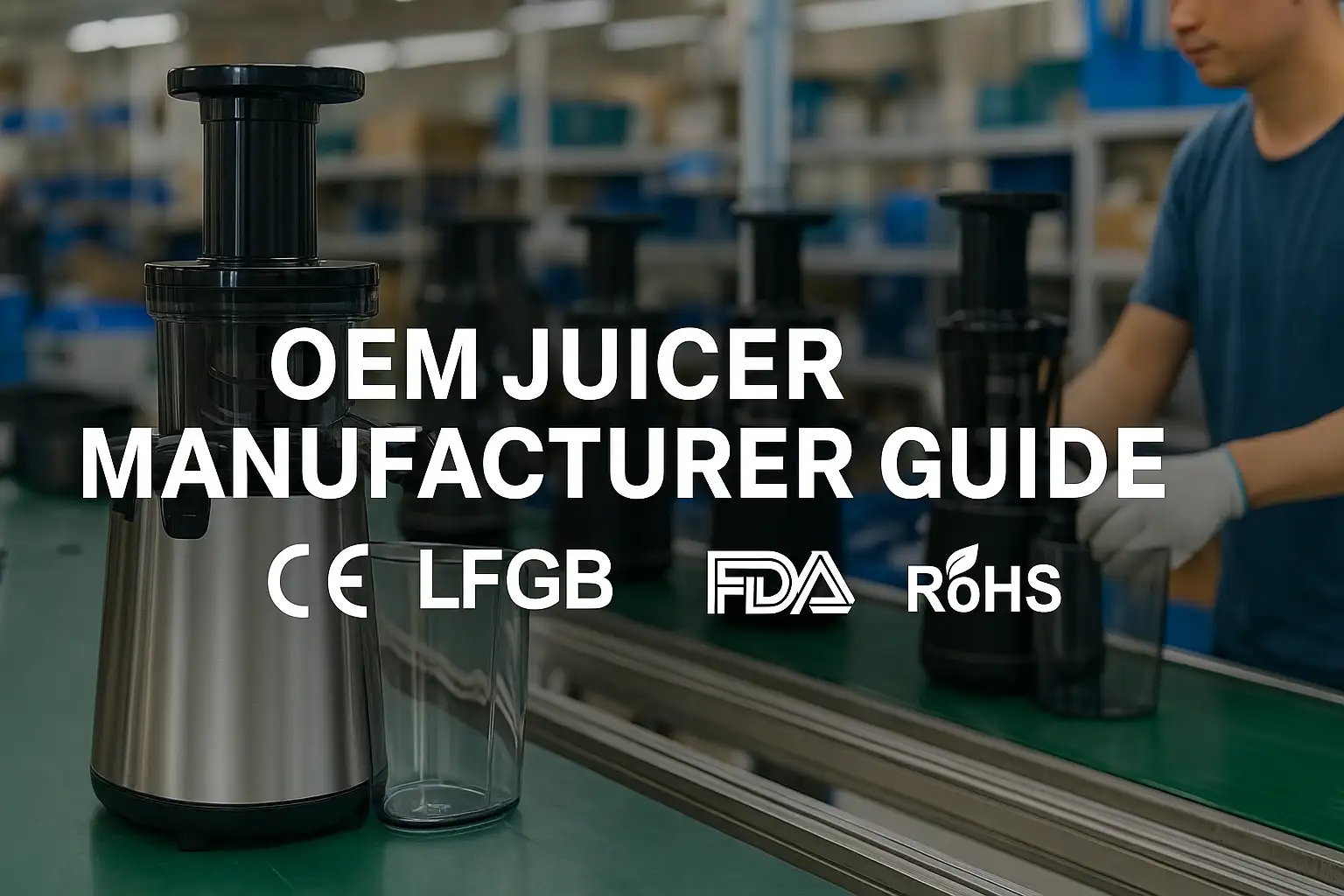
As global demand for juice-based wellness products continues to rise, more brands are turning to OEM manufacturers to produce custom juicer solutions tailored to their markets. For B2B buyers, retailers, and private-label startups, selecting the right OEM juicer partner means navigating technical specifications, international standards, and production capabilities.
This guide outlines the most important aspects of choosing an OEM juicer manufacturer, including required certifications, engineering specs, and business considerations for a successful partnership.
1. What Is an OEM Juicer Manufacturer?
An OEM juicer manufacturer builds a juicer for other brands, not under its name, but tailored to your brand. You receive a completed juicer machine to your specifications and label it yourself. This arrangement implies that you do not require your own factory or design team. Instead, you can leverage the expertise and equipment of a firm that already understands how to craft juicers, providing quality products while saving time and money.
They’ve got their own plants, they make their own parts, and they operate the entire process from design, fabrication, through testing and packaging. They send you the completed juicers, so you can get your product out in front of people without the huge start-up overhead associated with establishing your own manufacturing.
In the juicer world, speed and price are important. OEM makers help you get to market fast since they already have lines set up to build many types of juicers: centrifugal juicers, masticating, citrus, or even custom machines. You can request special modifications, such as size, appearance, color, or customize functionality to suit your market’s needs for fresh juice.
A lot of these factories have their own injection and motor shops, so they can control quality and speed up changes. Few other industry-leading OEM juicer manufacturers have partnered with the heavyweights for as long — we’re talking 10+ years — which means you snag a teammate who’s seen it all and can help you sidestep rookie blunders in the juicing business.
Quality is essential if you want to establish credibility in your brand. Good ones run strict checks and observe global safety standards–CE, GS, RoHS, CB, EMC, and LFGB. So you’re getting stuff that functions great, holds up, and is compliant with regulations in a number of different countries, ensuring that you can deliver quality juice to your customers.
An OEM (Original Equipment Manufacturer) juicer producer designs and builds juicers that are branded and sold by another company. These manufacturers offer: a streamlined process for producing high-quality juicers that meet the demands of the market.
- Product development based on your concept or existing designs
- Custom branding, color, packaging, and instruction manuals
- End-to-end production from mold tooling to quality control
Unlike ODM (Original Design Manufacturer), which offers pre-made designs with limited customization, OEMs allow full technical and aesthetic personalization, making them a preferred choice for businesses looking to create their unique line of.
2. Key Certifications to Look For
When you source an OEM juicer manufacturer, it’s savvy to look for their certifications. These certifications ensure the maker constructs with what standards. They demonstrate the company adheres to standards for safety, quality and international commerce. For you, it’s less risk and more confidence when you transact with foreign suppliers.
Begin with ISO9001. This is the gold standard of quality control for factories. It establishes guidelines for how a business conducts its operations, monitors issues, and audits for errors. ISO9001, for example, isn’t about paperwork — it demonstrates the manufacturer has a system to rapidly identify and resolve issues. If you find a juicer supplier with ISO9001, you know they care about quality work and solid back-end controls.
BSCI is a must too. This one verifies if the manufacturer employs workers ethically, compensates them fairly, and maintains secure working conditions. BSCI allows you to select a partner that adheres to social standards, not just technical ones. Brands selling in Europe or to global markets require this for peace of mind and seamless customs inspections.
Safety is second. For Europe, CE marking isn’t optional—it’s mandatory. All electrical juicers sold within the EU need to carry a CE mark. It indicates that the product complies with health, safety, and environmental protection standards. The devil is in the details here, such as the font size and width of the CE label, a factor that influences customs inspections.
Here in the US, seek out UL or ETL. UL (Underwriter Laboratories) is famous for rigorous safety testing. ETL is allowed for U.S. Sales and indicates the item passed tests for impact, fire and danger. These seals assist consumers to recognize the product is secure to utilize in the household.
For international trade, the CB system is critical. This system, overseen by the IECEE, enables member countries to recognize one another’s test reports for safety, in line with IEC standards. A CB report means your juicer cleared tests other countries rely on too — so you can sell places with less additional testing. A few member countries have additional requirements, so a local check may still be necessary.
Other big names you’ll see are TUV, LCIE, SGS and ITS. These labs are relied on around the globe for their transparent, accurate reporting. Certifications are about more than just ticking boxes. They help you demonstrate to buyers and partners that your product is secure and delivers on its promise.
To sell juicers in international markets, your OEM partner must provide equipment that complies with regional electrical, safety, and material standards.

Your supplier should be able to provide up-to-date lab test reports and certificates tied to specific product batches.
3. Engineering Specifications That Matter
Selecting an OEM juicer manufacturer requires you to consider engineering specifications that impact the quality juice produced and the user experience of different kitchen appliances, ensuring they meet market demands.

a. Motor Type & Power
| Motor Type | Pros | Best For |
|---|---|---|
| DC Motor | Stable speed, quiet, energy efficient | Home/slow juicers |
| AC Induction Motor | High torque, durability, less maintenance | Commercial/high-volume use |
| Brushless Motor | Long life, low heat, quiet | Premium/versatile models |
A juicer’s motor power, in watts, establishes the tempo for juice production. For slow juicers, low-speed motors (40–100 RPM) are critical — they preserve nutrients and output generous yields. Not enough power and your juicer chokes on hard produce, too much and you risk heat buildup, which destroys juice quality.
For commercial environments, you’ll want motors designed for hours of use, not just a few seconds at a time, or you’ll constantly be dealing with breakdowns. Be sure to always pair motor specs to your juicer’s intended purpose—don’t put a simple home unit in a place heavy duty machine is used!
b. Juice Yield Efficiency
Juice yield efficiency refers to how much juice you obtain from a given weight of produce. High yield is important because it amplifies ingredients, extends consumer delight, and reduces overhead for commercial purchasers.
Design matters a lot here — augers, mesh screens, feeding tubes all sculpt how much juice you extract. Slow juicers, with their constant, low-speed extraction, outdo centrifugal models for yield, particularly with leafy greens or wheatgrass.
If you’re a manufacturer, making this a #1 feature can differentiate your product, especially for health-conscious consumers, where every drop of juice is precious.
c. Material Composition
Material selection dictates the feel for security, durability, and convenience. Food-grade plastics and stainless steel are both common, but stainless wins on durability and hygiene, particularly in core components such as augers and filter baskets.
A lighter body can come in handy for transporting and stowing the juicer, but don’t make it so light that it’s perceived as cheap or fragile. Making cleaning easy—smooth, simple pieces make this task quicker, which keeps customers happy.
Green substances, such as BPA-free plastics or recycled steel, can assist you attract well-being aware clientele and adhere to demanding worldwide benchmarks.
d. Noise Level & Cooling System
Noise is a dealbreaker for a lot of users. For home and commercial spaces, a quality slow juicer should operate under 60 decibels—quiet enough for everyday use, even in communal spaces.
Cooling systems are just as vital: they keep motor temps in check, stop overheating, and extend motor life. Any OEM worth its salt should strive to reduce noise without sacrificing power, particularly for the European markets where the rules are tight.
A near-silent juicer breaks new customer bases and increases your brand’s allure.
e. Warranty & Component Life
A robust warranty indicates confidence and craftsmanship. Knowing the longevity of each part keeps buyers satisfied and returning.
Transparent conditions, no fine print, engender confidence quickly. Nice warranties enhance brand reputation and generate loyalty.
4. Customization & Private Label Options
Customization & Private label options provide you with a way to set yourself apart in the juice market. By working with an OEM juicer manufacturer, you have the opportunity to create products tailored to your brand and your specifications. You get to choose the design, the color, even the specifications of the juicers you want to market.
Many OEM juicer manufacturers allow extensive customization, including:
- Logo printing & laser branding
- Color matching based on Pantone codes
- Packaging design including retail cartons & inserts
- Multilingual manuals and region-specific plug types
Some also offer digital integrations (e.g. app-enabled smart juicers) for high-tech markets.
Customization isn’t just about making something look different. It allows you to craft your brand experience and how your customers perceive your products. When your juicer LOOKS & WORKS like your brand, it differentiates on a shelf and in the hearts & minds of your purchasers.
Private labeling – that’s what it’s all about when you’re growing your own brand. When your name’s on a juicer, it’s yours. This creates trust with your buyers, increases brand recall and fosters loyalty. Private label means you can sell a juicer with your own brand name, even if it was manufactured by another person.
It reduces the risk of expensive errors and assists you in detecting issues sooner. Dealing with a creator who offers after-sales support and continues with quality builds trust and saves you headaches later. With them to count on, you can concentrate more on growing your brand and less on putting out fires.
5. Factory Evaluation & Auditing Checklist

Selecting the right OEM juicer manufacturer is about more than price and product. You need a detailed schedule that covers every aspect of the factory’s operation, from how they manufacture your juicer to how they handle their employees. Begin with a desktop audit before you visit. This step gets you to identify risks early by verifying public records, certifications, customer reviews and company background.
Define your audit objectives so your team understands what to seek out and how to quantify it. Having these objectives up front keeps your audit focused and helps ensure nothing gets overlooked.
There should be a minimum of 10 main points in your quality audit checklist. Verify that the factory does function and safety tests on each unit. Have them segregate acceptance and rejected goods, and employ a reliable sampling plan for in-production quality inspection.
See how they trace defects, manage recalls, and maintain records. Check whether they collaborate with certified third-party labs for important product tests, particularly if they lack an on-site lab. This is a necessity for juicers, of course, as they make contact with the food and need to clear stringent safety marks in each market.
Examine the factory’s org chart and interview managers. A quality organization demonstrates that they understand how to process orders, address issues, and respond to your inquiries efficiently. Notice their demeanor — if they’re sluggish to respond or resist inspections, this may spell trouble down the line.
Certain suppliers will stall your order or use inferior materials if they don’t respect your business – so make sure you do! Review the factory’s equipment list and machine age. Old or poorly maintained machines may cause more defects or bottlenecks.
Inquire about personnel training. Our expert craftsman team is what helps ensure that every juicer matches your specs every time. Great factories will take you through their process, from raw materials to packing, and introduce you to line workers or quality inspectors.
Seek evidence of adherence to health and safety regulations, environmental guidelines, and equitable labor policies. Request to review certifications, safety records and any buyer or agency audit reports. Ethical and sustainability-savvy factories make not only safer partners, but help you satisfy domestic customer and legal demands as well.
Audits—regular audits, even after you begin working together—are the best way to catch problems early and keep standards high.
So, Before committing to a supplier, verify their facility and quality control systems:
- ISO 9001 or BSCI certified factory
- In-house engineering and mold workshop
- Batch testing, aging tests, and raw material inspection
- Incoming/outgoing goods inspection (IQC/OQC)
- Sample room & NDA confidentiality protocols
A good OEM partner should offer virtual factory tours or accommodate on-site audits by third-party inspectors for quality products.
6. OEM Partnership Tips for Long-Term Success

A great OEM partnership is more than signing a contract. It means defining a process where both parties continue to evolve. For your OEM juicer initiative, begin with transparent communication channels. Figure out who takes care of what—group chats, e-mail chains, or project apps for day-to-day notes and quick fixes.
Have back-up plans for when there’s a snafu or an emergency. Establish trusted points of contact on each side. This slashes delays and prevents ideas from slipping through the cracks.
Build trust by explicitly communicating your common objectives. When you and the OEM want to grow and win, you’re more likely to solve problems before they grow. Be candid about your requirements. If you’re going to increase your order volume or accelerate launches, communicate these plans early.
A great OEM partner will be able to scale up — either in terms of more output per month or faster new-model cycles. This allows you to satisfy demand without the eleventh-hour stress.
Make sure your OEM can handle your order volume and schedule. Get into the details: How many units can they make per batch? How quickly can they replenish if you sell out? Will they keep pace if you desire more frequent drops or schedule a global launch?
Demand evidence — such as manufacturing logs or testimonials from different labels. This helps identify gaps before you encounter a bottleneck.
Legal protections are not optional. Let NDAs protect ideas and design. Clarify who owns the molds/code/blueprints. Insist your partner has a solid policy to protect what’s yours. This protects you from copycats and mix-ups down the road.
Quality can never slip. Demand evidence, such as ISO 9001, to demonstrate their process is at a world-class level. Request to review their test data. Establish your own checks if you require additional comfort.
It’s better to identify and solve issues early than pull a batch of juicers. Be nimble as trends change. Juice markets shift quick–perhaps cold-press surges in Asia or consumers demand glass over plastic.
Share data with your OEM. Work out tweaks or new models in partnership. This keeps your brand fresh and leverages what your OEM understands.
To build a successful OEM relationship:
- Start with a small pilot batch and detailed spec sheet
- Communicate clearly on packaging, shipping labels, manuals
- Clarify tooling ownership, mold cost amortization, and exclusivity
- Schedule regular QC updates during production
- Establish after-sales service agreements and spare parts planning
A true partnership develops from a common vision. Keep that feedback loop open. Meet regularly to discuss the successes and failures. Have your OEM recommend changes too. This creates a team that’s prepared for anything.
Conclusion
Choosing the right OEM juicer manufacturer is a technical, regulatory, and strategic decision. From motor performance to food safety certifications, every detail influences your brand’s market readiness and customer satisfaction.
For B2B buyers seeking reliable, customizable juicer production, ElectMix offers OEM manufacturing support with full certifications, engineering expertise, and tailored branding services. Contact our team to start your private-label juicer project today.
Frequently Asked Questions
1. What certifications should an OEM juicer manufacturer have?
Reputable OEM suppliers should offer CE, LFGB, FDA, and RoHS certifications based on your target market, ensuring quality standards for juicer machines and other kitchen appliances.
2. Can I customize the appearance and packaging of OEM juicers?
Yes, most OEM suppliers provide logo printing, custom colors, and branded packaging for juicer makers, along with manuals in multiple languages.
3. How do I know if an OEM factory is reliable?
When evaluating a juicer machine, ensure the manufacturer has ISO 9001 certification, in-house engineering, and quality standards for fresh juice production, along with inspection processes like IQC/OQC.
ElectMix Team provides global e-commerce sellers and distributors with insights on commercial blending solutions, OEM customization, and profitable market opportunities.


