 Skip to content

Choosing a commercial blender is not a contest to find the largest horsepower number. The right machine is the one that can produce your defined recipes, at your required batch size and peak-hour pace, while remaining cleanable, serviceable and supportable in the market where it will be sold or used. A restaurant, a café counter, a hotel breakfast station and a distributor may all need a commercial blender, but they do not have the same operating risk.
Start with the business workflow, then qualify the complete appliance. Motor and controller performance matter, but so do the jar, blade, coupling, cooling path, controls, sound treatment, cleaning routine, compliance documents, spare parts and packaging. A supplier quotation becomes meaningful only when these details are connected to a production-intent sample and a repeatable test.
This guide provides a practical selection process for foodservice operators, importers, distributors and private-label buyers. It avoids universal power thresholds and brand rankings because neither can prove that a blender fits a specific menu or duty cycle.
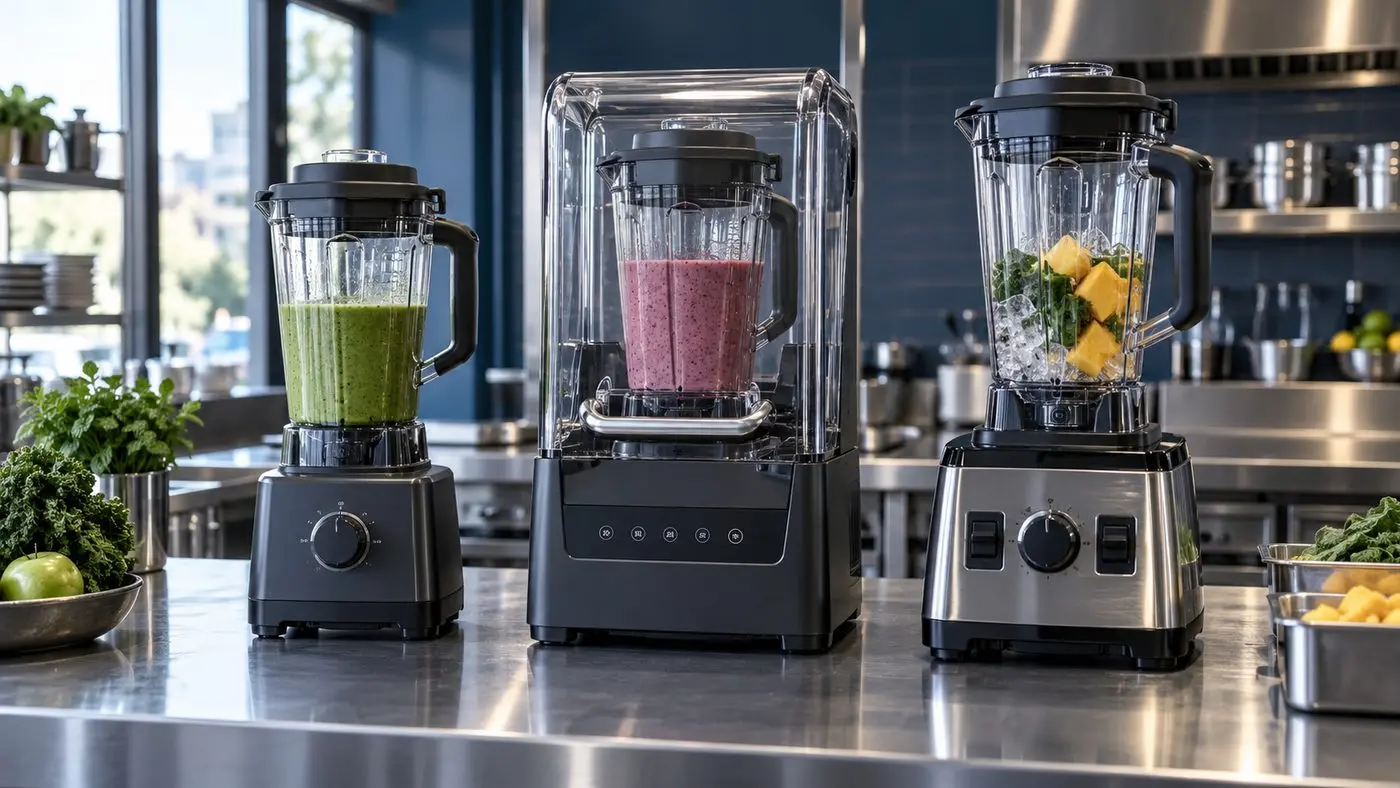
Three correctly proportioned commercial blender configurations for restaurant, café and front-of-house selection
Quick Answer: Match the Blender to the Job
Use the following sequence before comparing model numbers:
- Define every recipe the blender must perform, including the hardest approved recipe.
- Record normal fill, maximum fill, required texture and acceptable cycle time.
- Estimate cycles per hour and the duration of the busiest service period.
- Decide whether the machine will operate front-of-house or in a preparation area.
- Test production-intent samples with the same ingredients and procedure.
- Time loading, blending, unloading, rinsing and changeover—not blending alone.
- Confirm market-specific safety, sanitation, labeling and electrical requirements.
- Approve spare parts, warranty handling, packaging and change control before ordering.
A café may prioritize compact size, a sound enclosure and repeatable drink programs. A restaurant may value variable control and a jar that handles sauces, dressings and different batch sizes. A distributor must additionally consider electrical variants, certification scope, documentation, packaging damage and parts availability. No single specification answers all three needs.
Build a One-Page Application Profile First
The fastest way to eliminate unsuitable blenders is to write a one-page application profile. This document should be sent to every potential supplier so candidates are compared against the same requirement.
Include the menu, ingredient condition and preparation. “Smoothies” is too broad. A liquid-heavy fruit drink, a frozen-fruit smoothie, a thick smoothie bowl and a nut-based sauce place different loads on the same drive system. Record whether ice is cubed or crushed, whether frozen fruit is separated or arrives in blocks, and whether dense ingredients must be processed with a tamper.
Define batch size in usable terms. Nominal jar capacity is not the same as a practical working fill because ingredients need headspace and room to circulate. Include the smallest profitable serving as well as the largest batch. Some large jars process full batches well but circulate single servings poorly.
Write the peak pattern rather than only a daily total. Fifty drinks spread across ten hours are different from thirty drinks within forty-five minutes. State typical run time, unloading and reloading time, rest time, expected cycles per hour and peak-period duration. Include room temperature, counter clearance and nearby heat sources because ventilation affects repeated-cycle performance.
Finally, define acceptance. For each recipe, describe the required texture, maximum unprocessed pieces, temperature concern if relevant, cycle-time target and permitted operator intervention. A result should be judged against an agreed endpoint, not whether a salesperson says it “looks smooth.”
Application profile checklist
- Business type and installation location
- Destination country, voltage, frequency and plug
- Menu and ingredient preparation
- Normal and difficult recipes
- Smallest, typical and maximum fill
- Texture and cycle-time targets
- Cycles per hour and peak duration
- Cleaning and changeover frequency
- Front-of-house noise sensitivity
- Operator skill and training limits
- Required certifications and documents
- Expected order quantity, packaging route and spare-parts plan
This profile also prevents internal confusion. Procurement, product, quality and sales teams can approve the same intended use instead of evaluating different demonstrations.
Choose by Business Type, Not Marketing Category
Commercial blender labels are often broad. Translate them into operating needs.
| Business or channel | Typical priority | Main risks | Useful evidence before purchase |
| Smoothie or juice bar | Fast, repeatable frozen drinks | Queue time, heat accumulation, coupling wear | Peak-cycle recipe test, program repeatability, spare jar plan |
| Café front counter | Customer experience and compact workflow | Noise, enclosure cleaning, counter clearance | Installed-location sound comparison, open-height check, cleaning trial |
| Restaurant kitchen | Recipe range and texture control | Small-batch circulation, staff variation, cross-contact | Recipe matrix, variable-control trial, complete cleaning procedure |
| Hotel breakfast area | Simple use by rotating staff | Misuse, downtime, noise, lid errors | Training trial, clear labels, service response and spare unit plan |
| Catering operation | Transport and changing venues | Impact damage, power compatibility, setup errors | Pack-and-move trial, cord and plug review, protective case plan |
| Distributor or importer | Sellability and after-sales control | Wrong claims, returns, missing parts, incompatible variants | Compliance file, parts list, packaging test, controlled specification |
| Private-label brand | Differentiation with repeatable quality | Uncontrolled changes, artwork errors, delayed certification | Golden sample, BOM controls, pilot inspection, change-notification agreement |
The table is a starting point, not a model recommendation. Two cafés can need different machines if one sells mostly iced blended drinks and the other uses a blender occasionally for a single signature beverage.
Evaluate the Complete Performance System
The finished drink is produced by a system: electrical supply, controller, motor, cooling, mounts, coupling, blade, jar geometry, lid, recipe and operator. Quoting one component does not establish finished-machine capability.
Motor ratings need context
Ask what each power figure represents. Rated electrical input, measured input under a defined load, motor output and short-duration peak marketing language are not interchangeable. Confirm the rating plate data for the exact market version, including voltage, frequency and current.
Rather than selecting a fixed horsepower threshold, compare load response. Does the blender start the approved recipe without persistent stalling? Does speed remain stable? Does the texture reach the agreed endpoint within the intended cycle? Does the platform complete the peak pattern without abnormal odor, repeated protective trips or unacceptable restart delays?
The ElectMix guide to commercial blender motors, power, torque and reliability explains these motor-system questions in detail. Use that article for motor qualification; use this buying guide to balance the motor with every other purchasing criterion.
Cooling and protection must match the peak pattern
Inspect air inlets, exhaust openings and required counter clearance. Vents should not be easily blocked by a wall, shelf, towel or normal debris. If a sound cover is used, confirm that it is part of the validated configuration and does not restrict the cooling path.
Overload and over-temperature protection are valuable safety functions, but they do not make an undersized platform suitable. A trip may prevent damage. Repeated trips during the agreed normal workload show that the recipe, cycle pattern, ventilation or machine selection needs correction. The commercial blender overheating guide provides a safe operating framework without encouraging protection bypasses.
Drive coupling and mounts reveal real durability
The coupling transfers motor rotation to the jar assembly. Check engagement, backlash, unusual chatter, material wear and tolerance to normal jar placement. Install and remove the jar repeatedly, then inspect for rounding, debris, cracks or wobble.
Motor mounts, jar supports and feet control vibration. A heavy exterior panel cannot compensate for loose internal structure. Test on a counter similar to the final installation and listen for changing tone or new vibration after repeated cycles.
Select Jar Capacity and Material for the Workflow
Jar choice affects usable batch size, lifting, visibility, drop risk, cleaning, replacement cost and shipping. Do not select it as an accessory after approving the base.
Capacity means usable fill, not molded volume
A jar marked with a large nominal volume may need substantial headspace for safe circulation. Ask the supplier to demonstrate both the smallest intended serving and the largest approved batch. Check whether the lid remains secure, whether ingredients recirculate naturally and whether operators need excessive tamping or stopping.
Multiple jars may improve peak-hour throughput more than a larger motor. While one jar is washed or loaded, another can be used. Calculate the number of jars, lids and tamper tools required per location and include them in the opening spare-parts order.
Material is a trade-off
Clear copolyester jars offer low weight and ingredient visibility. Stainless steel can suit rugged handling or applications where transparency is unnecessary, but it prevents the operator from seeing circulation. Glass offers visibility and a different perception of quality, yet its weight and breakage risk can be difficult in rapid commercial handling.
The decision depends on exact material grade, wall design, handle attachment, blade interface, cleaning chemistry and drop expectations. “Tritan,” “stainless” or “glass” alone does not prove the finished jar. Use the Tritan, stainless steel and glass jar comparison to build the jar specification.
Check measurement marks, lid fit, cap retention, pouring control and exterior grip when wet. Inspect the blade-bearing area before and after testing for leakage, play and abnormal resistance. The jar must remain stable on the base without requiring operators to force or twist it beyond the intended method.
Blade Geometry Must Be Proven by the Recipe
Blade thickness and the number of tips are easy to photograph but poor standalone decision criteria. Geometry, pitch, balance, material, hardness, edge condition, jar ribs and clearance work together. A more aggressive blade can increase load without improving the desired texture.
Use the same production-intent jar and blade for every test. Run a recipe matrix that includes the easiest, most common and hardest intended items. Measure the endpoint that matters: remaining particle size, visual uniformity, pour behavior, temperature, cycle time or another product-specific criterion.
Inspect the blade assembly after cycling. Look for looseness, leakage, rubbing, chipped edges, corrosion, discoloration and changing bearing feel. If the assembly is replaceable, confirm the approved service method and part code. If it is not user-serviceable, the instructions must clearly prevent unsafe disassembly.
Do not accept a substitution to the blade, bearing, lubricant, seal or jar without review. A visually small change can alter motor load, vibration, cleaning and food-contact compliance.
Controls Should Reduce Operator Variation
Controls should match the staff and menu. A variable-speed dial and pulse function can suit a restaurant that makes many textures. Programmed cycles can help a beverage chain produce repeatable drinks with less operator judgment. A touchscreen may support multiple recipes and branding, but it adds software, cleaning and replacement considerations.
Test controls with the conditions staff will face. Are labels visible under installed lighting? Can the operator use the interface with damp hands or foodservice gloves? Is stop control obvious? Is accidental activation foreseeable? Can the surface be cleaned without trapping residue at buttons, knobs or panel seams?
Every preset must be validated with a defined recipe. A button labeled “smoothie” is not proof that the program suits every smoothie. Record the controller or software revision in the approved specification because a later change to speed ramps, time or current limits can change performance while the exterior remains identical.
For chains and distributors, decide whether programs can be locked or changed and who controls the master settings. An uncontrolled menu update can create complaints that appear to be hardware defects.
Noise Must Be Measured in the Intended Environment
There is no universal decibel number that defines a quiet commercial blender in every room. Sound depends on recipe, speed stage, jar, enclosure, counter, distance, room reflections and background noise. A supplier number without a method cannot support a fair comparison.
For front-of-house use, test the same recipe in a representative layout. Keep the meter position, distance, room and cycle stage consistent. In addition to a reading, observe whether staff can hear orders and whether vibration transfers into hollow cabinets or metal counters.
A sound enclosure can reduce direct airborne noise, but inspect the hinge, cover height, panel durability, cleanability and airflow. Measure the available vertical clearance with the cover fully open. Never place a standard blender inside an improvised box because heat can accumulate and controls may become difficult to reach.
The quiet commercial blender guide for cafés provides a complete test and installation checklist.
Cleanability Determines Effective Throughput
The shortest blend time does not necessarily produce the highest practical capacity. Time the complete cycle: ingredient loading, blending, pouring, rinsing, sanitation, drying and reassembly. A machine that saves ten seconds while blending but adds several minutes to changeover may reduce output.
Inspect lid grooves, removable caps, gaskets, handle joints, blade housings, jar bases, control seams and the area around the drive socket. Food-contact surfaces should be accessible to the documented cleaning method. Removable parts should have an obvious safe orientation and should not depend on improvised tools.
“Dishwasher-safe” must apply to the exact finished jar, lid, markings, gasket and blade configuration under the stated conditions. Repeated detergent, temperature and drying exposure can affect parts differently. Ask for the test basis rather than accepting a material-only statement.
For U.S. commercial food equipment, NSF’s food equipment standards portfolio describes NSF/ANSI 8 as addressing minimum food-protection and sanitation requirements for power-operated commercial food-preparation equipment. This does not mean every blender must follow the same certification route in every country; it shows why cleanability and hygienic construction must be evaluated at finished-product level.
Food-contact documentation should identify the exact materials, colorants, seals, lubricants, coatings and adhesives that contact food under the intended conditions. A resin statement is not automatically evidence for a complete jar assembly.
Safety and Compliance Must Match the Market Version
Before requesting quotations, state the destination markets and intended classification. Requirements can differ for household appliances, professional appliances and commercial equipment. Plug, cord, voltage, frequency, rating plate, manual language and critical components must match the tested version.
IEC 60335-2-64 addresses safety for certain electrically operated commercial kitchen machines. The exact applicable standard, national deviations and certification route should be determined by a qualified laboratory or compliance specialist for the specific product and market.
Ask for documents that identify the exact model and critical configuration. A certificate from a similar-looking product, another voltage version or an older controller revision may not cover the offered unit. Verify listings through the issuing body where possible.
Safety features should be evaluated in use, not only listed in a brochure. Check lid or jar interlocks if present, protection recovery, stability, cord strain relief, accessible moving parts, foreseeable misuse and clarity of warnings. Instructions must define fill limits, approved use, cleaning, protection recovery and conditions that require the machine to be removed from service.
The ElectMix overview of commercial blender certifications can help buyers organize the document request, but final compliance decisions should remain product- and market-specific.
Calculate Total Operating Cost
Purchase price is only one component of cost. Use a comparison period that reflects the planned channel, then include:
- Blender base and required jars
- Lids, caps, tampers and opening spare parts
- Labor for loading, blending and cleaning
- Energy under the real duty pattern
- Replacement jars, blade assemblies and couplings
- Technician labor and freight for service
- Downtime, loan units or location replacement
- Warranty administration and customer support
- Packaging damage and return handling
- Certification, documentation and private-label setup
Do not invent a precise payback figure without operational inputs. Instead, compare scenarios. A more expensive platform can be economical if it reduces cycle failures, cleaning labor or downtime. A lower-cost model may be correct for occasional preparation if its limitations are clearly communicated.
For multi-location buyers, calculate the cost of one common platform versus multiple specialized platforms. Standardization can simplify training and parts, but forcing one blender into incompatible duties can create greater operating cost.
A simple comparison formula
For each candidate, estimate:
Total operating cost = purchase and setup + labor + consumable and replacement parts + service and freight + downtime and returns
Use the same time period, workload and assumptions for every machine. Record uncertain inputs as a range rather than hiding them in one optimistic number.

Commercial blender recipe and workload test using measured ice, frozen fruit and liquid ingredients
Test Samples with a Controlled Procedure
A professional sample evaluation does not require a complex laboratory. It requires consistency, observation and written acceptance criteria.
Stage 1: Incoming configuration check
Record model, serial or sample ID, voltage, frequency, plug, controller revision, jar, blade assembly, coupling and visible critical parts. Photograph the unit and packaging. Confirm that later samples can be compared to this configuration.
Stage 2: Safe no-load and basic checks
Inspect external damage, cord, plug, jar seating, lid, controls and vents. Run only as instructed. Note abnormal sound, smell, vibration or control behavior. Do not open the electrical base or bypass protection.
Stage 3: Recipe matrix
Weigh or measure ingredients and control temperature and preparation. Run the easy recipe, common recipe, hardest approved recipe, smallest batch and largest batch. Record cycle time, interventions, finished texture, leakage and abnormal behavior.
Stage 4: Peak-period cycle test
Repeat the intended run, unload, reload and rest pattern for the duration of the real peak. Record protection events, restart delay, performance drift, odor and changes in vibration or sound. Follow the manufacturer’s stated limitations.
Stage 5: Cleaning and changeover
Time the documented operator cleaning routine. Inspect residue traps, reassembly errors and parts that are easy to lose. Repeat for recipes with relevant allergens or strong colors if those are in the menu, using the buyer’s sanitation procedures.
Stage 6: Post-test inspection
Recheck jar seating, coupling wear, blade bearing feel, leakage, lid fit, markings, feet and controls. Compare observations with the incoming record.
The commercial blender troubleshooting guide is useful for defining safe external checks and stop-use conditions during this stage.

Commercial blender, jar, accessories, spare parts and protective packaging under distributor inspection
Distributor and Importer Due Diligence
An operator buys performance at one location. A distributor buys performance plus repeatability across many customers, shipments and service cases.
Request a controlled product specification covering critical components, materials, electrical variants, performance criteria, labeling and packaging. Identify which changes require written notification, a new sample, document review or re-testing. “Equivalent component” should not be accepted without an agreed process.
Confirm spare-part codes, compatible revisions, minimum quantities, lead times and expected support period. Separate operator-replaceable items from parts that require qualified service. Stock the items most likely to suffer wear or accidental damage, such as jars, lids, caps, gaskets and approved coupling or blade modules where applicable.
Review packaging as part of the product. A blender can pass every recipe test and still arrive with cracked jars, rubbed controls or broken accessories. The shipping unit should restrain the base, separate hard components, protect the jar and survive the intended pallet or parcel route. ISTA’s test procedures explain why distribution testing must be selected for the actual package and route, not treated as one universal “drop test.”
Before production, agree on incoming inspection, pilot sampling, defect definitions, traceability, warranty evidence and failure-analysis communication. A long warranty is less valuable when part identification and responsibility are unclear.
If you are building more than one model for different customer groups, see our commercial blender product line planning guide for channel fit, SKU structure, landed cost and after-sales preparation.
OEM and Private-Label Selection
Start from an approved platform whenever possible. Cosmetic changes such as logo, color, carton artwork and manual language may be relatively low risk after the base product and compliance implications are confirmed. Changes to the motor, controller, jar, blade, coupling, cooling path, enclosure, interlock or food-contact material require engineering review.
Customization should begin with the application profile, not a styling request. Define performance, market, quantity, documentation and packaging before tooling or certification commitments. Freeze approved drawings, specification, bill of materials, artwork and golden samples. Confirm how substitutions are communicated.
For an established product platform, review the ElectMix product range and prepare questions against the checklists in this guide. For non-standard products or component combinations, the ElectMix custom manufacturing process can be used to assess feasibility, engineering scope, sample stages, compliance and production planning. Capability and timing should be confirmed project by project rather than assumed from a generic catalog.
Common Commercial Blender Buying Mistakes
Choosing by horsepower alone
Power language does not prove finished texture, cooling, cleanability or service life. Test the complete product under a defined workload.
Testing only one easy demonstration
Water, soft fruit or one short ice cycle cannot represent a full menu or concentrated rush. Use a recipe matrix and repeated cycles.
Ignoring smallest-batch performance
A large jar may look productive but perform poorly for one serving. Test the real minimum fill.
Treating a protection trip as normal duty
Protection is valuable, but recurring trips during the intended workload require investigation.
Buying a sound cover without checking space and airflow
Confirm full open height, cleaning access and validated cooling in the enclosed configuration.
Accepting a generic certificate
Documents must match the exact model, voltage, critical parts and destination market.
Leaving spare parts until complaints begin
Agree codes, quantities, compatibility and service responsibilities before shipment.
Approving the sample but not controlling production changes
A sample is useful only when its configuration is recorded and later substitutions are controlled.
Final Buyer Checklist
- The one-page application profile is approved internally.
- Every intended recipe and ingredient condition is defined.
- Smallest, typical and maximum working fills are tested.
- Peak cycles per hour and peak duration are documented.
- Market voltage, frequency, plug, labels and instructions are correct.
- The production-intent motor, controller, jar, blade and coupling are identified.
- Recipe, peak-cycle, noise and cleaning tests use repeatable methods.
- Protection behavior and stop-use conditions are clear.
- Jar handling, lid retention, leakage and coupling wear are acceptable.
- Food-contact and compliance documents match the exact configuration.
- Spare parts, service scope, warranty process and support period are agreed.
- Packaging is validated for the intended distribution route.
- Critical parts and change-notification rules are written into the specification.
- Pilot-production units repeat the required checks.
If the supplier cannot support several mandatory items, treat the unit as an unqualified candidate. Do not solve missing evidence with stronger marketing language.
Frequently Asked Questions
What power rating is best for a commercial blender?
There is no universal best power rating. Select by finished-machine performance under your recipes, fills, cycle pattern, voltage and ambient conditions, then confirm cooling, protection and serviceability.
Can a home blender be used in a restaurant or café?
A home blender may complete occasional tasks, but suitability depends on intended-use limits, workload, sanitation, safety, warranty and local requirements. A professional operation should use equipment approved for its actual duty and market.
What jar size should a restaurant choose?
Choose by usable working fill, not nominal capacity. Test the smallest serving, normal batch and largest approved batch, including headspace, lid retention, circulation, lifting and cleaning.
Is a sound enclosure necessary for a café?
It is valuable when blending occurs near customers, but it is not automatically required. Compare sound in the installed layout and verify cover height, cleaning, hinge durability and airflow.
Are preset programs better than variable speed controls?
Presets help repeat standardized drinks, while variable control suits changing recipes and textures. The better interface is the one staff can use safely and consistently with the approved menu.
How should commercial blenders be compared during sampling?
Use identical production-intent configurations, weighed ingredients, preparation, fill, program, environment and acceptance criteria. Record texture, cycle time, interventions, protection events, leakage, noise and post-test wear.
What spare parts should a distributor stock?
The plan often includes jars, lids, caps, gaskets and other approved wear or damage items. Exact parts depend on the design, service policy and market, and each needs a controlled code and compatible revision.
Does an NSF-compliant material mean the complete blender is certified?
No. A material statement does not establish certification of the complete appliance. Verify the finished product, model scope and listing with the relevant certification body.
When should packaging be tested?
Test the production-intent product, accessories, carton and inserts before mass shipment and after material, supplier or layout changes that could affect protection.
What information should an OEM blender quotation include?
It should identify the product configuration, intended market, electrical version, performance requirements, customization scope, compliance responsibilities, tooling or setup, sample stages, quantity, packaging, spare parts, lead time and change control.
Final Recommendation
Choose a commercial blender by verified fit, not by a single specification or a generic brand list. Define the workflow, test the complete production-intent appliance and calculate operating cost across labor, cleaning, parts, service and downtime. For distributors, add configuration control, compliance scope, packaging and after-sales readiness.
The result should be a documented purchasing decision: this configuration passes these recipes, at these fills and cycle conditions, for this market and channel. That statement is more useful—and more defensible—than calling a blender “best” without a method.
Buyers who need to compare available platforms can review ElectMix products. For a private-label or non-standard project, use the custom manufacturing page to understand the development route, then contact ElectMix with the one-page application profile described in this guide.
ElectMix Team provides global e-commerce sellers and distributors with insights on commercial blending solutions, OEM customization, and profitable market opportunities.


