Skip to content

- Key Takeaways
- What Is a Commercial Juicer?
- What Is a Cold Press Juicer?
- Side-by-Side Comparison Table
- Which Is Better for Juice Bars?
- Operational Considerations
- OEM Insight: What Distributors Look For
- Conclusion
- Frequently Asked Questions
- What is the main difference between a commercial juicer and a cold press juicer?
- Which juicer is best for juice bars?
- Are cold press juicers slower than commercial juicers?
- What are the benefits of cold press juicing?
- What should distributors consider when choosing between these juicers?
- Can commercial juicers handle large volumes of fruits and vegetables?
- Do cold press juicers require more cleaning and maintenance?
Key Takeaways
- Cold press juicers preserve nutrients and flavor better, making them ideal for premium juice bars and bottled detox programs targeting wellness-conscious consumers.
- Commercial centrifugal juicers excel in speed and affordability, perfect for high-traffic juice bars needing quick prep and minimal cleaning time.
- Juice shelf life and operational noise are two major differentiators—cold press offers 2–3 day chilled storage with quiet operation, centrifugal juice must be consumed fresh and is noticeably louder.
- OEM buyers must match equipment with business model: cold press for nutrition-driven brands; centrifugal for price-sensitive chains and daily throughput.
- Markets like Europe, Singapore, and the UAE favor cold press solutions due to regulatory quality expectations; while Southeast Asia and Latin America lean toward centrifugal machines for cost and speed.
- ElectMix offers OEM-grade juicers with global certifications, private label options, and customization for juice bar operators and distributors worldwide.
As the global wellness trend continues to grow, juice bars are popping up in urban centers, fitness chains, and health-conscious neighborhoods worldwide. Whether you’re launching a new juice bar or upgrading your existing setup, choosing the right juicing equipment is one of the most critical business decisions you’ll make.
This guide compares commercial juicers and cold press juicers, helping juice bar owners, franchise buyers, and OEM brands understand which machine delivers the best value, performance, and product quality for their market.
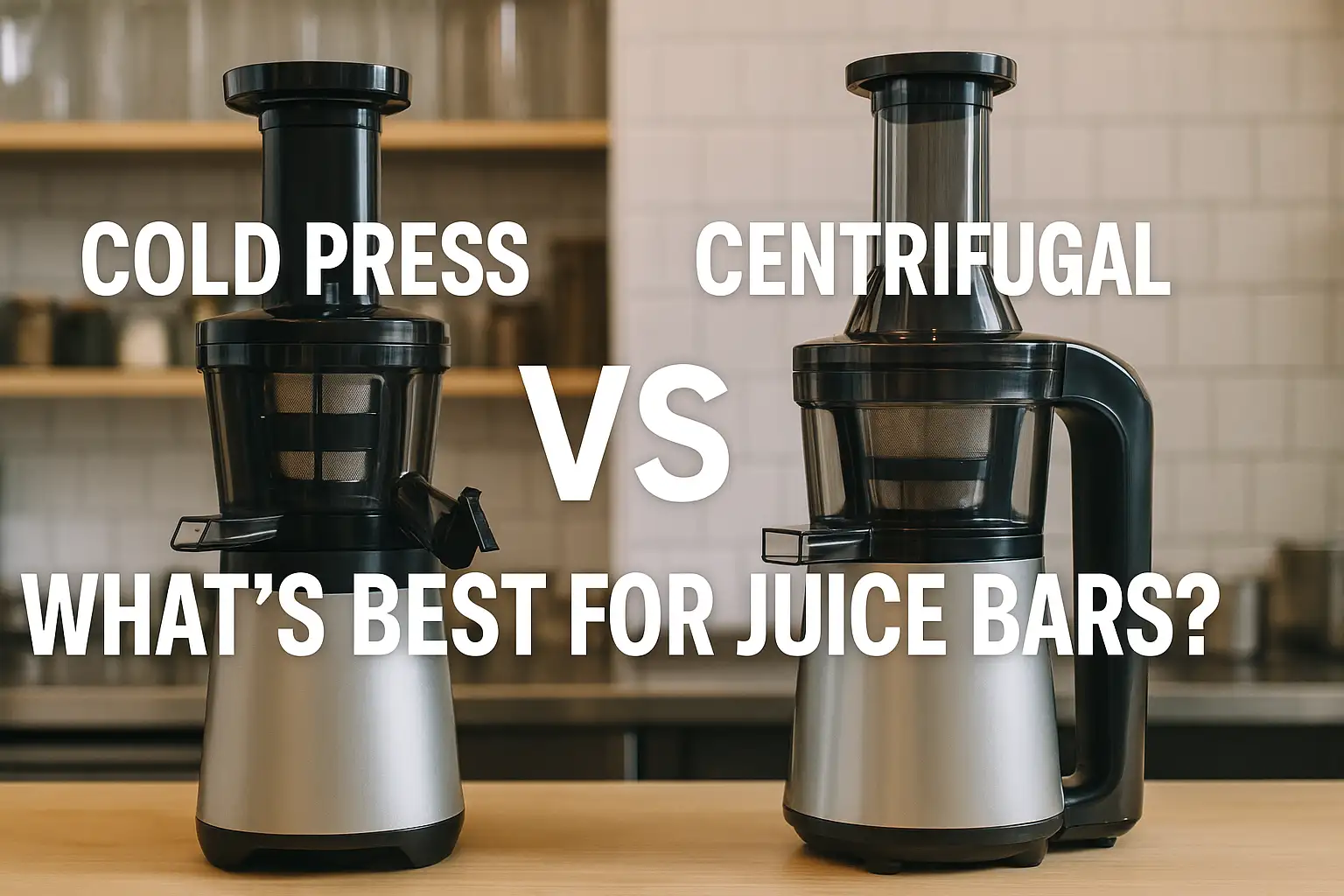
What Is a Commercial Juicer?
A commercial juicer is a piece of equipment designed to produce juice in great quantities quickly. You’ll find these machines at juice bars, restaurants and cafes where high production is essential. Engineered for continuous use, they can handle a variety of fruits and vegetables, from soft oranges to hard carrots.
The focus is on speed and minimum waste. While most commercial juicers are centrifugal or masticating models, you can find cold press machines in this setting. Each kind has its own anatomy and working method, which alters how they process various produce and how frequently they require cleaning.
Advantages:
Commercial juicers get as much juice as possible from every batch. This high yield makes them a smart pick for hectic shops looking to reduce waste and increase profits. The machines operate quickly so employees can serve more customers in less time, especially during peak periods.
A lot of these models cost less up-front than cold press juicers, assisting businesses with their budgets. Versatility is a huge bonus as well. The majority of commercial juicers accommodate a number of produce types—apples, leafy greens, carrots, and even sugarcane if you opt for a roller model. Certain ones have to be chopped or peeled prior to juicing, but they still enable stores to sell a ton of juice alternatives.
We can sum up points as below:
- Fast operation (ideal for rush hours)
- Lower upfront cost
- Suitable for citrus, apples, carrots, etc.
Disadvantages:
One major drawback is that conventional commercial juicers, primarily of the centrifugal variety, introduce heat and aeration while operating. This can degrade some vitamins and enzymes, resulting in juice that’s less nutritious. They are loud, which can annoy patrons seeking a silent reprieve.
Many commercial juicers need regular cleaning and care. Others fall apart if not cleaned following rigorous usage. Machines can be cumbersome and voluminous. No models work well with all types of produce.
One of the issues is that they need to be cleaned often. Since these machines process so much produce, pulp and juice easily get lodged in difficult to clean crevices. Employees might need to disassemble components and clean them frequently, on occasion multiple times a day.
We can sum up points as below:
- Generates heat and oxidation, which can reduce nutrient quality
- Noisy during operation
- Shorter shelf life of juice (must be consumed immediately)
Types of Commercial Juicers
Centrifugal juicers operate by spinning produce at high speed to separate juice from pulp. These are the speediest and most prevalent in hectic coffee shops. Masticating juicers, in contrast, apply a slower, pressing motion. They perform better with leafy greens and produce a higher juice yield.
However, they are more expensive and slower. Cold press commercial juicers utilize a two-stage dual auger system that cracks and presses produce for optimal juice quality. Sugar cane juicers utilize several rollers to crush hard stalks, which is essential for fresh sugar cane juice shops.
Key Considerations
Production capacity is what counts, so pick a machine that can match your daily demand. Some produce, like beets or pineapples, might require pre-cutting to make them fit into the chute. Maintenance is required. Heavy usage = more breakdowns when skipping cleaning and care.
Always pair the juicer type with your menu and customer demands.
What Is a Cold Press Juicer?
Cold press juicers, also known as masticating juicers, utilize a slow and gentle juicing method for extracting juice from fresh produce. Operating at around 52 RPM, these machines are significantly slower than centrifugal juicers, which can reach speeds of up to 12,000 RPM. The defining characteristic of cold press juicers is their use of hydraulic pressure, allowing for maximum juice extraction without heat buildup. This process helps retain more nutrients and enzymes, making cold-pressed juices a favorite among health-conscious consumers.
As more individuals prioritize their health, the demand for quality juice has surged, leading to an increase in the popularity of cold press juicers in homes and juice bars worldwide. Many enjoy the fresh taste and extended shelf life of up to 72 hours that comes with cold-pressed juice, which retains an abundance of vitamins and minerals.
The growing interest in homemade juice and nutritious juice options has made cold press juicers essential kitchen appliances. With the right juicer products reviews, consumers can find the best cold press juicer that suits their needs, enhancing their juicing experience and encouraging a healthier lifestyle.
Advantages
Their greatest advantage, to me, is nutrient preservation. Because they apply little to no heat, the juice retains more vitamins, enzymes and antioxidants. Oxidation is less of a concern as well, meaning your juice will last longer (typically up to 72 hours in the fridge) without sacrificing flavor or nutrients.
Another obvious benefit is the taste and mouth-feel. Cold-pressed juice is typically more concentrated, more velvety and more viscous. Juices of leafy greens such as spinach or kale, or hardy vegetables like carrots and beets, are extracted with potent, fresh flavors and rich color.
This two-stage crushing and pressing method means you get a higher yield and less waste, getting the most from each ingredient. Cold press juicers are most versatile in terms of produce selection. They’re capable of processing soft fruit, hard roots and tricky greens that speed juicers can have a hard time with.
Sum up points:
- High nutrient retention and richer flavor
- Low oxidation = longer shelf life
- High yield from leafy greens and soft fruits
Disadvantages
Cold press juicers tend to be more expensive than conventional centrifugal models. The added cost is due to the complicated manufacturing and the stronger components required to crush fruits and vegetables at slow speeds.
The slow squeeze is not good for anyone who’s thirsty or juicing in bulk. Cold press juicers operate at a snail’s pace, which is an issue in fast-paced environments or for commercial applications.
Maintenance is more laborious. These machines have additional pieces and require extra care post-use. This can be a pain for those of us seeking fast clean-up.
Others find that cold press juicers don’t quite extract as much juice from extremely watery fruits as centrifugal models. Leafy greens and roots give a high yield, but fruits such as oranges or apples can be a little lower.
Sum up points::
- Slower juicing process
- More expensive equipment
- More cleaning steps required
Side-by-Side Comparison Table

Here’s a side-by-side comparison table to illustrate the key differences between commercial juicers and cold press juicers. It allows readers to easily compare how each kind ranks in important categories including speed, juice quality, shelf life and ease of use.
For juice extraction, these tables simplify comparing things like juice yield, pH or even noise levels of each machine. I like this format, it’s straightforward and helps users get a good sense of what suits their needs without having to trudge through paragraphs of copy and industry speak.
For those of you attempting to select the ideal juicer for either commercial or household use, a table presents all the information side-by-side for a convenient, well-informed decision.
| Category | Commercial Juicer | Cold Press Juicer |
|---|---|---|
| Speed | Very fast (10,000+ RPM); cuts prep time; quick for busy settings | Low-speed (typically 40–80 rpm); slow to keep nutrients; ideal for small batches |
| Juice Quality | Moderate (foamy, oxidized); heat and air may lower vitamins; some pulp in juice | Excellent (smooth, vibrant); keeps more vitamins and enzymes; juice is smooth and rich |
| Shelf Life | < 1 hour | Up to 72 hours (chilled) |
| Noise Level | Loud (can reach 70–85 dB); not suited for quiet spaces | Quiet (often under 60 dB); works well in homes or cafés |
| Efficiency Yield | Moderate; waste is wetter; more fruit needed | High; dry pulp means more juice from each fruit or veg |
| Cleaning | Many parts; takes longer to clean | Fewer parts; easier to clean between batches |
| Features | Large motor; continuous feed; handles bulk; built for heavy use | Works with leafy greens and nuts; more options for recipes |
| Best For | High-volume, fast service | Premium juice programs |
It uses easy categories and straightforward comparisons to clarify things. For instance, a juice bar owner who must serve multiple customers quickly will find that a commercial juicer performs best for quick and bulk jobs.
However, it’s loud and requires more cleaning. A homeowner who wants to preserve more nutrients in their morning juice, or a small café who emphasizes ingredient quality, will find the cold press juicer excels in juice yield, quietness, and shelf life.
In research, side-by-side tables like this have compared juice appearance, shelf-life and nutrients retention post-pressing. This allows experts and consumers to examine not only the specifications but the practical compromises.
A few tables even include pictures or charts to indicate pulp texture or color, making it simple to view the results in a quick glance. For readers who have to balance a lot of information, a side-by-side table eliminates guesswork, displaying the information in a manner that’s fast to scan but still rich enough for intelligent decision-making.
Which Is Better for Juice Bars?

Juice bars have special requirements when selecting equipment, focusing on the best cold press juicer for quality juice. Decisions revolve around velocity, quantity, and consumer appetite, as the right juicer molds workflow and brand identity.
a. Cold Press Juicer: For Premium Juice Programs
Cold-pressed juicers satisfy health-conscious consumers wanting more than a quick sip. These machines operate slowly, pressing the produce to preserve more nutrients and enzymes. This approach ensures juices retain color, flavor and nutrition longer than juices made from quick-spinning centrifugal machines.
Cold press juicers are ideal if your business model focuses on nutrition, long shelf life, or take-away bottles. They’re popular in:
- Wellness-focused cafes
- Meal prep & detox brands
- Premium-priced juice menus
b. Commercial Juicer: For Speed & Volume
Busy juice bars have to provide juices to many customers quickly. Commercial centrifugal juicers sparkle here. These machines are quick, producing gallons of juice in minutes—perfect for the juice bar rush!
Centrifugal juicers work well if you need to serve customers quickly with fresh juice made to order. They are suited for:
- Smoothie bars
- Busy mall kiosks
- Budget-friendly juice chains
c. Customer Preferences: Fresh vs. Nutrient-Rich Juice
Others just want a fresh juice to go, not about how it’s made or nutritional content. Some crave juice programs, cleanses, or leafy green and superfood drinks, and demand juice with high nutrient retention. Juice bars must balance menus to satisfy both crowds.
Juice bars might even switch between both types of juicers to suit their different needs. Cold press for green drinks or elite blends, commercial centrifugal for traditional orange or carrot.
This combination keeps service fast but allows the brand to provide exceptional, premium beverages for those who are concerned with what’s going into their cup.
Operational Considerations

Deciding between a commercial juicer and a cold press juicer comes down to how the machine suits your daily juice business needs. A lot of companies have to deal with juice shelf life, noise, machine reliability, and how smooth their daily workflow is. These factors can significantly impact how effectively a juice bar, café, or restaurant can service their customer base and maintain their operation at a low loss.
Juice shelf life is a huge operational consideration in how you plan your day. Cold-pressed juicers, which slowly press fruit and vegetables, create juice that can remain fresh for 3-5 days. This means a business can whip up big batches and store ’em, handy for prepping in advance, or selling bottled juice. It helps manage scrap and provides consistent quality throughout the day.
By comparison, centrifugal juicers are speedier; however, their juice often separates and becomes flat in a matter of hours. This implies juicing more often and less headroom for enterprises that desire to prep ahead.
Noise level is another factor that can define the juicing experience. Centrifugal juicers are fast and noisy, which can annoy patrons seeking a quiet or relaxing atmosphere. This is particularly important in small cafés or open-plan boutiques, where background noise can spoil the mood.
Cold-pressed juicers, although not silent, operate at slower speeds and tend to be quieter. This renders them superior for venues seeking a sedate atmosphere or where patrons convene to converse or work.
Trustworthiness is important in a hectic environment. Downtime from broken equipment can drag down sales and frustrate employees. Cold-pressed juicers are more expensive to purchase and require additional maintenance to maintain their performance. They usually have more components and require detailed cleaning.
They’re ruggedly constructed for hard use. On the other hand, centrifugal juicers are easier to use and cheaper initially, but they require more cleaning and may break down sooner with frequent use. Ensuring the machine is ready to use every day can save time and money.
A checklist for operational planning:
- Juice shelf life: Pick a machine that matches how long you need juice to stay fresh. Cold-pressed for shelf life, centrifugal for instant.
- Speed of service: Choose centrifugal for fast-paced spots; cold pressed if batch prep matters more.
- Noise level: Think about the shop’s atmosphere and customer needs.
- Cleaning and care: Cold-pressed needs more time to clean, centrifugal is quicker but may need it more often.
- Build and reliability: Invest in a machine that matches your expected workload and maintenance plans.
- Cost: Balance upfront cost with long-term needs and the value of less waste or better juice.
OEM Insight: What Distributors Look For

Distributors consider numerous criteria when choosing between commercial juicers and cold press alternatives. It’s not about lining up specs, it’s about aligning products with markets and businesses and end users.
If you’re a B2B buyer sourcing equipment for franchise rollout or international clients, consider the following when deciding which juicer to OEM:
-
Target customer match: Distributors look for juicers built for either wellness-driven markets—where nutrient retention is key—or settings focused on quick service and low price.
-
Compliance and certifications: Products need to meet local codes, such as CE, UL, LFGB, or ETL.
-
Multi-functionality: Distributors value models that can juice a wide range of fruits, hard roots, and even leafy greens.
-
Customization: Options for jar sizes, material choices, and control panels help serve local tastes.
-
Nutrient preservation: Cold press units with slow speeds (40–80 RPM) help keep juice fresh for up to 72 hours.
-
Noise and efficiency: Low-speed, quiet operation is a must for many commercial venues.
-
Shelf life and cleaning: Easy cleaning and longer juice shelf life are essential in busy settings.
-
Material safety: BPA-free, food-grade materials support safety and help build trust.
Target customer segment (wellness vs convenience)
Wellness-focused buyers desire juice with a lot of nutrients, fiber and vitamins. Cold press juicers, which operate at low speeds, preserve more nutrients. Juice bars aiming for these buyers tend to emphasize long shelf life and the capacity to chew through dense roots or leafy greens.
In comparison, convenience buyers desire quickness and cost. They gravitate towards commercial juicers that extract juice quickly, with less attention to preserving nutrients. Understanding the age, habits, and location of customers aids distributors in selecting the appropriate model. For instance, in yoga-infused metropolises, cold press models dominate, whereas fast centrifugal types rule in high-traffic cafes.
Local power standards and certifications (CE, UL, etc.)
Local codes and certifications are a must. Safety and trust are reliant on being tested to standards like CE (Europe), UL (North America) or CB (worldwide). These marks indicate that a product is safe and permissible to sell in the area. Not having these can block you from big markets.
| Region | Standard/Certification |
|---|---|
| Europe | CE, LFGB, CB |
| North America | UL, ETL |
| Asia-Pacific | CCC, PSE |
| Global export | CB, ISO |
Compliance can make or break a distributor’s ability to enter new markets or sign large buyers. Products that aren’t properly certified can be dead on arrival, no matter how cool they are.
BPA-free, food-grade materials
Shoppers everywhere demand safe, toxin-free kitchenware now. For juicers, that’s BPA-free and food-grade plastics and metals. Brands with these characteristics experience more trust and returning buyers, particularly in health-conscious marketplaces.
Safe materials might be more expensive, but they increase perceived value and support higher price points. Having BPA-free to display is now a critical selling point for distributors worldwide.
Ease of cleaning & maintenance (affects return rates)
Cleaning is a crucible. If a juicer’s difficult to disassemble or clean, purchasers might not return. User-serviceable models reduce repair times and increase customer satisfaction. Busy juice bars want machinery that is low-maintenance and infrequently fails.
User-convenience features, such as straightforward cleaning instructions or easy, tool-free upkeep, really stand out.
Custom branding opportunities
Custom branding—whether it’s company logos, colors or special jar shapes—that distinguishes a business. In a saturated juice market, branding makes shops differentiate themselves and repeat business.
Exclusive branded gear equates to increased loyalty and repeat orders.
Cold press models generally appeal more to export clients in Europe, UAE, Singapore, and wellness-driven markets. Centrifugal models are cost-effective and favored in high-turnover markets like Southeast Asia, Latin America, and busy commercial zones.
Reference:
FDA – Food Contact Materials Regulations for Juice Equipment
EU – CE Marking Requirements for Food Equipment
Conclusion
Both commercial and cold press juicers have their place in a modern juice bar’s kitchen. Your final decision should be based on your speed requirements, juice quality expectations, and target audience.
- Choose a cold press juicer for rich flavor, long shelf life, and premium product branding.
- Choose a commercial juicer for speed, simplicity, and low-cost entry.
At ElectMix, we offer OEM solutions for both categories, with full customization, international certifications, and technical support for global distributors. Reach out today to find the best equipment for your juice business.
Frequently Asked Questions
1. Which juicer type gives the longest juice shelf life?
Cold press juicers, known for their cold extraction method, produce juice that can last up to 72 hours when refrigerated, while centrifugal juices typically oxidize within 30–60 minutes.
2. Are cold press juicers too slow for juice bars?
While slower than centrifugal models, modern cold press juicers, known for their ability to produce quality juice, have improved batch speed and are ideal for juice bars offering bottled or pre-made menus.
3. Which juicer is more cost-effective for high-traffic locations?
Commercial centrifugal juicers are ideal for high-turnover juice bars, offering low upfront costs and fast operation for maximum juice extraction.

ElectMix Team provides global e-commerce sellers and distributors with insights on commercial blending solutions, OEM customization, and profitable market opportunities.