Skip to content

- Key Takeaways
- The core differences in blending vs juicing
- How each method impacts nutrition
- Blending vs juicing for business
- Choosing your equipment
- The sensory and culinary experience
- Which One Is Best for Your Business?
- OEM & Custom Equipment from ElectMix
- Conclusion
- Frequently Asked Questions
Key Takeaways
- You retain fiber when blending and virtually lose it all when juicing. Go with smoothies for fullness and digestive benefits, and juice when you prefer a lighter, more rapidly-absorbed beverage.
- You receive different nutrients from each. Smoothies provide fiber along with whole-food nutrients, and cold-pressed juices concentrate vitamins and phytochemicals with less oxidation.
- You metabolize juice more rapidly than smoothies, which can cause a fast energy spike. Smoothies digest more slowly and can help stabilize energy through fiber and balanced macronutrients.
- Smoothies help you manage blood sugar more steadily, particularly when you include protein, healthy fats, and greens. Mostly-fruit juices can cause blood sugar to spike more quickly, so balance with veggies and small portions.
- You get distinct textures and tastes with each. Creamy smoothies are great for add-in versatility, whereas juices are clear, crisp, and can really amplify the flavor of a single ingredient.
- You select your technology based on your objectives and business strategy. Smoothie machines fit high-volume blended menus, centrifugal juicers provide quickness for made-to-order freshness, and cold-pressed juicers bring premium status at a premium price.
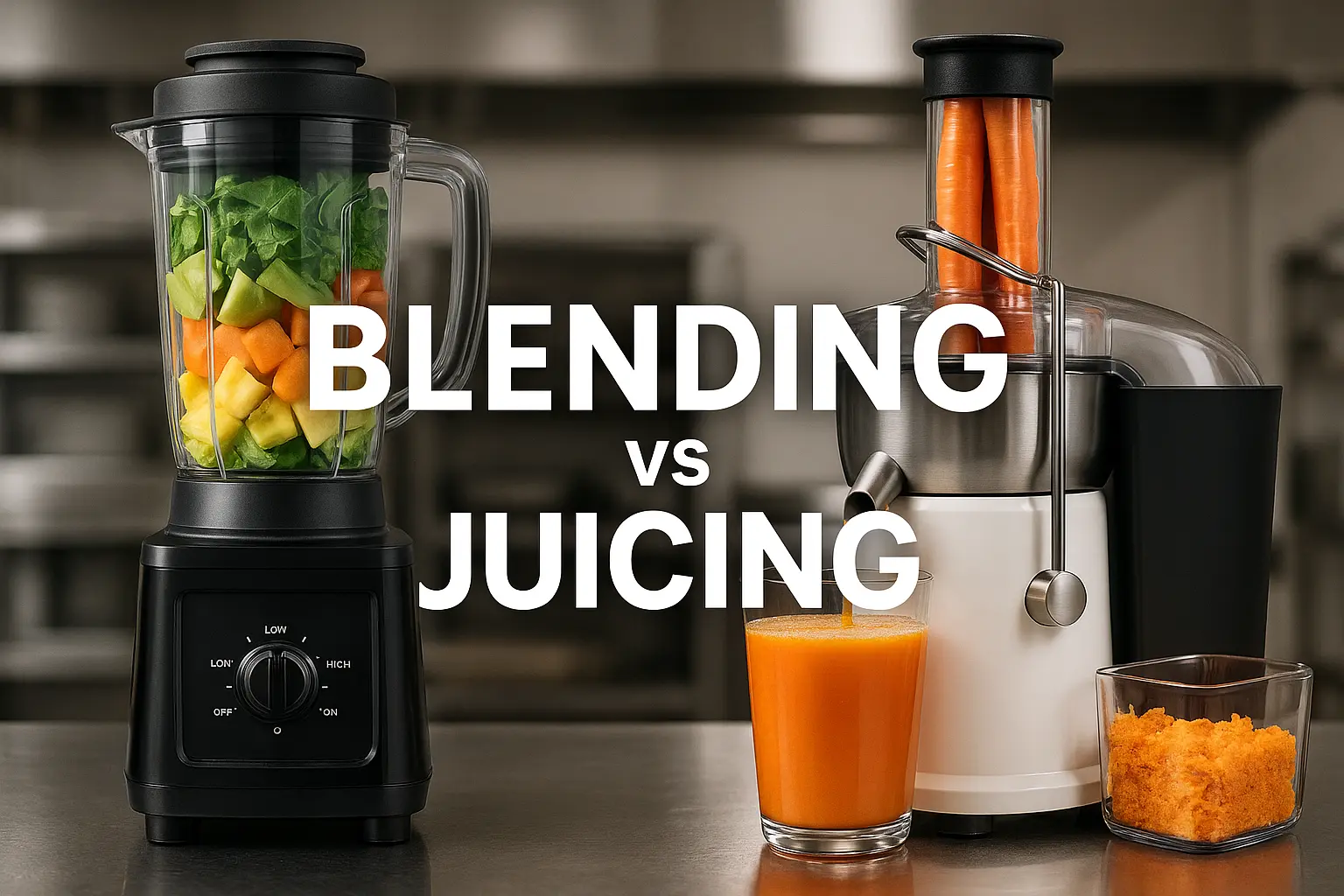
Blending vs juicing provides you with two methods to transform fruits and veggies, with obvious compromises you need to consider.
You retain fiber with blending, which promotes satiety, gut health, and steady glucose. You receive a smoother, lighter beverage with juicing, which can deliver more micronutrients per 250 ml but increases sugar load more quickly.
You select according to objectives such as digestion, calorie control and texture. To keep it simple, you’ll find side-by-side facts, use cases and tips below.
The core differences in blending vs juicing
You’re deciding between two juice extraction techniques that alter the form in which your nutrients arrive, the speed at which you digest them, and your satiety. Both use the same produce, but the mechanical press juicing and blended juices yield different mechanics and end results.
1. Fiber content
Blending retains the entire fruit or vegetable—skin, seeds and all—therefore your beverage contains the majority of insoluble and soluble fiber. That fiber decelerates the emptying of your stomach, promotes gut health, and keeps you satiated.
A blended concoction of spinach, banana and oats provides the roughage to knock out mid-morning hunger.
Juicing extracts liquid and leaves pulp behind. You get way less fiber, sometimes close to zero depending on the press and strain. A carrot-apple juice tastes airy and fresh, but it doesn’t satiate like a carrot-apple smoothie with chia.
2. Nutrient density
Juicing requires a smaller volume by concentrating vitamins and minerals. You can consume the micronutrients of 500 g of carrots and oranges in a single glass. That can come in handy when you need a quick hit of vitamin C or potassium and your appetite is thin.
Absorption might be rapid because there’s minimal fiber to decelerate it. Blending suspends nutrients across fiber and water, so the dose per sip is smaller, but you retain phytonutrients in skins and seeds that may get consigned to the pulp bin.
You get space to throw in add-ins—ground flax for omega-3, a protein powder or some yogurt—so the overall nutrient profile can be more diverse even if the juice’s per-milliliter vitamin content seems higher.
3. Digestion speed
Unlike smoothies, juices pass through the stomach quickly. That can be feeling light before a workout or when you need fast energy. The trade-off is that it fills you up for less time.
Smoothies require more effort to digest. Fiber and thicker texture slow gastric emptying and blunt a rapid rise in blood nutrients. If you sip a berry–oat–almond smoothie, you’ll probably stay full longer than after a berry juice.
4. Blood sugar
Fruit-heavy juices spike blood sugar because sugars are concentrated and fiber is minimal. If you juice, incorporate more low-sugar greens (cucumber, celery) and add lemon or ginger to maintain a modest sugar level.
Smoothies tend to digest better on blood sugar because of fiber, fat and protein. Add-ins, however, like sweetened yogurt, honey, or flavored syrups can push sugars high.
Better options include unsweetened milk or kefir, nut butter, seeds, and whole fruit in portions of about 80–120 g each.
5. Final product
Blending provides a thick, pulp-laden beverage with discernible texture–you’re tasting the entire plant. It’s forgiving for add-ins, meal-esque and travel-friendly.
Juicing produces a silky, liquid potion that’s easy to guzzle down quick. Some utilize it for brief “cleanses,” touting rapid absorption, while others long for the satiety fiber provides.
How each method impacts nutrition

Both mechanical press juicing and household juice extraction techniques modify what you obtain from the same fruits and vegetables, impacting the fiber, particle size, air exposure, and how blended juices manage heat and speed.
The smoothie advantage
With blending, you retain the nutritious skins, seeds (when safe) and pulp. That is, you retain virtually all the dietary fiber, which slows sugar absorption, stabilizes your energy, and nourishes your gut. Fiber also transports bound polyphenols that can make it to the colon, where your microbiome can put them to use.
If you toss in kiwi with skin, or add leafy greens and flaxseed, you’ve got way more fiber and omega-3 fatty than juice. Among other reasons, this is why blended drinks tend to retain more omega‑3s from greens, chia or ground flax.
Particle size is important. A high‑speed blender breaks cell walls and helps release carotenoids from mango or beta‑carotene from carrot, which can increase absorption. Yet the same turbulence also entrains air. More air accelerates oxidation of vitamin C and some polyphenols if the drink sits.
You can minimize this by blending cold and filling the jar as much as possible to reduce headspace, adding citrus and drinking within 15–20 minutes. Blending’s nutrition is adaptive as well. You can add yogurt for protein, nut butter for fat or oats for beta‑glucan.
That combo controls glycemic surges and keeps you feeling satiated for longer. For global use, think simple 250–300 g mixes: banana, spinach, yogurt; or mango, carrot, lime, and chia.
The juice advantage
Juicing removes the majority of insoluble fiber but may increase the amount of some antioxidants in the juice, particularly in certain fruits. In apples and mandarins, research indicates greater ascorbic acid, total polyphenols, and flavonoids in juice vs. Blends.
In apples, pear and mandarin, the ascorbic acid level is frequently much higher in juice, in part because pulp removal reduces water-binding fiber that can hold in antioxidants, leaving you with a more concentrated solution per milliliter.
Antioxidant activity shifts with extraction. Cold‑press and slow masticating juicers generally produce more antioxidant activity than fast centrifugal models, which incorporate heat and air. In citrus, vitamin C can provide approximately 65–100% of total antioxidant capacity, and therefore fresh orange or mandarin juice offers formidable radical-scavenging ability.
Organic acids count as well. Citric, malic, and ascorbic acids promote pH, taste and antioxidant stability that can support shelf-life when stored chilled and sealed. Whole‑fruit juicing (pressing peel and membranes when edible and safe) can provide more polyphenols than juicing just the flesh.
Example: whole‑pressed grapes or pomegranate raise flavonoids compared with flesh-only juice. To minimize nutrient degradation, keep produce cold, press quickly, store in an opaque, air-tight container and consume within 24 hours.
Blending vs juicing for business

You’re considering two business models with fundamentally different expenses, processes, and consumer rewards. Blending, particularly when creating green smoothies or blended juices, preserves fiber and produces thicker drinks, but restricts how many nutrients you can cram into each drink. On the other hand, mechanical press juicing eliminates fiber and concentrates micronutrients, enhancing the antioxidant capacity, but increases expense and waste. It’s your call, based on equipment, ingredient spend, throughput, and your guests’ expectations.
Smoothie shops
If you want speed, low waste, and simple training, blending is easier to start and scale. One benefit of starting a smoothie program is that equipment costs are almost nothing in comparison to juicing. You can survive with a high-powered commercial blender, cold storage and a rinse sink.
Prep is lighter, and you can depend on frozen fruit to stabilize pricing and reduce perishability risk. Menus are fluid. Build with fruit, greens, dairy or non-dairy bases, nut butters, seeds, oats and ice. This lets you score world flavors with simple substitutions—banana–spinach, mango–ginger, or cocoa–peanut.
Texture is part of the worth, and visitors anticipate fullness. Portions of 350–500 ml work in most markets. Margins are steadier than juicing since you can use frozen inputs and standardized scoops. Speed matters: a blender cycle is often under 30 seconds, which fits all-day foot traffic.
Blending reduces the nutrient density you can cram into a single drink, compared to juice, and health-centric visitors might perceive this as less “powerful.
Juice bars
Juicing requires a business juicer and additional work for wash/cut/press/cleanup. Produce is so perishable, and prices are tied to season and supply swings, that maintaining high profit margins is difficult. One of those rules of thumb is with commercial juicing, ingredients should be no more than 30% of the final price.
In reality, this is hard when ginger, berries or leafy greens soar. You do gain a clear value story: concentrated micronutrients and clean texture. Cold-pressed combos—apple–kale–lemon or carrot–orange–turmeric, say—indicate purpose. Bottle sizes of 250–300 ml are typical and maintain price points accessible.
Plan for waste and trim: batch small, cross-use pulp in baked goods if local rules allow, and lock supplier terms. Customer expectations tilt towards “clean” recipe with clear labeling. Demand peaks in morning and midafternoon, co-locating in restaurants with all-day traffic smooths volume.
Health cafes
If you operate bowls, salads, and light plates you can provide both, but be explicit on ROI and guest intent. Juices satisfy the “nutrient shot” use case, while smoothies serve the “meal bridge” use case. Train staff to describe nutrient extraction vs texture differences in 1 line so guests self-select fast.
Stock one high-watt blender per station, and one small cold-press or centrifugal unit for a pared-down juice list. Maintain 6–8 key SKUs that follow wide flavor tendencies—citrus–mint, pineapple–mint, beet–apple—but don’t pursue crazes that expand inventory.
Utilize metric recipes for uniformity, and keep juice COGS at or under the 30% goals with seasonal substitutions. Monitor ROI weekly: sales mix, waste %, prep time per ticket, and repeat orders. If volatility increases, steer towards blends for steadiness. If your demographic yearns for function-forward shots, root 1 or 2 juices and charge accordingly.
Choosing your equipment
When selecting your equipment for juice extraction techniques, consider how you prefer to drink your produce, the time you have, and the space and budget you can dedicate. The texture and speed of fresh juice, along with noise and cleanup, vary with the machine, so choose a tool that aligns with your daily consumption needs.
Smoothie machines
Our standard blenders handle soft fruit, leafy greens, and ice, making them ideal for daily green smoothies. High-powered models (over 1,000 W) can pulverize fibrous stalks, nuts, and seeds, producing a silkier blend with less gritty bits. If you’re in the mood for nut butters, tahini, or frozen fruit sorbet, opt for the high-power level to maximize the quality of your blended juices.
For hot foods, seek out units rated for hot liquids or with thermal control to prevent soups from overheating and minimize steam splash. Pitcher size counts if you batch prep. 1.5–2.0 L jars accommodate most households. Single‑serve cups are perfect for small kitchens and fast breakfasts.
Variable speeds and a real pulse key assist you adjust consistency, from thick smoothie bowls to thin drinkable blends. While stainless blades keep their edge longer than stamped blades, the jar design — vortex shape, baffles, or tamper — usually has a greater effect on smoothness than blade quantity.
Noise can be significant, especially with high-powered motors, so sound shields are a good investment. Check the cleaning features: a wide-mouth jar that fully disassembles saves time. Durability is evident in the drive socket, where metal outlasts plastic, and a good warranty is essential. If you enjoy fresh juice that’s pulpy and full of fiber, a quality blender is your most straightforward route to achieving your nutrient needs.
Centrifugal juicers
Centrifugal juicers rely on a high‑speed spinning blade pressed against a mesh filter to extract juice from pulp. They’re most effective with hard produce such as apples, carrots and beets. The feed chute tends to be wide, so prep is quick, and speed is high. This is great when you need juice in under a minute.
You exchange some yield and foam for speed. The quick spin whips in air that can alter mouthfeel and produces a lighter, frothier head. Taste trends bright but less full-bodied than slow juicing. If you enjoy clear juice and don’t mind a little foam, these are convenient.
Noise is remarkable. Cleanup – brand dependent, fine mesh baskets need a brush and TLC. Seek multiple speeds to tackle soft and tough materials, along with a durable locking arm for security. This is the convenience option.
Cold-pressed juicers
Cold‑pressed (masticating) juicers grind produce with an auger, then press through a fine screen. They operate at low speed resulting in less foam and heat and better yield, particularly for leafy greens, herbs and wheatgrass. Texture is silkier and creamier than centrifugal juice, with less separation.
Coarse and fine strainer models allow you to select between more body or ultra‑clear juice. Some of those come with a citrus juicer attachment or even a homogenizing screen for nut butter or frozen “nice cream,” making them a little more versatile than juice alone.
Others swear by a manual juicer for citrus – it’s inexpensive, silent and easy to clean. Anticipate slower production and additional components to wash. Noise is lower than centrifugal. If you cherish maximum extraction, lower oxidation, and pulp control, this is it.
Look at the build quality of the auger and gearbox, the length of the warranty, and how easily you can find spare screens.
The sensory and culinary experience
HOW YOU PROCESS PRODUCE ALTERS WHAT YOU EXPERIENCE IN THE GLASS AND HOW FILLED YOU FEEL AFTER. Smoothie blending, especially when using a quality blender, retains fiber and fine plant solids, creating nutrient-rich green smoothies. Juicing, through various juice extraction techniques, removes most fiber, resulting in a lucid, quick-suck beverage like fresh juice.
Texture
Smoothies are thick because the entire fruit or vegetable remains in, including pulp, skins, and seeds (if safe to blend). This allows for the nutritional benefits of blended fruits, as you receive the fine grit from berries, the creamy body from banana or avocado, and a shake-like mouthfeel with oats or nut butter. Many of us find this additional body more satisfying — the soluble fiber delays gastric emptying, boosting satiety after such a large glass of green smoothies.
For a smooth and silky texture, blend longer, add more liquid, or strain once. If you prefer rough or crunchy notes, skip processing and add toppers such as toasted seeds. Juices, in contrast, are airy and fluid, with minimal solids, allowing you to guzzle fast. The flavors hit at once because fiber no longer cushions them, creating a different experience from drinking smoothies.
The color remains intense in both, but juice usually appears more brilliant since it’s more transparent, which can elevate the apparent taste prior to tasting, making fresh juice a delightful option for many.
Flavor
Without the fiber, juice is more sharp tasting and straight forward. Citric and malic acid, in particular, are elevated, increasing freshness and tart snap, while sugar tastes sweeter thanks to expedited contact with taste buds. Aroma takes off in a hurry as well, with volatile compounds flying around, and smell engaging salivation and appetite, making that little glass seem more ‘alive.’
Mixtures stifle hard angles. Fat from yogurt or nuts soothes acidity, and fiber cools sweetness. Sprinkle in some citric acid to enliven a flat mix, or squeeze in lemon for the same lift + fragrance. Vitamin C (ascorbic acid) helps protect color and flavor against browning. A little added in either method inhibits oxidation, keeps greens vibrant, and can impart a subtle, fresh tang.
Satiety tips in favor of mixes. More dense, more fiber and protein makes you feel full longer. Juice is at best a quick flavor shot or pre-workout carb boost, not a meal.
Versatility
Blending works like a mini kitchen: smoothies, chilled soups, nut milks, sauces, and batters. You govern your body—drop in ice for fluff, or oats for cream, or chia for gel. Keep flavors balanced with acid-sweet-salt: mango plus lime, spinach plus pineapple, cocoa plus banana plus a pinch of salt. Incorporating green smoothies can enhance your nutrient intake.
Juicing is great for clean combinations and layered tasting flights. Pair apple with ginger for heat, carrot with citrus for brightness, or beet with lemon to cut earthiness. Short shelf life is real—store in the fridge in a sealed, full bottle and add ascorbic acid or lemon to hold color and taste. Fresh fruit juices can also provide numerous health benefits.
For nutrients, both surrender some to air and light—blend or press cold, cap quick and drink quick. Utilizing different juice extraction techniques can maximize the nutritional value of your drinks.
Which One Is Best for Your Business?

You need a beverage program to suit your menu, budget, and workflow. Blending and juicing, including fresh juice and blended juices, both have a strong global market, but vary in price, speed, nutrition, taste, and daily effort. It all depends on your idea, volume, and margin goals.
Business Type
For QSR, cafés, fitness studios, and hotels, blending tends to jive better. You probably already own blenders, so equipment expenses to start smoothies are nearly nil. A solid commercial blender can go all day, powers through frozen fruit, and accommodates add‑ins like protein or oats with minimal effort.
Juicing fits cold-pressed or wellness-led brands, high-end grocery bars and spas where a crisp, airy texture and price point is anticipated. It can support a brand based on fresh, seasonal ingredients and detox-like menus. You’ll require room for produce preparation, pulp bins, and cleaning.
If you operate a hybrid program, rely on smoothies for velocity and margin, and cycle a limited number of juices as hero items. This maintains work manageable and stock more consistent across locations and times of year.
Best Fit
Pick blending when you want high volume, maximum flavor versatility and healthy margins on a large population. Smoothies are seconds, travel well, and work for breakfast, lunch and late night. Global tastes—mango-spinach, banana-peanut, berry-yogurt—are simple to commoditize.
Pick juicing for premium positioning and lighter mouthfeel. Carrot-ginger, celery-cucumber and beet-apple go great, particularly where guests request low-fiber, crisp beverages. Expect slower service and more expensive price per cup to preserve margin.
For nutrition‑forward menus, note the fiber debate: blending keeps the fiber, which helps satiety and steadier energy. Juicing eliminates the majority of fiber, resulting in rapid absorption and a purer flavor. Both continue to be healthy choices, and both get guests at goal for the day in fruit/vegetable servings.
Why
ROI depends on maintenance and electricity consumption. Commercial juicers require daily pulp disposal and more frequent parts replacement — costing an average of $0.12 per serving in maintenance. In contrast, commercial blenders require blade maintenance less frequently, pulverize frozen ingredients with ease, and utilize approximately 18% less energy per serving — which accumulates over extended shifts. This efficiency makes them ideal for producing green smoothies and other blended juices.
Throughput and durability count. A powerful blender can blend all day long with fewer pauses, making it suitable for creating a variety of juiced foods. Juicers provide excellent clarity but are restricted in continuous service because of cleaning and pulp handling, which reduces queues during busy hours.
Economics of menu vary. With juicing, keep ingredients 30% or less of your final price. That generally translates to prudent yield watching on leafy greens and heavy roots. Smoothies are the most forgiving as frozen fruit, yogurt and ice stretch volume and hold flavor.
Fads come and go, but the appetite for both juices and smoothies remains robust. Plan seasonal rotations — citrus in winter, melon in summer — and maintain a core lineup year-round so your crew can prep quickly and waste less while maximizing the nutritional benefits of whole food blends.
OEM & Custom Equipment from ElectMix

You design equipment to suit a menu, a marketplace, and a price point, including industrial juicers for fresh juice and blended juices. ElectMix provides your OEM routes for blenders, allowing you to define precise specs and scale with less risk.
What drives your choice?
Begin with applications. Juicers extract raw nutrition from produce with low fiber into the cup; great for transparent juices, quick hydration stops and cleanse bars. Blenders tackle liquid and solid builds—smoothies, sauces, nut butters, frozen bowls—giving you wider recipe variety from a single foundation.
Think ROI in long term. Energy and maintenance swing margins greater than sticker price. Across comparable output, commercial blenders require approximately 18% less power per serving than juicers.
Juicers, particularly cold‑press, tend to be greater on wear components and cleaning time. If you’re selling higher ticket size premium juice, the yield can offset costs. If you push volume smoothies – energy savings might stack even quicker.
Specify what you need
Dial in motors by duty cycle: continuous-run lines need higher torque and thermal protection. Front-of-house builds favor low noise and quick-cool housings.
Pick plug and voltage to specific country codes, multi-site rollouts. Frozen fruit or ice, food programs, spec blade metallurgy and jar geometry for cavitation control. For cold-press juice, specify press force, mesh size and feed rate associated with your produce mix.
Need safety interlocks, IP rates for wet bars, or sealed bearings for sandy or dusty resort sites? For cleaning, request tool-less parts and dishwasher safe components to reduce downtime.
Match regional demand
Trends go by region. North American smoothie chains rely on high-speed blenders for fast casual menus and personalized add‑ins. A lot of European organic shops are buying cold‑press juicers for translucent, shelf-stable SKUs.
In the Middle East and Asia, hotels and cafés often run both: blenders for shakes and fruit drinks, juicers for fresh shot bars, and paired grinders for spices or nut pastes.
If you run a multi-region brand, ElectMix can replicate the same UI across machines but interchanges motors and plugs per market, so training remains straightforward.
Plan the line, not just the unit
For high volume juice, set up multiple juicers in parallel with staged pre-wash and pulp ejection to maintain constant throughput. For frozen workflows, opt for industrial blenders with programmable cycles, jar cooling and sound enclosures to maintain a peaceful front counter.
Map maintenance: stock blade kits, gaskets, and screens on a 6–12 month cycle. Track energy by kWh per litre output to benchmark sites.
ElectMix OEM supports both paths, so you can pilot, then roll out on the same core frame + local tweaks.
Conclusion
You’re familiar with the compromises by this point. Blending retains the fiber and delivers thick beverages. Juicing provides clear juice and strong flavour. Your choice depends on objectives, expense, and the ‘menu’ you wish to present. For a cafe, smoothies can increase ticket size with add-ins like oats or yogurt or nut butter. For a juice bar, fast shots and bright blends travel fast and shelf-stunning. They can work in tandem. So, a green juice for get-up-and-go, plus a mango-spinach smoothie for more sustenance.
To keep waste down, portion by cup size (ml). Record prep time per beverage. Try the flow in a real rush! Want equipment for your strategy. Contact ElectMix for a quote and a quick demo.
By partnering with ElectMix, you gain access to high-performance OEM blending and juicing solutions tailored for global B2B needs.
Contact us now to request an OEM quotation and product catalog tailored to your region.
Frequently Asked Questions
1. What is the difference between a blender and a juicer?
Blenders retain the entire fruit or vegetable, including fiber, while juicers extract only the liquid by separating out the pulp.
2. Which is healthier: blending or juicing?
It depends on your nutritional goal—blending provides more fiber for satiety, while juicing delivers more concentrated vitamins quickly.
3. Can I use a blender to make juice?
You can blend and then strain, but true juice extraction requires a dedicated juicer for optimal results and smoothness.
4. Which equipment is better for commercial use?
Blenders are faster and more versatile for thick drinks; juicers are ideal for cold-pressed or premium health beverages.
5. Does ElectMix offer both OEM blenders and juicers?
Yes, ElectMix provides customizable commercial-grade blenders and juicers with certifications, OEM branding, and international plug options.

Marketing & Product Lead at ElectMix | Innovating Commercial Blenders & Home Appliances | Driving Growth & Development