 Skip to content

- Key Takeaways
- Introduction
- Key Blender Features E-Commerce Sellers Must Know
- Commercial vs Domestic Blenders: What’s the Difference?
- What E-Commerce Sellers Need to Consider
- Working With A Blender Manufacturer: Key Questions to Ask
- Case Example
- A Sample Workflow from Concept → OEM Development → First Batch Delivery
- ElectMix’s Approach
- Conclusion
- Frequently Asked Questions
Key Takeaways
- Commercial blenders satisfy increasing demand for high-performance blending at home and businesses and provide e-commerce sellers with entry to expanded margins. Market products as commercial-grade to attract foodservice operators and health-conscious consumers.
- Private label and OEM options allow brands to quickly differentiate and respond to trends. Ask for samples, finalize your customization specs and map out seasonal designs to spur repeat buying.
- Concentrate on key attributes — things buyers care about like 1000 W or higher motors, high RPM, stainless steel blades, noise reduction, programmable controls and certifications. Feature sound enclosures, tough builds and obvious applications such as smoothies, soups and frozen drinks.
- CE, ETL, and FDA food-contact certification build trust and mitigate risk. Show certificates and badges in listings and have documentation at the ready to prevent customs delays and recalls.
- Consider packaging, logistics and after-sales support – and how you will scale these operations. Protective eco-friendly packaging, explain minimum order quantities, match fulfillment/warehousing to forecasts, warranty/parts support.
- ElectMix backs OEM and private label projects with quality, industry-leading noise and blade technologies, and dependable supply. Get an early start with ElectMix to coordinate branding, lead times and compliance for a seamless launch.
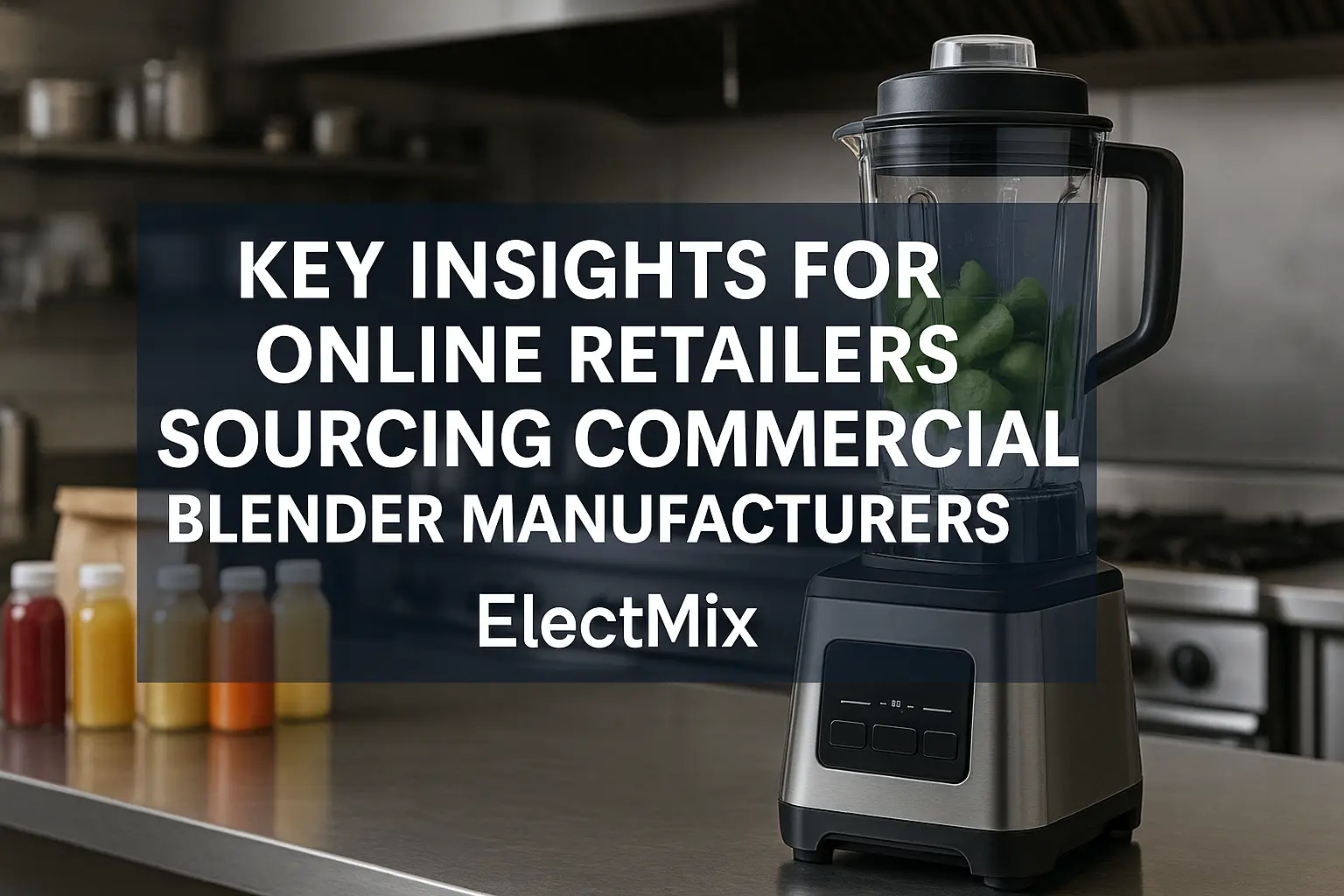
A commercial blender is a high-powered workhorse designed for quick, repetitive tasks in cafés, restaurants, and busy home kitchens. Standard models come with motors rated over 1,200 watts, long-lasting stainless steel blades, and large-volume jars ranging from 1.5 to 2 liters.
A lot of models pack on noise shields, variable speed, and preset cycles for smoothies, sauces, and ice. To assist you in making wise selections, the principal body of the reviews performance, construction, safety, upkeep and price, with specific examples and specs.
Introduction
Commercial blender demand is surging throughout e-commerce as consumers anticipate café-quality performance at home and reliable output in bustling kitchen environments. Sellers require transparent insight into specifications, benchmarks and manufacturing routes in order to price, position, and back these machines with less peril.
OEM, white- and private label routes enable faster market entry and brand growth at various cost levels. ElectMix answers that space as a stable manufacturing partner, constructed for volume supply, compliance, and custom specs.
Why E-commerce Sellers Are Now Sourcing Commercial-grade Blenders
Consumer demand for high-powered blending surged with international smoothie bars, protein cafés, and meal-prep culture. Consumers want smooth smoothies, hot soups and nut butters without stalls or grit. Restaurants, bars, hotels, require that same output shift-by-shift.
A commercial blender is a serious piece of foodservice equipment — engineered to tackle heavy duty tasks without breaking a sweat. Commercial units provide more torque, thicker shafts, and beefed up couplings.
Thanks to state-of-the-art cooling mechanisms, the motors stay cool even during rush hours, so the motor remains protected as it races through batch after batch. In good hands, a premium model can go 7–10 years in a professional setting, which reduces cost per coffee or plate.
Margins get better online, too, because pro-grade bikes can command more expensive prices—thanks to durability and performance. Sellers can pile on value with accessories, extended warranties, and service plans. Bundles with additional jars or tamper tools increase aov.
Industrial models appeal to chefs who require quick, consistent results and to wellness-conscious consumers who demand whole-food blends. Preprogrammed cycles—typically 30 to 42—encompass smoothies, soups, sauces, and milkshakes, enabling teams to just hit one button and go.
Interchangeable containers allow you to switch from salsa to drinks with no cross-flavor. Sizes vary between 1.4 L (~48 oz) all the way up to large jars for batch prep.
Rise of Private Label Kitchen Appliances
Our private label blenders allow your brand to stand out with custom colors, lids and jar shapes, while retaining tested core components. This provides a distinct advantage on crowded product pages and search results.
OEM and white-label routes provide flexibility. Start with a base motor platform, program power and preset cycles, then brand marks and packaging and inserts. Trade vessels for food or beverage pipelines.
Provide 220–240 V for certain regions and 50/60 Hz where necessary. These paths accelerate fashion reaction. If users request quieter lids, pulse modes for acai bowls or dishwasher-safe jars, revisions can slip into the next batch.
Private lines create loyalty. Repairs, spare jars and reliable recipes generate repeat buys and fewer returns. ElectMix backs this with rock-solid tooling, QC and parts continuity for multi-year programs.
Key Blender Features E-Commerce Sellers Must Know
Purchasers look for evidence that a good blender will blend with precision, endure under pressure, and be safe to operate. Highlight commercial blenders‘ specs and practical use-cases, then support them with certifications and warranty.
- Motor power (≥1000 W) and high rpm for tough loads
- Advanced blade geometry; stainless steel, food-safe materials
- Preprogrammed cycles; custom profiles; intuitive controls
- Noise reduction; sound enclosure; durable housing and jar
- Safety interlocks; overload protection; auto-shutoff
- Certifications (CE, ETL, FDA compliance), clear warranty terms
Motor Strength & RPM

The robust motor, usually 1000 W or above, powers through ice, frozen fruit, nuts, and fibrous vegetables without stalls, making it an ideal choice among commercial blenders. The high RPM and advanced design help break cell walls and cut blend time, which is crucial during peak periods. This countertop blender showcases features like continuous and peak power, ensuring buyers know the mixer won’t overheat during back-to-back orders.
Tasks tied to power include creating 1.5 L green smoothies in under 45 seconds, crushed ice for frozen drinks, and even hot soups from puréeing cooked veggies. With the ultimate blending technology, it can produce nut butters and thick sauces efficiently, providing exceptional beverage blends and consistency.
Include actual numbers where you can, such as batch volume in liters, typical blend cycle times, and sound levels at max. These specifications highlight the functionality and versatility of this high power motor, making it a standout choice for both professional kitchens and home kitchen models.
Blade Design & Material
Food-grade stainless steel blade resists corrosion and holds an edge. Multi-level or wing-tip geometries pull ingredients down, minimize cavitation and provide silkier texture with less stops.
Vendors – specify blade count, angle and fixed or removable assembly. Specify cleaning steps (rinse-and-pulse, dishwasher-safe jars) and how frequently to replace bearings or seals.
Provide replacement blade kits and part numbers. Basic graphics or a marked-up drawing assist purchasers contrast blunt vs sharp, serrated vs smooth, and upward vs downward sweep blades.
Programmed Settings
Preprogrammed cycles maintain results consistent over staff shifts. Custom profiles include smoothies, frozen drinks, soups, dips and purées, each with timed pulses and ramp-ups.
Icon-driven interfaces and one touch start slashed training time and minimized mistakes.
| Setting | What it does | Benefit |
|---|---|---|
| Smoothie | Pulse + ramp to high | Even texture, fewer air pockets |
| Frozen drink | Higher torque bursts | Fast ice crush, less melt |
| Soup | Longer mid-high run | Warm, silky finish |
| Sauce/Dip | Short, low pulses | Chunk control |
Market custom cycles for signature recipes and lockable panels to avoid tampering.
Noise Level & Durability
Quiet units complement cafés, bars and open kitchens. Sound enclosures and airflow tuning make a clear difference during rushes.
Mark decibel ranges at high speed, and mention isolation mounts or proprietary dampers. Durability signals trust: metal drive sockets, die-cast bases, BPA-free, impact-resistant jars, and shockproof feet.
List anticipated lifespan in hours or cycles, as well as warranty conditions on motor and components. Examples: 2-year motor warranty, 1-year parts, tested for 10,000 cycles.
Commercial-grade Certification

List certifications in the gallery and specs: CE for EU markets, ETL for electrical safety, and FDA-compliant food-contact materials in the U.S. These marks indicate that the blender complies with safety, sanitation, and electrical standards.
Certified models are preferred by professional kitchens and clear inspections more quickly. Place every mark by the buy box and in datasheets to decrease pre-sale inquiries.
Commercial vs Domestic Blenders: What’s the Difference?

Commercial blenders are designed for non-stop shifts in hectic kitchens, whereas domestic machines are appropriate for light, once-a-day tasks at home. These gaps manifest themselves in build, power, duty cycle and lifespan–along with the corresponding price.
| Feature | Commercial Blender | Domestic Blender |
|---|---|---|
| Intended use | Continuous, 50–100 cycles/day | Intermittent, 1–2 cycles/day |
| Motor power | 1000–2000+ W | 300–1000 W |
| Build | Heavy-duty alloys, reinforced jars, cooling | Lighter plastics, basic seals |
| Batch size | Larger jars (e.g., 1.5–2.5 L) | Smaller jars (e.g., 1–1.5 L) |
| Performance | -Conquers ice, frozen fruit, fibrous veg | -Struggles with tough loads | RPM boasts | Rated at load, less drop | No-load RPM can fool | | Lifespan | Multi-year under heavy use | Shorter under heavy use | | Price & warranty | Premium price, professional warranties | Lower price, basic warranties |
Design, Pricing, Performance, Lifespan
Commercial designs utilize tougher housings, metal drive sockets, and high-durability bearings, making them ideal for professional kitchens. Cool paths and thermal protection keep motors stable on back-to-back runs. Domestic units, however, prioritize small size and price, performing well with smoothies, sauces, or soft foods. Unfortunately, seals and couplers wear out quickly under strain, leading to potential waste ingredients over time. Price reflects parts and duty cycle, and while a cheaper blender may seem like a victory now, upkeep and repairs can add hundreds over its lifetime.
Pro units, such as those featuring advanced design and high power motors, can be more expensive initially but bypass downtime, particularly when service lines are lengthy. The vast majority of domestic motors range from 300 to 1000 watts, while commercial blenders generally run 1000 to 2000 watts or more, ensuring perfect consistency even when slicing through ice and frozen fruit without stalling.
RPM specs are often deceptive; most brands measure at no load, and real blending slows the blade. Sellers should state expected lifespan by duty cycle (e.g., 50 cycles/day) and describe care, including gasket checks and blade assembly inspections. Providing clear information on maintenance can help ensure the longevity of the item.
It is crucial to provide obvious levels—entry pro (1000-1200 W), mid (1500 W + noise shield), and high output (1800-2200 W for large batches)—with clear pricing and warranty information. This transparency helps consumers make informed decisions when selecting the ultimate blender for their needs.
In summary, while domestic blenders may be appealing due to their lower cost, investing in a commercial model with features like proprietary airflow innovations can lead to better performance and less hassle in the long run. Understanding the differences between these models will guide you to the right choice for your home kitchen or professional setup.
Why E-commerce Brands Should Choose Commercial Units
Commercial blenders are designed to slash returns and support tickets, as their robust motor and coupling endure difficult loads and high-volume usage. This stability not only supports ratings but also keeps logistics costs low. With a 2.0 L jar, these high-quality blenders can serve cafés, bars, test kitchens, and even high-use homes, making SKU management easier and forecasts cleaner across various markets.
The term “professional-grade” stands out in advertisements and product detail pages. It’s essential to pair claims with proof, including wattage, duty cycles, and verified sound levels, while avoiding ambiguous ‘high speed’ wording. Demonstrating under load performance and cycle expectations is crucial in showcasing the ultimate blender capabilities.
Professional-grade” is what jumps out at me in ads and PDPs. Pair claims with proof: wattage, duty cycle, verified sound levels, and service networks. Don’t get us with ambiguous ‘high speed’ wording; demonstrate under load performance and cycle expectations.
For those requiring heavy-duty use several times a day, investing in a commercial unit is the safer choice, offering both functionality and reliability in high-demand environments.
Ultimately, the right commercial blender can enhance your kitchen operations significantly, ensuring you meet your unique needs with precision and ease.
What E-Commerce Sellers Need to Consider

Performance, lifespan, and safety are what buyers of commercial blenders prioritize. Sellers require rigorous oversight to package and brand, ensuring compliance and logistics to win trust and scale. Use the checklist: packaging protection and eco options; brand assets and inserts; supplier OEM/private label capability; MOQ and freight; 3PL or dropship setup; warehouse plan; CE/ETL/FDA documentation; listing badges; and region-specific rules for optimal functionality.
Packaging And Unboxing Experience
Create packaging that can survive drops and shaking. Employ molded foam or pulp trays, double-wall cartons, and jar guards. Weighty jars—glass or stainless steel—deserve corner guard to prevent cracks and dents. Add simple handling icons and a damage seal.
Provide value with a quick-start card, complete manual, and a QR code to video tutorials. Optional extras help: a spare gasket, tamper, or extra copolyester jar. For bustling bars, a printed recipe card for 2–10 speed steps or timer presets minimizes mistakes.
Powerful unboxing fuels reviews and shares. A tidy cable wrap, snug-fit inserts and branded tissue increase perceived quality – which counts when folks are shopping around 1-3 hp models with similar specs.
Utilize recyclable board and water-based inks. Provide a low-waste pack option wholesale. Describe materials explicitly to resonate with sustainability-conscious shoppers without greenwashing.
Custom Branding & OEM Options
Most factories can add logos on bases and jars, along with custom colors for housings and private-label packaging, as part of their offerings for commercial blenders. Define finishes, such as matte versus gloss, and specify pantone codes and placement tolerances. For jars, verify marking permanence on materials like glass or stainless steel to ensure durability and quality.
Request pre-production samples with final motor spec (wattage), controls (programmable/timers), and jar type to confirm fit and branding alignment. Check print clarity and rub resistance.
Seasonal or limited runs—like a professional blender in a holiday colorway—can drive spikes in interest without altering core internals, showcasing the versatility of your product line.
Logistics: MOQ, Fulfillment, Warehousing
MOQ impacts unit cost and cash flow, especially for commercial blenders. Higher MOQs lower the drop price but increase the storage risk, particularly among variants such as food, immersion, and bar blenders. It’s essential to link orders to 90-day sales forecasts and peak hours for high-volume sites to ensure perfect consistency in supply.
Select fulfillment routes early. Dropship from supplier for low stock. Use a 3PL for accelerated global SLAs. Hybrid for local spikes. For warehousing, map cubic volume per SKU, jar material limitations, and spare parts (blades, gaskets) inventory.
Draft a simple flowchart: Supplier QC → inbound check → shelf/bin → pick with jar-type match → pack with inserts → label with compliance → ship. Follow-up and what to do: monitor cycle time and damage rate, then adjust pack density.
Compliance: CE, ETL, FDA Food-contact Safety
Match target markets: CE for the EU, ETL or equivalent NRTL for North America, and FDA-grade food-contact for jar, gasket, and blade-touch materials. Stainless steel and glass, no problem. Copolyester does require certain statements.
Gather CB reports, test logs and declarations of conformity. Hang on to them and distribute upon request to customs or platforms. Include badges and certificate numbers on product pages and cartons.
Failure to do so risks seizures, delistings and recalls. It corrodes trust, regardless of the horsepower or watt rating. With an average 10-year useful life, appropriate papers protect long-term sales.
Working With A Blender Manufacturer: Key Questions to Ask
Make sure you know and agree on scope, timelines, and lifetime costs before you commit. Align specs to use cases: food, immersion, or bar blenders; control type (toggle/paddle, electronic, programmable); jar size (0.9–1.3 L for single serve, 1.9 L+ for batch work); motor power (1,000–2,500 W for shakes, 3–6 HP for heavy-duty); jar material (glass for display, copolyester for heat/acid).
Expect up to 10 months from brief to delivery and a product life of some 10 years.
-
What is monthly capacity at my SKU spec + min order size? Request peak and off season numbers and actual line rates per hour.
-
What are tooling/sample/pilot run/mass production lead times? Buffer for holidays and port congestion.
-
Which customization options exist: motor wattage, blade stack, controls, jar geometry, materials, colors, firmware? Pay attention to unit cost implications.
-
What testing is standard: life-cycle, thermal shock, drop, noise, and seasonal stress (hot/humid, cold/dry)? What happens with failures?
-
What certifications can you provide (e.g., UL, CE, food‑contact, RoHS)? Timelines and cost to add markets.
-
How are post DV/PV build changes handled and cut‑off to prevent delays?
-
What parts will be stocked, for 7–10 years and where?
What Makes A Factory Reliable For Private Label Orders?
Ask for ISO 9001 or equivalent, traceable lots, published QC gates from incoming parts to final audit. Trustworthy vendors provide test information and yield reports. They maintain BOMs and firmware in version control and log divergences.
Confirm in‑house engineering: electrical, firmware, and blade/jar teams. Inquire if they could prototype jigs, print fixtures, and cut soft-tool parts. A pilot line with torque, current draw and noise testing is a bonus.
If travel’s difficult, ask for a live virtual tour. Check out incoming inspection, motor winding, jar molding, blade balancing, burn-in racks and pack-out. Request to view a control type changeover and a small lot build.
Demand clear channels: one account manager, one technical PM, defined response times, and a shared tracker for issues. Weekly calls keep scope tight.
Sampling and Prototyping
Pre‑production samples minimize risk. You want one off‑tool cosmetic set and one functional, built on pilot processes.
Write test criteria: blend time for ice, nut butter smoothness, current draw under load, noise in dB, thermal rise after 10 cycles, and seal leak checks across hot and cold seasons. Establish pass/fail benchmarks.
Establish a revision timeline with feedback, fixes, re‑test, and approval dates. Tie every modification back to a drawing or firmware version.
Record all notes as well as images and videos. Save them in a common folder and refer to ticket ids.
After-sales Support
Lock warranty terms by market and use case, with exclusions for misuse and commercial duty cycles.
Confirm parts access: blades, seals, jars, motors, control boards. Inquire about local depots and repair SLAs.
Provide a direct contact for emergency claims, phone and email, plus escalation path.
Establish return and swap policies, freight policies, and credit terms. Map the RMA flow end to end.
Case Example
A mid-size online seller designs a private label commercial blenders for cafes, gym bars, and home power users. Targeting 1,500 W, 2.0 L BPA-free jar, pulse and variable speed, 100 cycles per day, <85 dB at 1 m. The price target is middling, with a margin after ads over 25%. The timeline to the first sale is 120 days.
The team screens suppliers on a B2B platform and shortlists three factories that build for known brands. They ask for ISO 9001, food-contact in EU/US and 3rd party audit reports. Two suppliers clear document checks. They have five pilot samples per supplier with different blade stacks and motor windings.
Test runs consist of 1,000 smoothie cycles — with 500 g ice, 300ml water, and frozen fruit — recording blend time, motor temperature in °C, and noise readings. One vendor demonstrates more stable windings and less overheating. They move forward but negotiate upgrades, including a stainless coupler, improved lid seal, and thermal cutoff at 130°C.
Packaging is designed for global shipping: double-wall carton, molded pulp, and clear icons. All labels have metric first, along with plug variants. User guide includes cleaning steps, jar max fill lines in liters and safety warnings. For compliance, the seller schedules CB/CE/GS testing and a food-contact migration test for the jar.
They conduct a 48-hour life test at 60% load to validate duty cycle claims. Production begins with a 500-unit pilot. An inspector checks 20% of units, verifying torque, blade sharpness, and less than 0.5 mm wobble. Two defects appear: a sticky speed dial and lid vents that drip under hot soups.
Fixes: add silicone grease to the potentiometer shaft and widen vent baffles by 2 mm. For the noise, they put a foam pad underneath the motor base. Cost goes up 0.8%, but it reduces returns risk. Launch preparation couples both SEO and paid search together.
Product page features clear use cases: crushed ice in 20 seconds, nut butter in 3 minutes, and hot blend up to 80°C with care notes. They shoot short clips with a sound meter in view and publish repair-friendly info: spare jars, blade assemblies, and a 12‑month warranty. Fulfillment is divided between two zones to reduce shipping times.
- Supplier search, audit, and sample testing
- Certification, safety, and life testing
- Pilot run with QC and fixes
- Packaging and manual localization
- Launch page, media, and warranty setup
- Inventory split and logistics plan
- First orders via ads and email to past buyers
A Sample Workflow from Concept → OEM Development → First Batch Delivery
A well defined workflow helps maintain cost, risk and lead time and aligns teams on scope, specs and compliance for a commercial blender.
Concept Ideation
Define the use case: café smoothies, bar ice-crushing, or prep kitchen purees. Set core specs early: motor power (e.g., 1.5–2.2 kW), jar size (1.5–2.0 L), duty cycle, target noise level in dB, and target lifespan in cycles.
Take into account voltage requirements for the different markets (100–120 / 220–240 V). List must-have certifications by region: CE for Europe, UL for North America, and LFGB for food contact.
Pick materials by risk and durability: Tritan for clarity and impact resistance, stainless steel for jars or blades, BPA-free plastics for lids and grips. Construct a basic Gantt chart with a 3–6 month window spanning design, prototyping, tooling, validation and production, with spare room for test failures.
Required docs and milestones
- Product requirements document (PRD) with target specs and markets
- Compliance plan (CE, UL, LFGB) and test matrix
- Risk register with mitigation owners
- Timeline baseline and change log
Design Approval
Turn the PRD into 3D CAD with exploded views and tolerances. Lock blade geometry, motor cooling airflow, and noise-damping. Run simple FEA for jar stress and blade hub.
Review ergonomics: grip width, lid seal force, control layout, and cleanability. Freeze CTQ features and agree golden samples.
Docs and milestones
- CAD pack, BOM with materials (Tritan TX1001, 304 stainless etc)
- Tolerance stack-up report, DFM/DFS notes from OEM
- Design review minutes and ECR/ECO log
- Pre-compliance review checklist
Prototyping
Construct quick prototypes, then a working sample. Tested blend time, ice performance, thermal rise, noise and safety cutoffs.
WOW, validate jar drop tests, blade wear, and seal life. Iterate until targets hold.
Docs and milestones
- Test plans, data logs, and failure summaries
- Updated CAD and BOM revisions
- Pilot tooling decision and pre-tool sign-off
Production
Open tooling, run T0/T1 shots, correct defects. Do a pilot run of 500–1,000 units to demonstrate yield and field reaction.
Scale incrementally (e.g., 500 → 2,000 → 10,000+), with in-line and final quality checks per step. Verify voltage labeling, instructions, and per market markings.
Docs and milestones
- PPAP/FAI, control plan, and inspection records
- Certificates (CE DoC, UL file, LFGB reports)
- Packaging specs, barcodes, and ship tests
Delivery
Book ocean or air freight, share tracking, and issue a post-delivery checklist: visual QC, function test, noise check, voltage check, label review, spare parts count, and feedback survey within 14 days to guide the next batch of commercial blenders.

ElectMix’s Approach
Here’s what differentiates a commercial blender partner and how a specialized manufacturer underpins scale, safety and cost control across markets.
OEM and private label work begins with explicit specs, not speculation. ElectMix maps use cases—smoothie bars, hotel kitchens, or central prep—then aligns motor power, jar size, duty cycle, and sound needs. Something like a 1.5–2.0 L jar for café lines that do 200+ cycles/day, or a petite 1.0L version for kiosks with limited room.
The team does concept-to-tooling – CAD, rapid prototyping, pilot runs and then locks BOM for repeatable output. Branding is flexible: custom housings, control panels in multiple languages, and barcodes or QR labels that meet regional rules. Packaging that’s e‑commerce and retail ready, with drop tests and moisture checks so units come in perfect.
Scalable production from small trial batches to high volumes with lead time plans for peak seasons.
Proprietary Technologies – Sound Enclosures and Advanced Blade Systems.
Noise, noise, noise – what a real pain in service areas. ElectMix develops double-wall sound enclosures featuring damped hinges and silicone seals to silence noise at its source. Airflow channels keep the motor cool while the cover is closed, so cycles run at full bore without heat drop-off.
Blade sets employ hardened stainless steel with variable pitch and offset teeth to draw thick loads—ice, frozen fruit, nut butter—down into the vortex. Add in a high-torque motor and staged ramp-up, and the mix kicks off silky smooth and minimizes cavitation.
Jar geometry promotes uniform flow, available in BPA-free Tritan or glass with metric markings in 50 ml increments. Programmable presets allow staff to tap into repeatable textures across locations, handy for chains that sell the same 300 ml smoothie in Paris and Manila.
ElectMix’s Commitment To Quality Assurance, Certifications, And Customer Support.
Quality control tracks from incoming parts to pack-out. Motors undergo burn-in, blades go through salt-spray tests and every single one is vibration and leak tested. Certifications can include CE, ETL and food-contact compliance per market, supported by full test reports.
Spare parts are listed with obvious SKUs for jars, seals and couplers, and support teams provide troubleshooting guides, video walkthroughs and multi-language manuals. Warranty terms scale by program, and failure data rolls into design updates so later batches get better.
Partner with ElectMix for Reliable, Scalable Blender Solutions.
ElectMix supports full private label flow: listing assets, A+ images, spec sheets, and carton sizes for freight quotes. MOQ tiers align with new launches, while forecast tools align production with sales spikes.
Drop tests, power plug options and region-ready manuals help sellers list with confidence and slash returns. In other words, a rock-solid product roster, great docs and inventory that arrives on schedule.
Conclusion
Commercial blender shopping for e-commerce, select with the facts that matter. Coordinate jar size with order volume. Check motor wattage and duty cycle. Demand transparent test data on noise, blend time, and heat. Confirm spare parts lead time. Request UL, CE and food-grade evidence. Conduct small batch pilots. Track return rate, defect rate and net margin.
For OEM work, lock specs down early. Nail blade style, jar resin, lid seal and motor class. Set QC with AQL limits. Write a brief, obvious warranty. Maintain a two-supplier strategy for critical components.
ElectMix’s method stays simple: open docs, tight QC, fast parts, fair MOQs. Looking for a quick list or a vendor introduction? Tell us your target price, jar size, and order plan, and receive a lean shortlist today.
Frequently Asked Questions
Which key features should e-commerce sellers highlight?
Focus on motor power (≥1000 W), stainless steel blades, jar capacity, and noise reduction.
What certifications matter for global sales?
Ensure blenders have CE (EU), ETL (North America), and FDA food-contact certifications.
What should I ask a blender manufacturer before OEM or private label?
Ask about motor specs, blade quality, sound level, certifications, and warranty.
How does an OEM workflow typically run from concept to first delivery?
Define requirements, review samples, test compliance, confirm BOM, and run pilot batches.
How does ElectMix support e-commerce sellers?
ElectMix provides OEM development, scalable manufacturing, QC testing, and compliance support.

Marketing & Product Lead at ElectMix | Innovating Commercial Blenders & Home Appliances | Driving Growth & Development


