 Skip to content

- Key Takeaways
- The Rise of Juice Bars & Why Masticating Juicers Matter
- What Juice‑Bar Operators Need: Yield, Speed, Noise, Cleaning
- OEM Sourcing Checklist for Slow Juicers (MOQ, Certifications, Custom Branding)
- ElectMix OEM Capabilities for Juice‑Bar Clients
- How to Choose Between Standard vs Customized Models
- Conclusion
- Frequently Asked Questions
- What is a masticating juicer, and why do juice bars prefer it?
- How does a masticating juicer impact yield and cost per serving?
- What specs matter most for commercial juice bars?
- What OEM requirements should I confirm before placing an order?
- How does custom branding differ from a standard model?
- How fast can a slow juicer serve customers during peak hours?
- What makes ElectMix a credible OEM partner for juice bars?
Key Takeaways
- Masticating juicers are backing the worldwide growth of juice bars by making cold press juice that retains more nutrients with a richer mouth feel than centrifugal models. The slow extraction minimizes oxidation and prolongs refrigerated shelf life for better taste and consistency.
- For hectic kitchens, strike a balance between yield and speed with best-in-class RPM and robust motor energy. Aim for models that minimize noise and ease daily cleaning to support an inviting atmosphere and consistent throughput.
- With masticating juicers, you can diversify your menus with leafy greens, hard roots, soft fruits, nut milks, and wheatgrass shots. Introduce blends that mix fiber-rich produce and herbs for flavor dimension and repeat buys.
- As you source OEM slow juicers, establish your MOQ up front and check global food safety and export certifications. Compare supplier lead times and warranty coverage and after sales service to minimize downtime risk.
- Think of ElectMix as a case study for scalable, customized masticating solutions that increase yield and consistency. Consider options such as bigger pulp containers or specialty augers when your recipes necessitate increased throughput or uncommon textures.
- Standard versus customized models with an easy decision matrix that considers volume, ingredients, brand, and total cost of ownership. Think maintenance, think spare parts, and think future capacity for margin protection over time.
A masticating juicer is a slow-speed machine that crushes and presses produce to squeeze out juice with less heat and air.
It creates greater juice yield, smoother consistency, and usually extended refrigerator life. Most models operate at 40 to 120 RPM, process leafy greens well, and function with nuts for milks.
Noise remains low compared to high-speed spinners. To assist your selection, the following sections discuss important specifications, usage tips, cleaning, and worth by price range.
The Rise of Juice Bars & Why Masticating Juicers Matter

Juice bars and health-focused cafes are taking off globally, creating a lot of pressure to provide next-level taste, texture, and freshness. This shift has driven up the demand for efficient commercial juicers, including centrifugal juicers, and inspired interest in home setups that can replicate the bar experience without the daily expense.
The surge in fresh and cold press juice orders has a practical cause: people want fiber-rich, nutrient-dense drinks that support immune health and digestion. It really adds up buying bottles every day, so they flock to home juicers to save money and monitor ingredients. Millennials have a major part to play here, with custom blends, lower sugar, and plant-forward habits preferred.
This momentum shows up in the market numbers: the global juicer market is projected to reach USD 4.37 billion by 2030, growing at a 7.4% compound annual growth rate from 2024 to 2030. Within that, masticating juicers will grow even faster—around an 8% compound annual growth rate—due to superior nutrition and increased juice yields.
Masticating juicers matter because they press juice at slow speeds, typically 40 to 150 RPM. This slow grind minimizes heat and air, which reduces oxidation and helps preserve vitamins, plant enzymes, and phytonutrients. The outcome is vivid flavor, creamy mouthfeel, and smooth juice that maintains its color and flavor longer in the refrigerator.
Many users report getting as much as 30 percent more juice from the same weight of produce compared to centrifugal units, which can spin at thousands of RPM and incorporate air. For a juice bar, that higher yield reduces waste and increases margins. For home users, that translates into fewer store runs and more value for every kilo of greens or fruit.
Shelf life increases when slow juice extraction is used. Less foam and less heat mean less rapid breakdown, so cold press juice often stays vibrant for a longer window when stored in clean, sealed bottles at 4 to 5 degrees Celsius. That assists small cafes to prep in batches and home users to plan for a few days at a time.
Here are some popular juice combinations:
-
Green blends: kale, spinach, cucumber, celery, lemon, ginger. Clean taste, less foam, stable color.
-
Root-focused: carrot, beet, apple, lime. Thick consistency, natural sugary taste, consistent vitamins.
-
Citrus and pineapple: orange, grapefruit, pineapple, mint. This combination lowers bitterness and provides a fuller body.
-
Herb-forward ingredients include parsley, basil, and cilantro, combined with apple and lime. Bright acids and a strong aroma capture the essence.
-
Nut and seed milks: almond, cashew, sesame. They provide a smooth mouthfeel and fine pulp control for straining.
-
Tropical mixes include mango, papaya, and passion fruit. They create a thick, dessert-like juice with fewer stringy bits.
-
Vegetable tonics include tomato, red pepper, and celery. They provide balanced salinity and are good for savory blends.
What Juice‑Bar Operators Need: Yield, Speed, Noise, Cleaning
Juice bars operate on razor-thin margins and a steady stream, making the choice of a quality juicer crucial. Masticating juicers need to achieve high juice yields, work efficiently for rush hours, and clean up quickly to maintain a bright and cheery atmosphere while keeping costs down and staff sane.
Yield

High juice yield means more milliliters per kilogram of produce, which reduces cost per serving. Here’s what juice-bar operators need: yield, speed, noise, cleaning. A quality commercial unit should achieve a yield of 65 to 80 percent on greens, 70 to 85 percent on citrus and apples, and leave pulp that is crumbly, not wet.
Dual-stage augers help press more from kale, ginger, and wheatgrass without clogging. Wider feed chutes, ranging from 70 to 90 millimeters, decrease prep waste from trimming. Reverse modes and fine or medium strainers maintain output consistency across recipes such as celery-apple, carrot-ginger, or pineapple-mint.
Try with your top five recipes and balance input against output in grams to verify actual margins.
Speed
Masticating models run slow on purpose, but heavy use demands throughput. Try to achieve auger speeds of 60 to 100 RPM with a powerful motor so the unit can maintain this speed without heat accumulation.
What juice‑bar operators need: yield, speed, noise, cleaning. About a 200 to 300 W commercial‑grade motor with steady torque can digest dense roots and fibrous stems in back-to-back batches. Measure actual service speed: target 1.0 to 1.8 liters in 5 minutes on mixed produce.
Continuous feed hoppers and auto-pulp ejection cut bottlenecks. If you batch ahead, assume 3 to 4 liters in 10 to 12 minutes of morning prep, then refill during the rush with prepped produce trays for easy load and go.
Noise

A quiet bar aids sales and staff concentration. Desire units rated around 55 to 65 dB under load, roughly normal talk level. Rubber feet, sealed gearboxes, and balanced augers cut shake.
A quieter juicer assists kitchens in shared spaces or early morning prep near guests. Test noise with the hardest recipe you sell, carrot-beet-ginger, because tough produce drives sound up. If the bar is small, situate the juicer on a heavy mat and maintain 20 to 30 cm from walls to reduce resonance.
Cleaning

Fast, repeatable cleaning keeps lines moving and lowers labor. Keep an eye out for tool-free disassembly, smooth housings, and dishwasher-safe parts rated up to 70 °C.
Small crevices around the juice spout and pulp chute prevent build-up. A rinse-through between recipes takes under 60 seconds; run 300 to 500 ml of clean water, then purge. End-of-day deep clean should take 6 to 8 minutes, soak time included.
Use food-safe sanitizer if your health code mandates, and stash two strainer sets for mid-shift swap.
- Dual‑stage auger, fine/medium strainers, dry pulp output
- 60–100 RPM, 200–300 W motor, strong torque
- 70–90 mm feed chute, reverse mode, auto‑pulp ejection
- 55–65 dB noise, anti‑vibration feet, dense mat placement
- Tool‑free teardown, dishwasher‑safe parts, fast rinse‑through
- Food‑grade materials, spare strainers, clear service parts access
- Continuous duty rating, thermal protection, easy warranty support
OEM Sourcing Checklist for Slow Juicers (MOQ, Certifications, Custom Branding)
This checklist helps align product specs, compliance, and branding with your sales plan, whether you run a juice bar or a D2C line focusing on quality juice.
MOQ: match batch size to cash flow and storage
Verify the supplier’s minimum order quantity (MOQ) prior to samples. For countertop masticating units, common MOQs are 200 to 500 units for standard models and 500 to 1,000 units for custom colors, molds, or packaging.
If you’re doing a pilot run or seasonal bundle, request tiered MOQs with price breaks, such as 200, 500, or 1,000 units, and lock your quote valid period. For multi-market launches, split shipments by region under one PO to reach MOQ without overburdening a single warehouse.
Spare parts MOQ, notably for augers, strainers, and motors, is typically 1 to 3 percent parts as a buffer packed with the main order. If funds are tight, ask for a mixed-model MOQ, such as two colors and one base motor, or rolling releases against a blanket PO at a set unit cost.
Certifications and safety: ensure clean import and use
To ensure compliance with market requirements, map marks are essential for target markets to avoid delays. For the EU, verify CE, RoHS, and food-contact declarations (EC 1935/2004) for all food-path plastics and silicone used in products like centrifugal juicers. In the U.S., testing for UL or ETL for electrical safety is crucial, along with FCC for EMC and FDA-grade materials for food contact in appliances such as the nutribullet slow juicer.
Request LFGB when selling into Germany or beyond in the EU for tighter migration limits. In the UK, add UKCA. In Aus/NZ, see RCM. Request full test reports associated with your specific model number and BOM, not generic certificates.
Conduct pre-shipment inspections with power tests at appropriate voltage levels, ensuring noise levels are below 60 to 70 dB, and check for thermal cutoff functionality. Maintain a comprehensive technical file that includes labels, manuals, DoCs, and test reports for a minimum of 10 years to support your juicing needs.
- Define SKU specs: motor power ranges from 150 to 250 W, RPM ranges from 40 to 80, chute size, materials include Tritan and stainless steel 304, and color.
- Confirm MOQ tiers, unit pricing, and spare parts policy.
- Verify safety and food-contact certifications for each market.
- Lock AC voltage, plug types, and compliance labels by region.
- Test sample units for yield, pulp dryness, and noise.
- Set packaging drop-test standard (e.g., ISTA 2A).
- Agree on warranty and parts availability window (3–5 years).

Supplier capability comparison
| Supplier | Lead time (days) | Warranty (consumer) | After-sales service | Spare parts stock | Custom branding options |
|---|---|---|---|---|---|
| A | 35–45 | 24 months | Regional repair partners; ticket portal | 5 years | Color, logo pad print, OEM box |
| B | 50–60 | 12 months | Mail-in depot; email support | 3 years | Laser logo, custom mold (MOQ 1,000) |
| C | 28-35 | 18 months | on-site training for distributors | 5 years | full DDP pack, multi-language manual |
ElectMix OEM Capabilities for Juice‑Bar Clients
Clear goals for juice bars include achieving high juice yields, minimizing waste, and utilizing machines like the nutribullet slow juicer that can withstand long shifts. ElectMix constructs slow masticating systems that satisfy such demands with solutions aligning with various menus and brand strategies.
High-performance slow masticating systems for commercial use

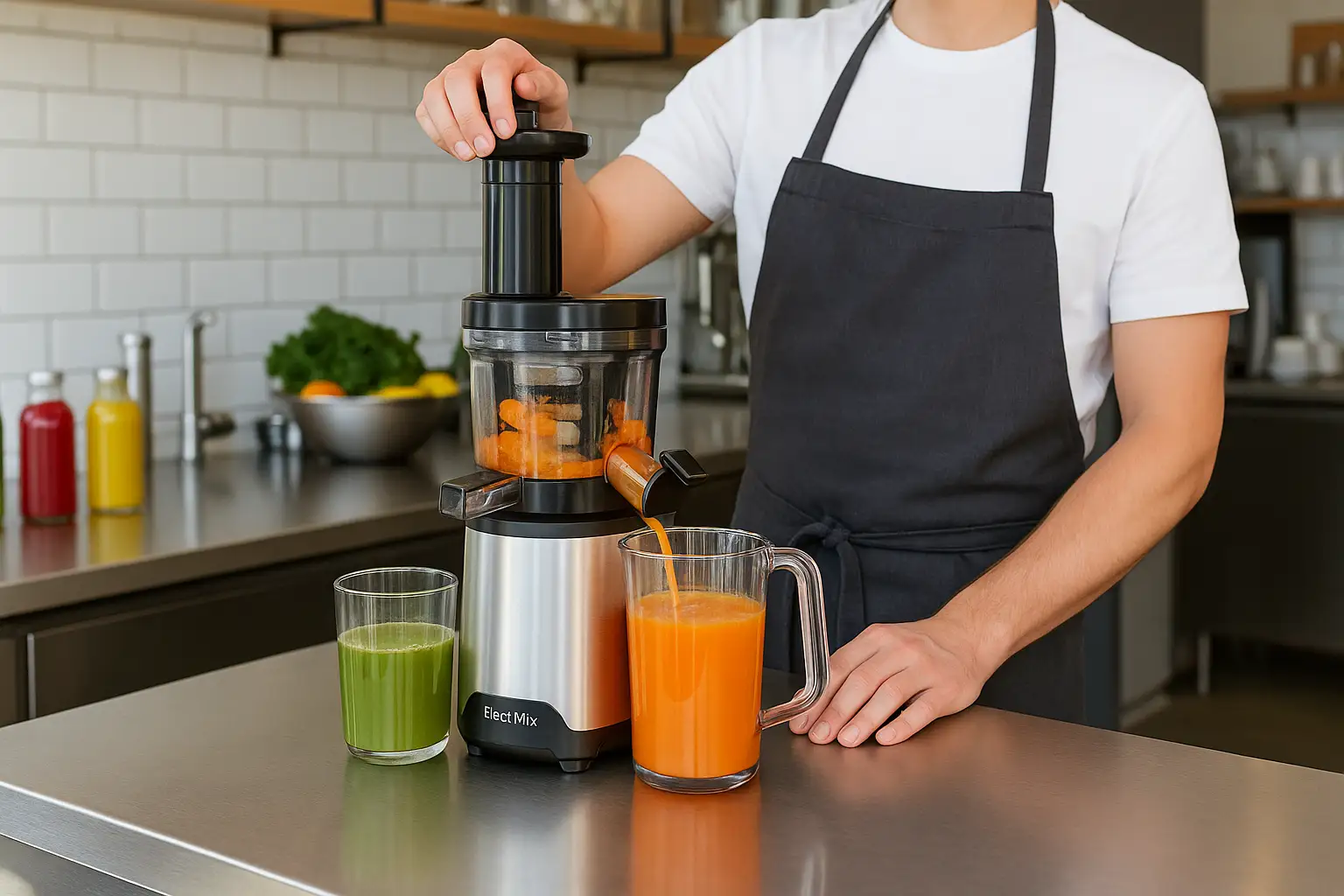
ElectMix OEM capabilities for juice-bar clients (case study). This tempo aids in maintaining color and flavor consistency from batch to batch, which counts for citrus combos, greens, and root mixes. It’s a machine, after all, rated for heavy use, with sealed gear boxes and torque that shoves thick produce without stalling.
In lab tests and field use, systems achieve as much as 90% extraction on typical items such as celery, carrot, and apple when feed sizes and pre-cut steps align with Auger profile. OEM builds can transition to 40, 60, or 80 RPM motors when a bar requires faster flow or more delicate pulp control.
Partnerships that lift yield and consistency
A multi-site juice bar group in Europe paired ElectMix cold press units with a two-step prep: 20 mm pre-cut on carrots and beets, 10-minute chill, then press at 43 RPM. Yield increased 6 to 8 percent on roots and 4 percent on leafy blends.
Waste weight decreased and shelf color maintained for 24 hours in sealed 250 ml bottles. One Asian coastal cafe chain used ElectMix’s slow masticating line for a celery and pear base. In a narrow-screen kit, they achieve up to 88 percent yield and reduce foam by a third, which reduces top-off time during rush hours.

Custom features for unique menus
OEM choices range from logos to auger material to motor specifications to color. Juice bars can select a harder auger polymer for fibrous greens or a stainless-steel auger for ginger shots. Bigger pulp bins of 10 to 12 liters and longer juice spouts assist non-stop runs.
Screens are offered in fine, medium, and smoothie grades so bars can dictate mouthfeel for orange-carrot blends versus nut milks. For power-scarce sites, 60 RPM motors strike an optimum balance of speed and torque on 220 to 240 V lines without tripping.
Supply chain reach and on-time delivery
ElectMix maintains parts hubs close to key ports and stocks essential spares, including motors, augers, and seals, to prevent backorders. The OEM minimum is 300 units, but certain projects qualify at 100 units when color or motor selections remain standard.
Our lead times are perfect for seasonal ramps with online, DTC wellness brands and in-store juice bars. On the ground sweats less service gaps. Field reports less, as machines soak the big loads, slashing man hours and keeping lines short.
For specs or OEM talks, contact ElectMix (https://electmix.com).
How to Choose Between Standard vs Customized Models

Selecting a masticating juicer is simply a matter of how you juice, how often, and what you anticipate in daily use. Standard models are off-the-shelf units with fixed components and presets. Customized models add specialized features, modular components, and precise control. The correct selection is determined by your volume, produce mix, clean-up time, and budget.
-
Weighing the advantages and disadvantages.
Standard models: lower upfront cost, simpler setup, fewer parts, and a shorter learning curve. Suitable for mixed home usage, low volume (below 1-2 liters per day) and users who want guaranteed results without adjustments.
Cons: one-size-fits-all approach, fewer speeds and screens, smaller chutes on many units, and average performance on tricky produce like wheatgrass.
Customized models: stronger performance on specific produce, such as leafy greens, celery, and hard roots, interchangeable filters to set pulp levels, and options like wider chutes, dual-stage augers, or variable speeds.
They can scale for juice bars and specialty drinks like nut milks or sorbets. Cons: higher price, more parts to clean, extra maintenance due to complex design, and longer setup time.
-
Fit the machine to your requirements.
For volume, approximate daily liters and peak hours. A household producing 500 to 750 milliliters per day can get by with a standard unit. A small café pushing 5 to 10 liters will want custom augers, reinforced gearboxes, and larger hoppers.
As far as ingredients go, standard models do well with apples, carrots, citrus, and cucumber. If your plan leans into kale, parsley, wheatgrass, turmeric, or beet, scan for customized pressure caps, slow RPM control, and narrow-feed augers that grip fibrous strands.
For specialty drinks, select custom screens for sorbet, nut milk, and high-fiber blends. Check chute size. Wide chutes cut prep but may trade precision. Narrow chutes need more prep work but often feed leafy greens better.
-
Consider the long-term cost and service.
Standard models tend to have less expensive components and general availability internationally. They clean faster with fewer screens and fewer seals, which saves you labor every day.
Custom models may have proprietary seals, unique screens, and additional gaskets. Consider spare parts lead times, shipping costs, and service networks in your area.
Cleaning matters: if daily cleanup time must stay under 10 to 12 minutes, lean standard; if you can spare 15 to 20 minutes for deep cleans, a customized setup may pay off in yield.
-
Construct a basic decision matrix.
Score each from 1 to 5 on initial price, daily volume fit, produce compatibility, cleanup time, maintenance burden, spare parts access, pulp control, branding potential, and future scale.
A home user might prioritize cleanup and price. A juice company might prioritize brand features such as custom color, transparent housing, and private-label panels, yield on greens, and upgrade paths like larger hoppers and second unit add-ons.
Select the model with the highest overall score, not just the least expensive.
Conclusion
Masticating units help juice bars hit key targets: high output, consistent speed, quiet operation, and easy cleanup. These gains manifest themselves in both cost per cup and wait time. Employees keep cool. Guests hear more chitchat than chomp.
OEM paths appear unobstructed. Verify MOQ. See safety marks such as CE and ETL. Design logos on the casing and packaging. Kick Map spare parts and lead time. A tiny chain might decide to go with a stock model. A massive crowd could fine tune the feed chute, auger, or motor spec.
ElectMix demonstrated genuine yield and uptime increases in the case study. It is easy to assemble. It has easy maintenance. Pulp.
Okay, now let’s get ready to choose. Post your daily cup count and menu mashup. I can be model or make a trial run.
Frequently Asked Questions
What is a masticating juicer, and why do juice bars prefer it?
A masticating juicer, often referred to as a slow juicer, employs a slow auger to pulverize produce, providing higher juice yields and superior nutrient retention. Juice bars prefer this impressive juicer model for its uniform quality, quieter operation, and lower waste, enhancing customer satisfaction.
How does a masticating juicer impact yield and cost per serving?
It gets more juice from your fruits and vegetables than other juicers, especially when using a dedicated juicer like the nutribullet slow juicer, which leaves less pulp waste. This high juice yield reduces cost per serving and increases profitability, making it a wise choice for your juicing routine.
What specs matter most for commercial juice bars?
Pay attention to juice yields, motor torque, noise, continuous run time, and cleaning time when selecting a quality juicer. Look for a juicer with simple-to-clean components, strong augers, and food-safe materials, as these factors impact the juicing process and overall efficiency.
What OEM requirements should I confirm before placing an order?
Check MOQ, lead time, certifications (CE, RoHS, ETL), warranty, spare parts, and support after sales for your favorite juicer. Query us for custom branding, packaging, and accessories to enhance your juicing routine. Ask for samples, performance data, and noise and yield tests to back up assertions.
How does custom branding differ from a standard model?
Standard models ship with set specs, but custom branding can incorporate your logo and colors, enhancing brand awareness. This approach anticipates increased MOQs and extended lead times, ultimately boosting customer loyalty and differentiation in the juicing market.
How fast can a slow juicer serve customers during peak hours?
Throughput varies with feed size, produce type, and operator technique, especially when using a dedicated juicer. Commercial units can provide consistent output with constant loading, ensuring high juice yields without compromising juice quality during the juicing process.
What makes ElectMix a credible OEM partner for juice bars?
ElectMix provides certified parts for your favorite juicer, proven outputs, whisper-quiet operation, and hassle-free cleaning, ensuring high juice yields and efficiency in your juicing routine.

Marketing & Product Lead at ElectMix | Innovating Commercial Blenders & Home Appliances | Driving Growth & Development


