 Skip to content

- Key Takeaways
- Heavy-Duty Blender Motor Guide: Wattage, RPM & Torque Explained
- Why Motor Specs Matter More Than Brand Names
- Understanding Wattage: What It Tells You — and What It Doesn’t
- RPM Explained: Speed Without Strength Is a Problem
- Torque: The Most Overlooked Motor Metric
- How Wattage, RPM, and Torque Work Together
- Why Home Blender Motors Fail in Heavy-Duty Use
- What to Look for in a True Heavy-Duty Commercial Blender Motor
- Matching Motor Specs to Real Business Use Cases
- OEM Perspective: How Commercial Blender Motors Are Engineered Differently
- Final Takeaway: Choose Motor Performance, Not Marketing Numbers
- Frequently Asked Questions
- What makes a blender motor “heavy-duty”?
- Why is torque important for blender motors?
- Is a higher wattage always better for blender performance?
- How does RPM affect blending results?
- Why do home blender motors fail with heavy-duty use?
- What motor specs should I check for commercial use?
- How are commercial blender motors engineered differently from home models?
Key Takeaways
- Motor specs like wattage, rpm, and torque should be considered together, as none can truly capture a blender’s real-world performance on their own.
- Powerful doesn’t always mean powerful blading ability. Think about torque and efficiency for dense or hard ingredients.
- Torque stability is vital to commercial blending because it ensures reliable performance when working with heavy or constant loads.
- RPM is an indicator of speed. Without sufficient torque, that speed will cause heat buildup and inadequate blending of thick mixtures.
- Buyers should concentrate on continuous power ratings, cooling systems, and real torque.
- Focus instead on what will actually work and last under real workload demands, not on brand or hype.
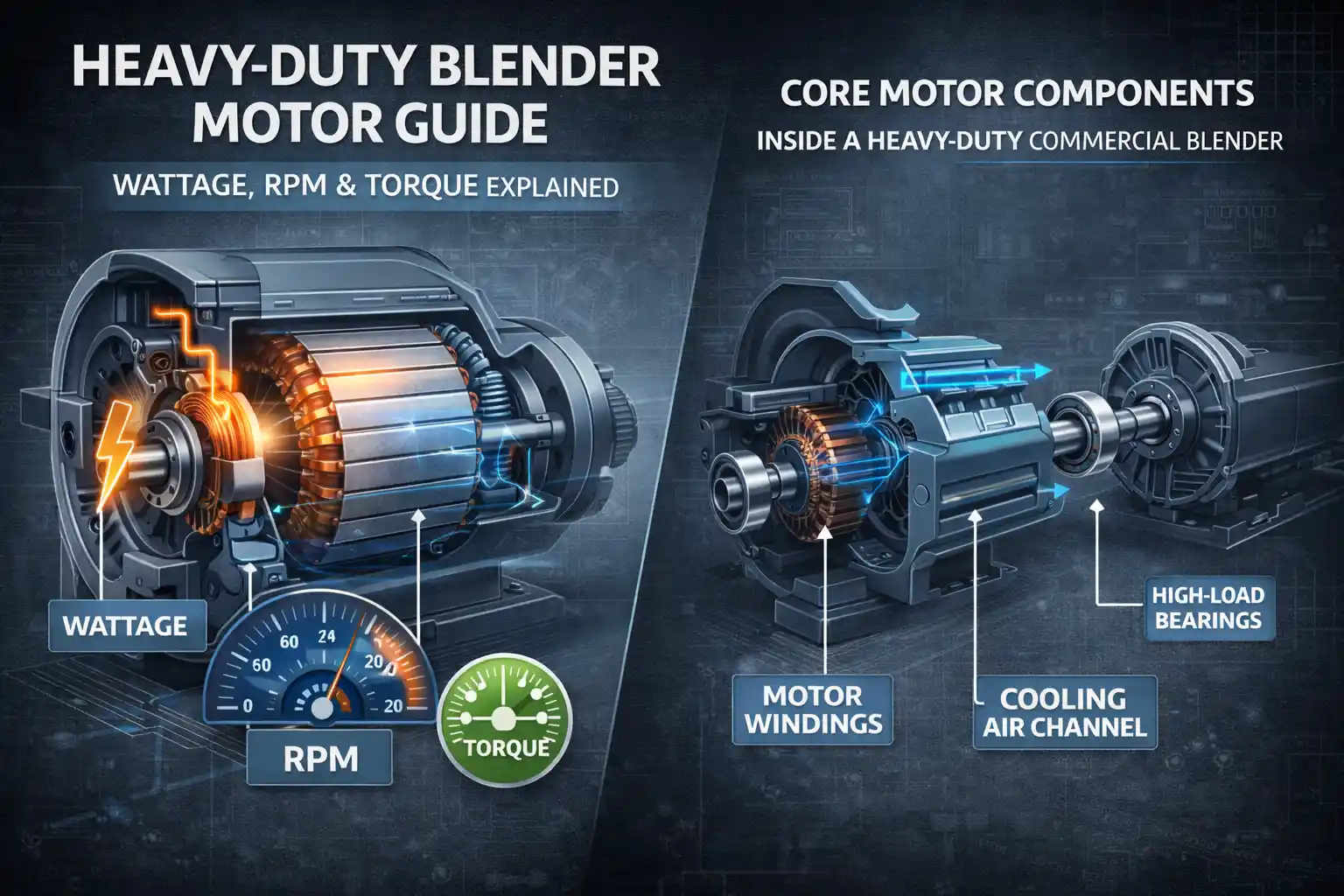
A heavy duty blender motor provides more power and longer run time than a standard blender motor. These motors use robust components that withstand dense blends and everyday use.
Many high-end blenders for your home and work kitchen use these motors for silky shakes, nut butters, and soups. Speed settings and cooling fans help keep them safe and stable.
The following sections highlight key features, along with advice for maintenance and utilization.
Heavy-Duty Blender Motor Guide: Wattage, RPM & Torque Explained
Heavy-duty blenders are designed for hard work, particularly in the commercial blender industry. Motors don’t all function equally; power, speed, and force all contribute to how efficiently a blender can blend, crush, or grind. If you’re shopping for a commercial blender that will stand the test of time and crush the hard stuff, it’s useful to understand what these terms mean and why they matter.
| Feature | What It Means | Typical Range (Heavy-Duty) | Main Function |
|---|---|---|---|
| Wattage | Power drawn by the motor | 1,000 watts or higher | Handles load, crushes ice, blends tough foods |
| RPM | Blade speed (revolutions) | 20,000+ RPM | Finer blends, smoother purees, faster mixing |
| Torque | Rotational force | High torque (varies) | Keeps blades moving through thick mixes |
I’d suggest looking for a commercial blender motor with 1,000 watts or more to get started for hard tasks such as crushing ice or nut butters. Motors with lower wattage, in the 300 to 500 watt range, can blend soft fruits or liquids, but can stall or wear out quickly when used for thick or dry foods.
RPM, or how fast the blades spin, is key. High-speed commercial blenders can exceed 20,000 RPM. That means blades can spin more than 330 times per second, which aids in making smooth blends, but generates heat and noise, sometimes as loud as a lawnmower.
It’s a myth that more wattage necessarily translates to better results. High wattage doesn’t necessarily translate to more power at the blade or better performance. Here are some reasons why:
- Wattage shows energy use, not blending strength
- Weak design or small blades can waste power
- Insufficient cooling can cause even a powerful motor to overheat and slow down
- Some brands market peak, not average, wattage
Torque is what allows blades to grind through thick or frozen food without losing momentum. Stable torque is more important than peak RPM for heavy use. Heavy torque means the blender doesn’t bog down when you’re whipping up doughs, nut butters, or frozen drinks.
This matters in commercial kitchens, where professional blenders run for long stretches and have to maintain speed under load. When looking for a heavy-duty blender motor series, check these points:
- Wattage above 1,000 for thick or dry foods
- High, stable torque for steady result
- RPM over 20,000 for smooth blends
- Good cooling to handle long, hot runs
- Noise level can be an issue in communal environments due to loud motors
OEM-grade commercial blenders have properties that make them durable and perform better under pressure. These include specifications that ensure they can handle continuous running life and demanding food processing capabilities.
- Metal drive sockets instead of plastic
- Better cooling fans and vents
- Overload shut-off systems
- Strong, balanced blades
- Easy-to-clean, strong housings
Why Motor Specs Matter More Than Brand Names

For selecting a serious blender, commercial blender motor specs are a better indicator of what the machine can handle than the brand name on the box. What makes a blender different is the motor under actual stress. The big brands might promise quality, but real-world usage proves that a no-name brand with good specs will frequently keep up or outlast a pricier name.
The secret is the motor’s load performance. The data indicates that commercial blenders optimized for torque maintain 80 to 90 percent of their rated speed when driven to the limit, whereas motors designed for speed only fall to 50 or 60 percent. This can be a big difference if you mix thick batters or frozen fruit in bulk.
Strong torque blenders don’t decelerate or overheat as quickly, and they tackle demanding tasks with less drama. Consider this: A blender with only high RPM might sound impressive, but will stall quickly when you throw in ice or nuts. Meanwhile, a less flashy prototype with rock-solid torque can turn nut butter or dough with fewer stops and starts.
It’s easy for brands to discuss peak HP, but what’s more important is running horsepower and torque, the power that keeps the blades spinning. Torque enables a blender to crush ice or pulverize raw veggies without bogging down. A quality commercial blender motor with great specs can run for months in a hectic kitchen without skipping a beat.
This is vital in restaurants or smoothie bars, where hours offline equals lost revenue. Even minor details like steadiness of blender operation are important. High-speed motors that aren’t built well can shake, especially at 18,000 to 24,000 RPM, making the blender loud and less safe.
Motor longevity is yet another point that most buyers miss. A less expensive blender might save money initially, but if you need to replace it annually, it ends up being more expensive than a reliable unit that lasts ten years. A powerful motor translates to less maintenance and fewer malfunctions, which makes a difference in both residential and professional kitchens.
Checklist for choosing a heavy duty blender motor:
- Look for high torque power, not just peak HP
- Verify that the motor maintains speed under heavy load of eighty to ninety percent.
- Make sure it is rated for continuous service
- Ask about vibration levels at high speed
- Compare expected lifespan and ease of maintenance
Understanding Wattage: What It Tells You — and What It Doesn’t
Wattage is the number we look at when selecting a powerful blender motor. It indicates how much power the blender consumes, but that figure by itself doesn’t necessarily imply more powerful or better blending. Wattage, expressed in watts (W), is the rate at which that work is done.
For blenders, this tends to be between 300W for small blenders and 1,500W for top-of-the-line, professional machines. Most home cooks will find 600W to 1,200W caters to daily needs, with 1,000W being a standard benchmark for reliability. Wattage only tells half the story. Other considerations, such as blade design, torque and RPM, influence a blender’s performance against various foods.
Input Wattage vs Usable Power

The wattage you see on a blender box is frequently input wattage. This is how much power the blender pulls from your outlet. Usable power is what actually spins the blades and purees your food. Not all input power reaches the blades; some is lost as heat or noise.
These losses imply the actual blending power is invariably less than the stated wattage. Blenders that are more efficient waste less energy, so more of their input wattage spins the blades. For instance, two blenders could both list 1,000 watts, but if one is less efficient, you will see weaker blending.
Efficiency usually correlates with superior engineering and premium components. Buyers should be looking for units with the best efficiency ratings or details on motor strength, not just wattage. When you compare input wattage with torque or motor strength, you get a much better idea of what the blender can actually do. This keeps you from overpaying for power you will never need.
Common Wattage Marketing Traps
Peak wattage is a common marketing tactic, which is the maximum power the motor can draw for extremely short periods. Continuous wattage, meanwhile, is the power the blender can use consistently without overheating. Brands love to put the higher peak number in ads, which can fool buyers into thinking they’ll get that much performance all the time.
House blender manufacturers occasionally fudge motor specs. They can post peak numbers or round up specs to get noticed, which can make a 600W blender appear as powerful as a 1,000W one, even though it isn’t. It’s best to read the fine print and seek out continuous ratings or independent reviews.
Look for terms like “professional” or “commercial,” which typically indicate the blender can operate at higher wattages for longer periods.
| Blending Application | Suggested Wattage Range (W) |
|---|---|
| Protein Shakes | 500–600 |
| Smoothies | 600–900 |
| Frozen Foods, Ice, Nuts | 900–1,200 |
| Heavy Duty/Commercial | 1,200–1,500 |
RPM Explained: Speed Without Strength Is a Problem

RPM, or revolutions per minute, indicates the speed the blender blades spin. It’s a prominent statistic on most blender boxes. Consumers like to use RPM to compare models, assuming more is better. For smoothies, a higher RPM does indeed pulverize fruit and ice faster, resulting in a smoother drink.
If we dig deeper, RPM only details half the equation. The force that spins the blades, torque, is just as important, particularly for heavy-duty work such as nut butters or creamy soups. Pureeing things smoothly or grinding spices isn’t just about how fast the blades spin. It’s about how much push the motor delivers to keep those blades moving under pressure.
Others boast 11,000 RPM or more, but if the motor can’t maintain it when things get thick, the speed plummets. That drop, sometimes nearly two-thirds, can make all the difference between smooth and chunky.
What RPM Actually Measures
RPM indicates the number of complete revolutions the blade makes each minute. It’s a count, not an indication of how hard the blade can push through your ingredients. Two blenders could both spin at the same RPM, but if one is more powerful, it will crush nuts, seeds, or frozen foods far better.
High RPM matters when you’re pureeing soft things such as fruit or cooked vegetables. When you mix in something dense, like frozen chunks or sticky pastes, speed by itself can’t power through.
For example, many blenders have multiple speed settings, each with its own RPM. This puts you in control for various activities. Lower RPMs assist in mixing or chopping without pulverizing everything to mush. Higher RPMs are great when you’re after a silky smoothie.
The spectrum is broad; some hover near 8,000 RPM while others exceed 11,000. For tough work, it’s the combination of rapid and consistent force that gets things done.
When High RPM Becomes a Liability
High RPM can cause blades to heat up fast. This heat can sauté or scorch fresh greens and herbs before you’re ready. Another problem is cavitation, when the blades spin so fast they create air pockets. Ingredients could simply swirl and never actually be chopped.
If you puree something thick too quickly, you could end up with a patchy mixture. The outside becomes creamy, but the centers remain lumpy. For items such as nut butters or curry pastes, this implies stopping frequently to scrape down the sides and decelerating the entire process.
In some cases, exceptionally high RPM can wear the motor down faster, particularly if the blender isn’t designed for heavy use. That’s why a quality heavy-duty blender balances speed with strength. It’s about finding the right setting for what you’re making.
Grinding spices requires a flash of high speed, but thick soups flourish with a slower, steady blend.
Torque: The Most Overlooked Motor Metric

Torque is the turning force produced by a commercial blender motor, measured in Newton-meters (Nm) or pound-feet (lb-ft). This essential motor characteristic has a significant impact on a blender’s ability to pulverize thick, dense, or fibrous foods. While many consumers focus solely on wattage or speed (RPM) when purchasing regular blenders, understanding torque can enhance your experience with powerful motors designed for heavy-duty blending.
A motor with good torque is crucial for maintaining speed against resistance from ice, nuts, or frozen fruit. Even if a commercial blender boasts high wattage, low torque can lead to stalling during tough blends. This highlights the importance of torque ratings over mere power numbers, especially for those seeking reliable, professional blenders that can handle demanding tasks.
As a savvy buyer in the commercial blender industry, always prioritize torque ratings to gain a true understanding of a blender’s performance and lifespan. This knowledge will ensure you invest in a machine that meets your blending needs efficiently and effectively.
What Torque Means in Real Blending Scenarios
High torque on a commercial blender motor means it can work against resistance from hard foods. When you pulverize frozen fruit or ice, the blades encounter significant resistance. If the motor has sufficient torque, it continues spinning without stalling or overheating, which is crucial for pulverizing smoothies or crushing dense doughs. This is especially important for heavy duty blenders used in food processing capabilities.
Load stability is an added bonus in a commercial blender. Torque allows the blender to maintain a steady velocity even as the load varies. For instance, if you suddenly add more frozen foods while blending, a high-torque motor does not reduce its speed, resulting in a batter that remains level with fewer clumps or chunks lingering.
Blade momentum is important. High torque allows the blades to maintain their optimal spin rate even when under significant demand. This assists the blender in slicing through seeds, stems, and hard fibers. It keeps the mix nice and easy, with no stopping and stirring required. In practical application, this saves time and streamlines the process.
Why Torque Determines Commercial Durability
Ice crushing is a blender’s motor’s worst test. It’s why only high-torque motors can crack and crush ice cubes without bogging down. If torque is too low, the motor will stall or burn out after a few attempts.
Making nut butter is a different story. Dense, sticky nuts, like almonds or peanuts require both strength and consistency. A high-torque motor can grind them down without overheating or jamming, so you achieve creamy, dreamy results every time.
Lower-torque motors might have to make lots of stops or might not complete the task at all. Frozen fruit and fiber-heavy mixes require steady torque to blend smoothly. Seeds, skins, and tough fibers can stall a feeble motor quickly.
If a blender can’t maintain its speed, you’ll get a lumpy consistency or be forced to blend in smaller batches. High torque solves this by allowing users to mix big loads all at once, with less stress and more confidence.
How Wattage, RPM, and Torque Work Together
Choosing a heavy duty blender motor is about more than just one number on a spec sheet. The specifications such as wattage, RPM, and torque all contribute in varying ways to how well commercial blenders can crush through thick, dry, or tough foods. Each metric counts, but none of them tells the full tale by itself.
Why No Single Metric Tells the Whole Story
Wattage represents how much power a blender can draw, with most units drawing between 1,000 and 1,800 watts, and high-speed units drawing more. This matters for handling difficult ingredients, but doesn’t ensure a blender will be effective on every job. A high wattage, low torque variant could breeze through smoothies, but it may lag or stall with heavy mixes or dough.
On the other hand, a blender with high torque and low wattage will power through dense foods such as nuts, but it can be sluggish or ineffective when working with liquids or soft fruits.
RPM, or how fast the blades spin, is a common selling point. With a no-load speed of 25,000 to 30,000 RPM, a blender can hit extremely fine, smooth textures, great for smoothies or purees. Just having a fast blade speed isn’t so useful if your motor does not have the torque to power through heavier loads.
Torque, measured in newton-meters (Nm), is what keeps the blades from bogging down under strain. High torque is essential when breaking down dense nut butters or ice. Heat management is an element. High RPM motors run hotter at full speed, while high torque models running slower can avoid overheating. They may still warm up if operated for extended times under a heavy load.
Balanced Motor Design vs Spec-Sheet Stacking
Balanced, in this case, means not pursuing the highest possible values for each. How wattage, RPM, and torque work together is crucial. The best blenders for most applications combine a powerful motor of over 1,000 watts with both high RPM and sufficient torque to prevent stalling on demanding tasks.
Brands that concentrate exclusively on wattage or RPM end up giving you a machine that sounds strong but cannot handle working. For real-world application, you want to seek out a motor that provides a balance of speed and torque, not one that leads the pack in either wattage or RPM.
This equilibrium is what makes a blender more versatile, able to toggle from soft fruits to fibrous vegetables or dry grains without losing a step.
Example Scenarios: Smoothie Bars, Protein Shake Chains, Food Prep Kitchens
In a smoothie bar, it’s all about speed and smoothness. High RPM motors, approximately 25,000 to 30,000 RPM, puree fruits, leafy greens, and ice into a smooth, slurpable consistency. In a hectic rush, if the motor isn’t torque-y enough, it can stall out or overheat when confronted with thick frozen fruit or chunks of ice.
Protein shake chains have to process powders, seeds, and viscous supplements. That’s where torque plays a bigger role. A motor that delivers strong torque will keep those blades spinning even when dense powders push back against blending, batch after batch.
Food prep kitchens handle anything from silky smooth purees to dry grinding and nut butters. They require a motor that has both high wattage and high torque. Crushing ice, making nut butters, or grinding dry grains all require a hard-working drive.
A prototype balanced between torque and RPM provides kitchens the flexibility to tackle a lot of prep work without specialized tools.
Why Home Blender Motors Fail in Heavy-Duty Use
If you push a regular blender motor to do more than it was designed for, it’s going to struggle. Many users attempt to blend thick mixtures or run their machines for extended periods, mistakenly assuming home blenders have the same food processing capabilities as commercial blenders. This practice leads to easy failure.
Common Reasons for Motor Struggle
Overheating is a leading cause of premature motor burnout in commercial blenders. When blending dense foods like frozen fruit, nut butters, or dough, a regular blender overheats. Motors that run at full speed for extended periods in a commercial blender motor series begin to break down. Without sufficient time to cool, heat accumulates, leading to potential damage.
Some commercial blender machines have rudimentary thermostatic protection, but it won’t suffice for heavy duty blending. Once the motor overheats, internal components can melt or burn out, significantly affecting the blender’s lifespan.
Overloading is another issue. Overloading the motor or giving it large, hard pieces all at once makes the motor work harder. This can cause it to jam or wear out quickly, especially in professional blenders. For example, jamming two whole apples and some ice into a home blender might feel efficient, but it will stall the blades and overwork the motor.
Age and everyday use come into play too. A commercial blender used daily in a bustling kitchen might limp along for a couple of years before it begins to bog down.
Know the Limits: Thermal Protection, Load Feedback, and Build Quality
Home blenders aren’t always designed with robust thermal protection, unlike commercial blenders that typically feature advanced sensors to prevent overheating. These commercial blender machines are engineered to turn off before heat can cause damage, ensuring a longer lifespan. In contrast, home blenders might just run until the motor is overheated, leading to rapid burnout.
Load feedback is another Achilles heel for regular blenders. Industrial machines, equipped with a heavy duty blender motor series, can detect when they are overworked and adjust their performance accordingly. Unfortunately, many home blenders lack this capability and continue spinning despite excessive load, risking damage.
Industrial-grade windings in commercial blenders are built to last, using robust components that can handle tough tasks. For example, while a home blender with a 500-watt motor can whip up smoothies, it struggles with heavier tasks like making nut butters compared to the efficiency of a 1,200-watt commercial blender.
Watch for Maintenance and Quality Issues
Missed cleaning can cost a blender its life. Food or liquid that remains inside can leak into the motor via deteriorated gaskets or seals. This results in rust, shorts, or other harm.
Improper use is common. If you combine dry ingredients with no liquid or skip the sequence of adding contents, the motor grinds more than it should.
Blender motors can fail because of a defect from bad quality control at the factory. Even a brand new machine can break prematurely if its wires are loose or its seals are not tight.
What to Look for in a True Heavy-Duty Commercial Blender Motor
A TRUE HEAVY-DUTY COMMERCIAL BLENDER MOTOR > More than just a big power number on paper. For those picking a blender that’s going to get heavy use — whether it’s at a bustling coffee shop, juice bar or catering kitchen — both the specs and design have to match the real-world demand of big batches and hard ingredients.
Wattage, horsepower, torque, and RPM along with long use safeguards are the key points to check. Every component contributes to how well your blender performs, day in and day out.
Continuous Power Rating

It’s sustained production that distinguishes commercial-grade motors from consumer counterparts. Peak wattage or horsepower may be catchy, but it’s the continuous rating that lets you know if the motor can keep up with hours of blending.
For light-duty commercial use, a 3 to 4 HP motor with at least 500 watts can manage most tasks. For heavy-duty or continuous blending, such as thick smoothies, nut butters, or crushing ice all day, a 5 to 6 HP motor with 750 or more watts is a safer bet. A few extra-heavy-duty blenders go as high as 7 HP or more for extremely big batches and thick mixtures.
A blender’s continuous power rating means that is what it can run at for long stretches without worry about it overheating or breaking down. Commercial kitchens need that, particularly when blending thick mixtures back-to-back.
Selecting a blender by its sustained power rather than just its max burst helps prevent downtime and keeps results consistent.
Torque Stability Under Load

Torque is what enables a commercial blender motor to cut through dense, viscous blends effectively. High RPM numbers are useless if the torque does not remain stable under load. Real torque-centric designs in heavy duty blenders keep blade rotation powerful even as your vessel fills with tough or dense ingredients.
Look for specifications that emphasize high torque yield, not just fast spinning. Blenders that boast high RPM but insufficient torque struggle with nuts, grains, or frozen fruit. This can lead to stalling, inconsistent blends, or motor burnout.
Top commercial blenders utilize motors built to maintain consistent torque across various load sizes, ensuring yield remains smooth and consistent batch after batch. Some feature variable frequency drives (VFDs) that keep speed and torque consistent as the load varies.
This is particularly useful in environments where both ingredients and batch sizes can change significantly.
Cooling & Motor Protection Systems

In heavy-duty blenders, a strong cooling system is crucial. Without good airflow or thermal protection, motors can overheat and performance drops quickly. Many now have fans, heat sinks, or even liquid cooling.
This means longer run times and less risk of damage from heat build-up. Commercial blenders are designed for a gruelling duty cycle, frequently operational for multiple hours at a time, occasionally with only brief pauses.
Motor protection systems like built-in overload sensors or auto shutoff are important safety features. They protect the motor under heavy strain and prolong the life of the machine. Programmable and electronic controls can assist in managing these cycles, allowing users to set blending durations and speeds appropriate for various tasks, thereby reducing the risk of overuse.
For businesses blending non-stop, these safeguards separate a blender that gives out in a few months from one that holds up.
Matching Motor Specs to Real Business Use Cases
Matching motor specs to real business use cases, such as those in the commercial blender industry, is crucial for environments like juice bars and central kitchens.
Juice Bars vs Cafés vs Central Kitchens

Juice bars require commercial blender motors that operate at much higher speeds, usually in the range of 15,000 to 30,000 RPM. These spots tend to emphasize fresh fruit, leafy greens, and occasionally ice. A 1.5HP motor, weighing in at approximately 1,100 watts, churns through 25 to 50 servings a day effortlessly, showcasing the food processing capabilities of heavy-duty blenders.
Cafés, on the other hand, may mix a broader variety of drinks, such as thick smoothies or frappés. Here, 2HP motors, about 1,500 watts, are common, enabling employees to whip up dense blends and ice in bigger quantities. Central kitchens that serve upwards of 200 drinks a day frequently utilize commercial blenders with 3HP motors.
These powerful motors have to crush ice, frozen fruit, and handle high-volume demand for hours on end. Motors in the 2HP to 3HP range keep up with such volume and stress, minimizing downtime and ensuring stable performance.
Sure, some juice bars can squeak by with a 1HP motor, but busy spots soon discover the boundaries. A standard blender with a 300 to 1,000 watt motor may suffice for home or light office use, but it will falter under heavy loads or extended operation, especially in a commercial blender business.
The wrong match results in overheating, poor blend consistency, and additional repairs. For international readers, it is crucial to consider servings per day, type of ingredients ground, and speed required daily in their commercial blender machine choices.
Why “Over-Spec” Is Often Safer than Under-Spec
Business folks tend to pick a motor spec with a little more horsepower than it actually requires. Motors rated for higher horsepower, such as 2HP to 3HP, won’t grunt as much over extended hours, so they last longer and require less servicing.
If a café picks a motor on the lower end, it might save upfront, yet risk stalling during rushes or burning out sooner. When crushing ice or thick cards, the motor’s max yield torque and current limit protect from sudden stalling.
Underpowered motors push harder, heat up, and can wear down quicker. Repair and downtime costs typically swamp the marginal savings of a lower-rated motor. For some, a slightly bigger motor means fewer breakdowns, more consistent blends, and smoother service.
Long-Term Cost Implications
Running costs count. A 1HP blender operating 4 hours costs $0.50 per day, and a 2HP motor doubles that to $1.00. For restaurants operating multiple machines, those expenses accumulate.
Higher-horsepower motors tend to complete jobs more quickly, thereby reducing overall power consumption. For light commercial use, 1.5HP motors are sufficient and maintain daily costs lower.
For heavy production, a 2HP to 3HP motor costs more to operate but can manage more servings and more challenging work. These typically cost about $0.50 to $1.50 per day, depending on power and blender run-time.
Energy efficiency features, such as automatic shutoff or variable speed controls, assist in handling these expenses.
OEM Perspective: How Commercial Blender Motors Are Engineered Differently

Commercial blender motors distinguish themselves from regular blenders in several respects. OEMs engineer these powerful motors to handle the intensive requirements of bustling kitchens, juice bars, and food service environments. Every component and characteristic is designed for extended run times and variable workloads, ensuring stable performance for the commercial blender industry.
Motor Design Variations
OEMs design motors varying from 1.5 HP for less-intensive prep work all the way to 3 HP for heavy blending. This allows companies to select a motor size that matches their blending volume. A smoothie shop, for instance, might require a 2.5 HP motor that can power through an all-day run, whereas a coffee shop might opt for a 1.5 HP unit for occasional use.
The frame and body of the motor are frequently strengthened, occasionally with stainless steel, to endure high torque and remain hygienic. These distinctions make the motors endure rough use even longer.
Compare High RPM and High Torque
There are commercial blenders that are designed for high RPM, turning the blades rapidly to create velvety beverages or purees. Others emphasize high torque, which is superior for grinding ice or nuts. A few hit a middle ground, offering both speed and strength.
For instance, a bar blender operates at over 20,000 RPM for silky cocktails, while a heavy-duty food processor requires high torque to pulverize fibrous roots or frozen fruit. It depends on what foods you make most often.
Know the Key Build Features
Ventilation is KING in commercial blender motors. Additional vents, bigger fans, and unobstructed air channels keep heat moving away so the motor won’t overheat during continuous use. Others utilize sound enclosures to reduce noise, which is valuable in open kitchens or cafes.
These covers can reduce noise by 70%, so you can actually talk to your customers. Overload protection is standard and can employ thermal cutoffs to turn the motor off if it overheats. This protects the machine and prevents expensive repairs.
Materials selected, such as stainless steel, are hygienic, easy to clean, and resist wear, preserving the food-safe environment.
Why ElectMix-Type Platforms Focus on Reliability, Repairability, and Spec Transparency

ElectMix stands out by focusing on three key areas: reliability, repairability, and clear specs. Our commercial blender motors are built to last for years with basic maintenance, including regular cleaning, inspecting components, and oiling moving parts.
We’re transparent on the specs so customers know what to expect when it comes to power, speed, and construction. That makes it simpler for users around the world to shop between variants and schedule maintenance.
Replacement parts and repair guides are accessible, aiding companies in minimizing downtime and expenses. This method serves global customers well, who require robust, durable equipment that is simple to maintain.
Final Takeaway: Choose Motor Performance, Not Marketing Numbers

Heavy-duty blender motors aren’t all created equal, and selecting the right one means looking beyond the big numbers on the label. Too many brands flaunt peak watts or marketing buzzwords, which doesn’t guarantee that the commercial blender motor will endure or function well under duress. For buyers and users, the fundamental question is how the motor handles actual work, day in and day out, not what its number looks like in ads.
Torque, first and foremost, is crucial in a heavy-duty blender motor. This torque is what keeps the blades turning, even when dealing with heavy-duty or resistant foods. A powerful motor won’t slow or stop if it is crushing ice, grinding nuts, or blending frozen fruit. This is more important than simply a wattage or horsepower figure when considering commercial blenders.
For instance, a blender with a 1200-watt motor but low torque may stall when pulverizing challenging ingredients, whereas a lower wattage high-torque motor can breeze through the same task. Final Takeaway: pick motor performance, not marketing specs. Always look for specifications or reviews that discuss pulverizing hard items, not just max wattage.
Second, consistent production ought to be a primary consideration. Many commercial blender machines provide a peak yield, which is the maximum amount a motor can generate for a short period. In practical usage, what matters is how much power the motor can deliver over an extended period without overheating or experiencing excessive wear.
For commercial kitchens, smoothie shops, or anyone blending in big batches, a motor that can run for hours with stable performance is far more valuable than one that offers a short burst of high power. Look for ratings that specify ‘rated power’ or ‘continuous duty’ rather than just ‘peak wattage.’
Third, match the motor specs to your real-world workload. If you just pulverize soft fruits or liquids, a mid-range motor might be sufficient. For thick smoothies, nut butters, or dough, a real heavy-duty motor with strong torque and high continuous power is worth the price.
In hectic kitchens, a commercial blender with built-in cooling or overload protection can keep the downtime at bay. Certain models include air vents or thermal sensors to prevent the motor from burning out in extended blends.
Checklist to keep in mind: Do not fall for peak wattage claims. Always rate torque and steady yield first. Pick a motor that fits your real needs, not just your budget.
For additional tips or assistance with specifications, contact us or view our complete guides.
Frequently Asked Questions
What makes a blender motor “heavy-duty”?
Heavy-duty blender motors, like those found in commercial blenders, feature powerful torque and rugged components, allowing for blending large amounts of hardy ingredients without overheating.
Why is torque important for blender motors?
Torque measures the crushing force of a commercial blender motor on hard foods. High torque indicates that the heavy duty blender motor can effectively handle thick or tough mixtures, enhancing its food processing capabilities for professional use.
Is a higher wattage always better for blender performance?
Not necessarily. While higher wattage often suggests more power, factors like efficiency, torque, and build quality are crucial. A good commercial blender motor with moderate wattage can outperform a low-quality high-wattage motor.
How does RPM affect blending results?
RPM (revolutions per minute) indicates the speed at which the blades of a commercial blender motor rotate. High RPM means fast blending, but without powerful motors, speed alone cannot break down dense ingredients or large batches.
Why do home blender motors fail with heavy-duty use?
Home blender motors were never designed for continuous use, unlike commercial blender motors, which can handle big batches and tough ingredients effortlessly without burning out or failing.
What motor specs should I check for commercial use?
Pay attention to wattage, which should be over 1,000, along with the commercial blender motor’s torque and durability. These essential motor characteristics assist in providing reliable performance in hectic settings.
How are commercial blender motors engineered differently from home models?
Commercial blender motors, specifically designed for the commercial blender industry, utilize stronger materials and optimized cooling to ensure stable performance, allowing heavy duty blenders to handle thick, tough blends without burning out.

Marketing & Product Lead at ElectMix | Innovating Commercial Blenders & Home Appliances | Driving Growth & Development


