Skip to content

Choosing a juicer motor is not simply a matter of comparing wattage or selecting the model with the highest RPM. The motor works as part of a complete extraction system that includes the controller, gearbox or transmission, shaft, coupling, auger or cutting disc, filter, housing, ventilation path and overload protection. If any part of that system is poorly matched, an impressive motor specification may not translate into reliable juicing performance.
This distinction matters to distributors, private-label brands, restaurant-equipment suppliers and commercial operators. A machine used for occasional soft-fruit preparation faces a very different workload from one processing carrots, celery, ginger and leafy greens throughout a busy service period. The correct motor must therefore be selected according to the juicer type, ingredients, required throughput, operating cycle, starting and running load, cooling, noise expectations, electrical configuration, cleaning environment, replacement-parts strategy and target-market requirements.
This guide explains how RPM, torque, duty cycle and motor construction affect a juicer in real operation. It also provides a practical sample-testing method and RFQ checklist for B2B buyers.
Key Takeaways
- RPM describes rotational speed, but it does not prove that a juicer can maintain that speed under load.
- Motor-shaft RPM and auger or cutting-disc RPM may be different, especially when a gearbox is used.
- Torque must be assessed together with the gearbox, controller, coupling and extraction assembly.
- Centrifugal and cold-press juicers require different motor characteristics and should not be compared by RPM alone.
- A thermal cut-out protects the appliance, but it does not prove suitability for unlimited continuous operation.
- Motor lifespan cannot be expressed honestly without defining ingredients, load, operating cycles, ventilation and maintenance.
- Sample testing should use representative ingredients and a written method rather than an unloaded demonstration.
- Spare parts, change control and serviceability are part of commercial motor reliability.
Why Juicer Motor Selection Cannot Be Reduced to Wattage
Wattage normally describes electrical input under specified conditions. It does not directly tell a buyer how much useful mechanical output reaches the auger or cutting assembly. Two juicers carrying similar wattage figures may behave differently because of motor efficiency, controller limits, gear reduction, blade or auger geometry, coupling design, filter resistance, ventilation and ingredient load.
Peak input figures can be particularly misleading. A short electrical peak during start-up is not the same as the power that the machine can sustain throughout a realistic operating cycle. Rather than asking only how many watts a motor has, a commercial buyer should ask whether the figure is rated input, measured input or a peak claim; at which voltage and frequency it was measured; which working assembly was connected; which ingredients and batch size were used; and whether thermal protection activated.
The U.S. Department of Energy Motor Systems resources promote a systems approach to motor performance. Although the guidance is not written specifically for countertop juicers, the principle is relevant: actual load, controls and connected components all affect performance. Wattage is one specification, not the purchasing decision.
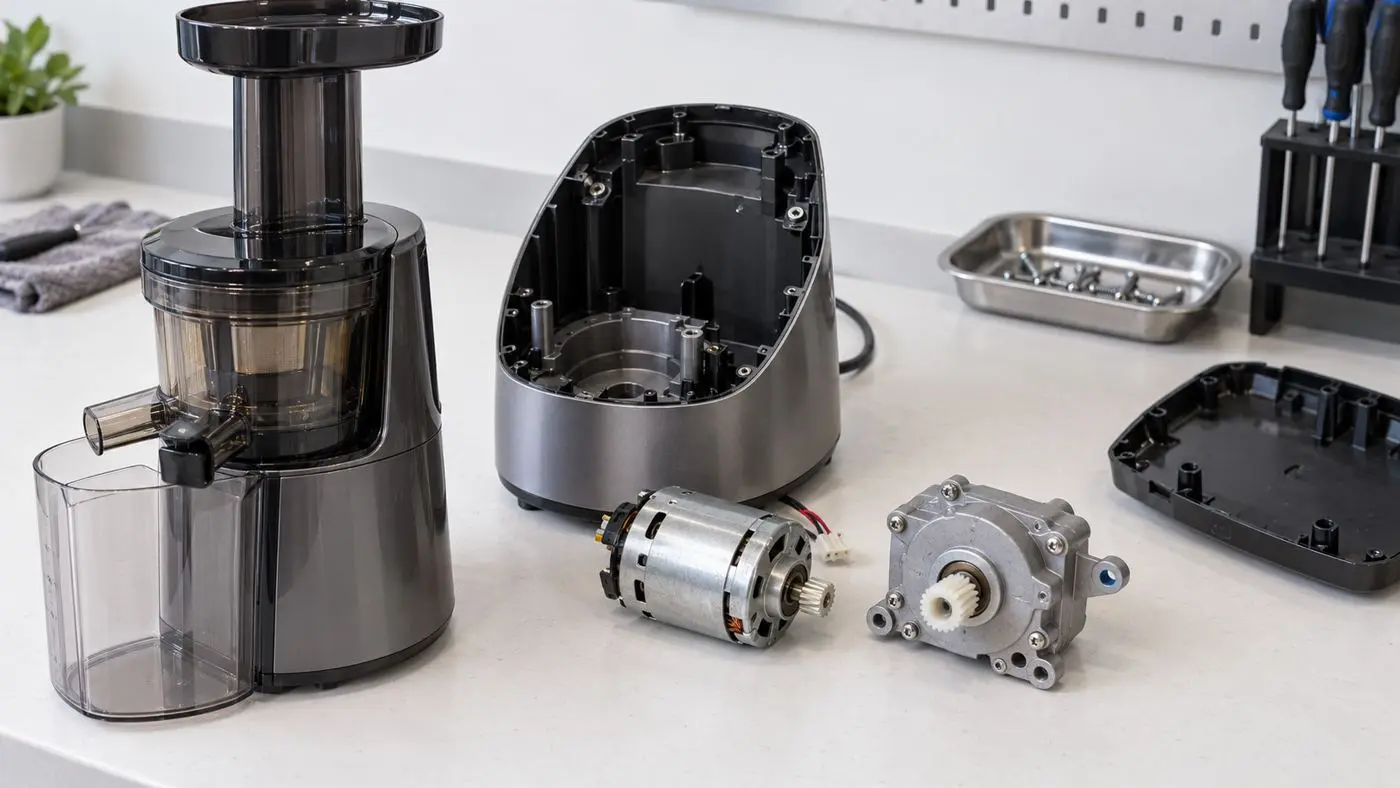
Commercial juicer motor beside stainless steel juicer on engineering bench
What RPM Actually Means in a Juicer
RPM means revolutions per minute. It describes how many complete rotations a shaft or working assembly makes in one minute. However, a juicer can contain several rotating parts, and they may not operate at the same speed.
Motor-Shaft RPM vs Working RPM
In a centrifugal juicer, the motor may drive a cutting disc and spinning filter basket directly or through a transmission arrangement. In a cold-press juicer, the motor commonly works through a gearbox that reduces speed before power reaches the auger.
The supplier should identify whether a quoted RPM refers to unloaded motor-shaft speed, loaded motor-shaft speed, gearbox output speed, auger speed, cutting-disc speed, filter-basket speed or maximum programmed speed. Describing a slow juicer as having a low-RPM motor may be incomplete: the motor may rotate much faster while the reduction system produces a low auger speed.
Unloaded Speed vs Speed Under Load
An unloaded demonstration does not represent actual juicing. Load changes according to produce hardness, fibre length, feed rate, ingredient temperature, preparation size, filter condition, pulp accumulation, auger clearance and outlet restriction.
A motor may reach its stated speed when empty and slow considerably when hard or fibrous produce enters the chamber. Some reduction is normal, but excessive speed loss may indicate insufficient usable torque, unsuitable controls, an overloaded extraction assembly or a blockage. Sample testing should observe cycle time, sound changes, vibration, repeated stalls and protection events under representative load.
Why Higher RPM Is Not Automatically Better
Centrifugal juicers depend on relatively fast cutting and separation. Higher working speed may support rapid service, but it can also increase noise, vibration, aeration, mechanical imbalance, bearing stress and heat. Cold-press juicers operate on a different principle: the auger crushes, transports and presses ingredients. Increasing auger speed without reviewing the chamber, filter, outlet and feeding system may reduce control rather than improve output.
Claims that high RPM always destroys nutrients, or that low RPM automatically preserves more nutrients, are too broad. Juice condition depends on the complete extraction method, ingredient, residence time, aeration, temperature, storage and handling. Buyers should focus on observable outcomes such as processing time, yield under an agreed method, pulp condition, foam, consistency, cleaning time and reliability. ElectMix’s guide to cold-press and centrifugal juicers provides additional system-level context.
How Torque Affects Real Juicing Performance
Torque is the turning force available at a shaft. It helps the working assembly continue moving when ingredients create resistance. Torque is especially relevant when processing carrots, beetroot, ginger, celery, leafy greens, fibrous stems and dense mixtures. However, “high torque” is not a complete specification. A supplier should identify where torque is measured and under which conditions.
Starting Torque and Running Torque
Starting torque is the force available as the motor begins rotating. Running torque is the force available once the system is operating. Starting conditions may become difficult when produce remains in the chamber, pulp has compacted, the filter is partially blocked, components are incorrectly seated or the operator starts with an overloaded feed chute.
An aggressive start may place additional shock on the coupling, gearbox and shaft. Some controllers gradually increase output, while others stop or reverse when resistance exceeds a defined limit. Buyers should test normal start-up and recovery from a manageable obstruction without requiring an operator to reach into the cutting or pressing area.
Torque in Cold-Press Juicers
A cold-press juicer needs enough output torque to rotate the auger against changing ingredient resistance. Performance also depends on auger pitch and material, chamber clearance, filter geometry, pulp outlet, feed-chute design, gear reduction and reverse-control logic.
A motor with adequate output torque can still struggle if the pulp outlet is too narrow or the chamber creates unnecessary resistance. Increasing torque without strengthening the gearbox, coupling or auger may simply transfer stress to a weaker component. Engineering should balance the complete load path.
The Role of the Gear Reduction System
A gearbox reduces speed while increasing usable output torque. Important questions include the reduction ratio, gear and bearing materials, lubrication method, moisture protection, jam response and replacement availability. Gear noise should be evaluated throughout sample testing. Clicking, grinding or oscillating sound may indicate poor alignment, wear or inconsistent engagement.
Operators should not open or lubricate a sealed gearbox unless an authorized service procedure requires it. Routine advice to add lubricant or tighten internal parts can create safety, contamination and warranty risks.

Cold press juicer motor gearbox coupling and auger assembly
Motor Requirements by Juicer Type
Centrifugal Juicers
A centrifugal juicer generally requires rapid acceleration, stable high-speed operation, reliable bearing support, secure basket retention, effective vibration control, adequate cooling and protection against overload or imbalance. Uneven feeding and pulp accumulation can affect basket balance even when the motor is functioning correctly.
During sample testing, observe whether the unit moves across the worktop, develops changing noise or shows visible vibration as pulp accumulates. Inspect the basket, retaining system and bearing support after repeated cycles. A centrifugal platform may suit made-to-order speed, but preparation, cleaning, noise and ingredient cost still need consideration.
Cold-Press and Masticating Juicers
A masticating juicer usually relies on controlled low-speed output, suitable torque, a reduction gearbox, a robust auger, a consistent pulp outlet, obstruction-clearing control, effective seals and practical disassembly. Its workload can remain substantial even though the auger turns slowly.
Relevant observations include reverse frequency, recovery after a temporary jam, pulp condition, feed pressure, cycle duration, gearbox noise, cleaning time and seal condition. ElectMix’s guide to commercial masticating-juicer features provides broader context. Any numeric claim on an existing page should still be checked against the actual product before reuse in sales material.
Citrus Juicers
Citrus-juicer requirements vary by design. A compact reamer may experience frequent short starts, while a lever-operated or automatic machine creates another load pattern. Define fruit size, pressure, servings per hour, strainer cleaning, drip management, front-of-house noise and replacement parts. The correct motor must match the reamer, transmission and service pattern.
Duty Cycle, Cooling and Overload Protection
Duty cycle describes the relationship between operating time and rest time. The word commercial does not automatically mean that an appliance can run continuously. Some commercial machines are designed for repeated short cycles; others support longer batch work.
How to Define a Commercial Workload
Before requesting a quotation, write down average and peak servings per hour, ingredients, batch weight, longest cycle, rest time, daily operating period, cleaning intervals, ambient temperature and counter arrangement. A hotel breakfast area, a small café and a batch-production operation should not receive the same duty-cycle assumption.
Ask the supplier to state the workload used for internal validation. “Suitable for continuous use” is not sufficiently precise unless the test conditions are disclosed.
Cooling-Air Path and Ventilation
Cooling can be affected by vent position, fan size, air-channel geometry, motor mounting, controller position, counter clearance, pulp and ambient temperature. An enclosure that reduces noise may restrict airflow if acoustic and thermal design are not coordinated. A powerful fan also cannot cool effectively when the inlet is blocked.
During evaluation, confirm that normal cleaning can keep ventilation openings clear and that the air path does not direct contamination into food-contact areas.
What Thermal Protection Can and Cannot Prove
Thermal protection may stop or limit the motor when temperature becomes excessive. It is an important safeguard, not evidence of unlimited operation. Repeated shutdown may indicate excessive load, blocked ventilation, inadequate rest, worn bearings, a jammed assembly or controller problems.
Record every protection event. The supplier should explain the recovery procedure and whether the operator must switch off, unplug or wait for cooling.
The Complete Drive System
Coupling and Shaft Alignment
The coupling transfers motor output to the auger, basket or working assembly. It must tolerate repeated starts and stops without excessive wear. After testing, inspect for cracks, rounded engagement surfaces, debris, heat discoloration, looseness and abnormal shaft movement.
A sacrificial coupling may be designed to fail before a more expensive motor or gearbox. If so, the supplier should explain the function and supply replacements. Shaft misalignment can increase vibration, bearing load and seal wear.
Controller and Wiring
Electronic controls may regulate speed, starting current, reverse operation and overload response. Confirm voltage and frequency, control method, reverse logic, sensor inputs, error indications, thermal response, wire retention and replacement availability.
A brushless motor eliminates brush wear but relies more heavily on electronic control. Controller quality and serviceability therefore become part of the motor-system decision.
Moisture Protection
Juicers operate around liquid, wet produce and repeated cleaning. Inspect the drive-shaft seal, bowl drainage, switch location, cable entries, base ventilation, control-panel seams and possible spill paths. Cleaning instructions should identify which components can be immersed. The motor base should not be sprayed or immersed unless specifically designed and documented for that method.
How to Evaluate Juicer Motor Lifespan
There is no universal number of years or hours for every juicer motor. Life depends on ingredient resistance, feed rate, cycles, rest periods, ambient temperature, ventilation, moisture, gearbox condition, bearing load, controller settings, cleaning and manufacturing consistency.
Request Test Conditions, Not Marketing Promises
Ask how many cycles were tested, which ingredients were used, the batch weight, cycle and rest duration, failure criteria, replaced parts, post-test inspection and whether the quoted configuration was used. A supplier may protect proprietary details, but it should be able to explain the validation method.
Wear Parts and Serviceability
Commercial reliability includes access to couplings, brushes where applicable, gearboxes, bearings, controllers, switches, seals, augers, filters, bowls and lids. A low purchase price becomes less attractive when a minor failure requires replacing the complete appliance.
Warranty and Traceability
Warranty length alone does not prove durability. Review covered components, commercial-use exclusions, labour, freight, replacement procedures, maintenance requirements and spare-part availability. Batch or serial traceability helps investigate recurring failures and identify affected lots.
Safety, Sanitation and Market Requirements
Motor selection cannot be separated from product safety. IEC 60335-2-14:2025 includes auger and centrifugal juicers within its kitchen-machine scope for household and similar use. Commercial kitchen machines may involve IEC 60335-2-64:2021 or other requirements depending on classification. Confirm the route with a qualified laboratory for the exact product and market.
NSF food-equipment standards explain that NSF/ANSI 8 addresses food-protection and sanitation requirements for powered food-preparation equipment. Certification should never be claimed unless the exact model is listed.
The FDA explains that food-contact substances can include materials used in processing equipment and food-preparation surfaces. This does not mean the complete juicer receives a general FDA certificate. See the FDA food-contact information.
How to Test a Juicer Motor Before Mass Production
Step 1: Define the Method
Record model, voltage, frequency, ingredient, weight, preparation size, feed order, cycle, rest period, repetitions and ambient conditions. Use the same method for supplier comparisons.
Step 2: Observe Operation
Record start-up, speed stability, stalls, reverse events, protection events, vibration, noise changes, leakage, juice flow, pulp discharge and cleaning difficulty. Electrical measurements should be taken only by qualified personnel using suitable equipment.
Step 3: Inspect After Testing
After safe disconnection, inspect coupling wear, auger or basket condition, gearbox sound, seals, fasteners, housing, odour, liquid ingress and filter damage. Retain the approved sample, method and results with the golden-sample record.
Step 4: Re-Test Important Changes
A substitution involving the motor, controller, gearbox, coupling, auger, filter, seal or structural material may affect performance. Require written notice and decide whether it needs document review, targeted testing, a new sample, compliance review or golden-sample reapproval.
Juicer Motor RFQ Checklist for B2B Buyers
Include the juicer type, café/restaurant/hotel/retail use, front- or back-of-house position, ingredients, batch size, servings per hour, peak pattern, voltage, frequency, plug, market, capacity, reverse function, controls, noise expectations, cleaning method, materials, certifications, forecast quantity, branding, packaging, spare parts, warranty and delivery schedule.
Buyers can review ElectMix products before preparing the RFQ. Product pages should be treated as platform references; performance claims must still be confirmed for the ordered configuration.
For projects involving non-standard motors, controls, housings, tooling or coordinated components, review ElectMix Custom Manufacturing. Feasibility depends on specification, quantity, tooling, component availability and target-market requirements.
Common Juicer Motor Selection Mistakes
- Selecting the highest RPM without considering the extraction system.
- Comparing wattage without test conditions.
- Ignoring the gearbox in a slow juicer.
- Testing only soft fruit.
- Treating frequent thermal shutdown as normal.
- Accepting a fixed lifespan claim without evidence.
- Ignoring spare parts and service access.
- Approving a sample without a controlled record.
Frequently Asked Questions
What does RPM mean in a juicer motor?
RPM means revolutions per minute. It may describe motor-shaft speed or the speed of the auger, cutting disc or filter basket. Ask which component is measured and whether the figure represents loaded or unloaded operation.
Is higher RPM better for a commercial juicer?
Not automatically. Centrifugal systems generally require faster rotation, while cold-press juicers use slower output and gear reduction. The correct speed depends on extraction method, ingredients, throughput and acceptable noise.
Why is torque important in a cold-press juicer?
Torque helps the auger continue rotating when hard or fibrous produce creates resistance. Performance also depends on the gearbox, controller, auger geometry, chamber clearance and pulp discharge.
What wattage is best for a commercial juicer?
There is no universal wattage. Required input depends on juicer type, capacity, ingredients, duty cycle, electrical market and system efficiency. Compare tested performance under a defined workload.
Does thermal protection mean the motor can run continuously?
No. Thermal protection reduces damage risk when temperature becomes excessive. It does not prove unlimited operation. The intended operating and rest cycle must still be defined.
How can a buyer evaluate motor lifespan?
Request test conditions, inspect the complete drive system, run representative tests and review spare-part support. Avoid unsupported promises that a motor will last a fixed number of years.
Should buyers choose a brushed or brushless motor?
Neither is universally superior. Brushed motors may offer familiar servicing, while brushless motors eliminate brush wear but rely on electronic controls. Consider cost, noise, controller quality, serviceability and workload.
Which internal parts should ordinary operators maintain?
Operators should not open the motor base, lubricate sealed gearboxes, adjust wiring or dismantle electrical components unless an authorized procedure instructs them. Routine work should remain limited to specified cleaning, inspection and external replaceable parts.
What belongs in a juicer RFQ?
Include juicer type, ingredients, batch size, servings per hour, voltage, market, cleaning method, documentation, branding, packaging, quantity and spare-parts expectations.
Can ElectMix support a customized juicer project?
ElectMix can review suitable B2B projects based on function, materials, motor and control requirements, quantity, tooling and market. Manufacturing may combine direct resources with coordinated specialist partners. Contact ElectMix with the product brief.
Final Recommendation
The correct juicer motor is not necessarily the one with the highest RPM, wattage or advertised torque. It is the motor system that matches the extraction method, ingredient load, duty cycle, electrical market and service plan.
Commercial buyers should evaluate the complete drive system, including the controller, gearbox, coupling, shaft, auger or basket, seals, ventilation and overload protection. Sample testing should use representative ingredients and a documented method. This approach supports better supplier communication, sample approval, production inspection and warranty handling throughout the product lifecycle.
The final approval should also identify which specification changes require notification. A motor with a similar appearance or input rating may still use different windings, bearings, protection settings or controller parameters. The same principle applies to gear materials, couplings, seals and extraction components. Recording the approved configuration gives purchasing, engineering and quality teams a common reference. It also prevents later discussions from depending only on photographs, informal messages or broad statements that a replacement component is equivalent. For repeat orders, this controlled reference is often as important as the initial performance test.

ElectMix Team provides global e-commerce sellers and distributors with insights on commercial blending solutions, OEM customization, and profitable market opportunities.