 Skip to content

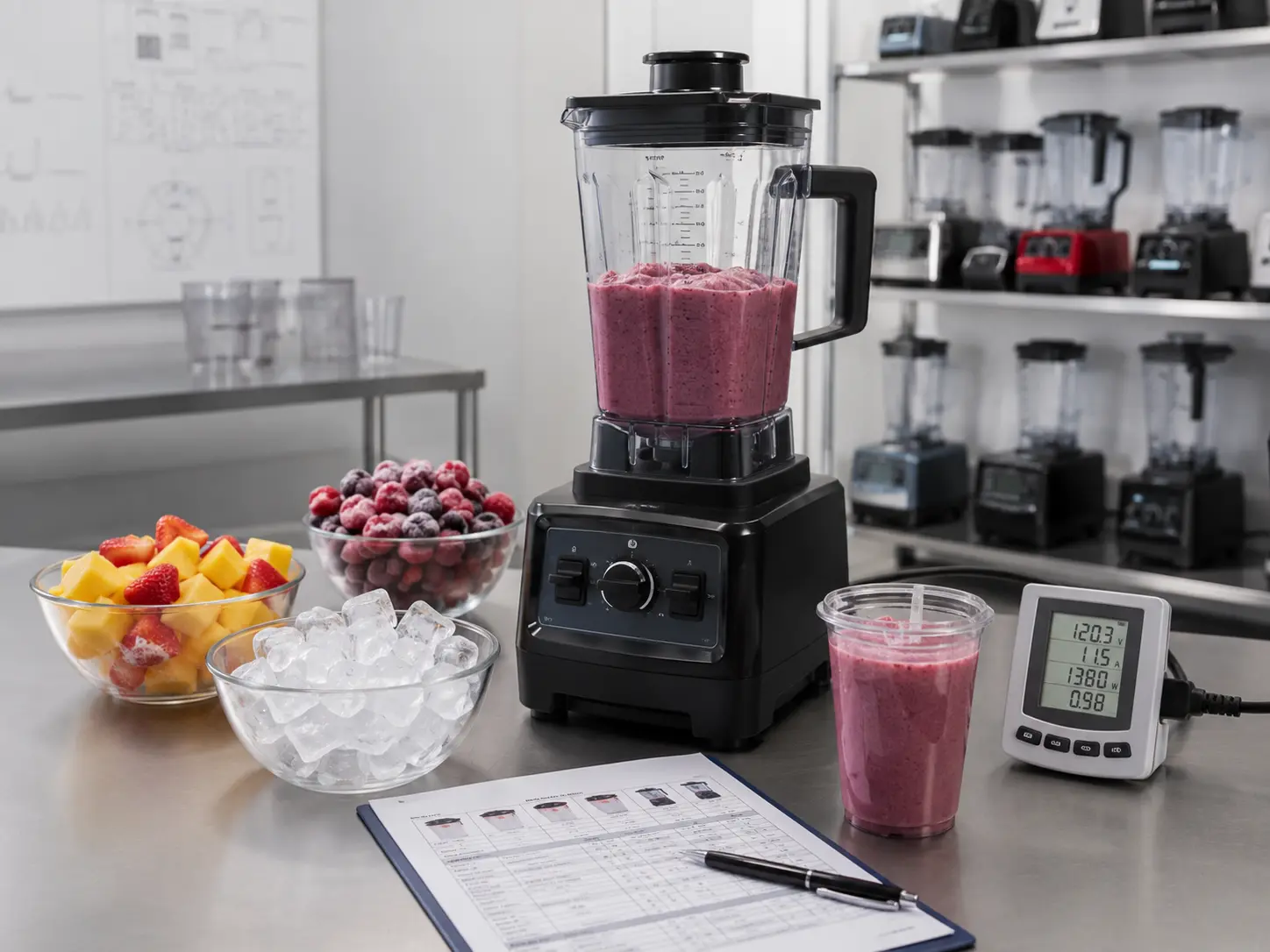
Many buyers start a commercial blender comparison with one question: how many watts does it have?
That is understandable. Wattage is easy to compare. A 2200W blender sounds stronger than a 1500W blender. A 3HP motor sounds more impressive than a 2HP motor. On a product sheet, higher numbers often feel safer.
But in real commercial use, blender power is not that simple.
A blender with higher wattage is not automatically better for every business. A café making a few soft fruit smoothies per day does not need the same power level as a smoothie bar blending frozen fruit and ice every few minutes. A restaurant using a blender for sauces and purées has different needs from a juice bar serving thick frozen drinks during peak hours.
The right commercial blender power depends on your recipe load, daily volume, ingredient resistance, blending cycle length, motor cooling, blade assembly, jar design, and target user.
In short: choose enough power for the workload, not the biggest number on the spec sheet.
This guide explains how to evaluate commercial blender power in a practical way. It is written for cafés, smoothie shops, restaurants, hotels, distributors, importers, and OEM/private-label buyers who need to choose the right blender specification for real business use.
If you are comparing commercial blender models more broadly, you can also visit the ElectMix Knowledge Center and our Commercial Blender Guides.
Quick Answer: Match Blender Power to Recipe Load and Daily Volume
There is no universal wattage that fits every commercial blender application. The right power range depends on what the blender needs to process and how often it will run.
| Use Case | Typical Power Priority | What Buyers Should Check |
| Light café drinks | Moderate power may be enough | Smooth texture, easy cleaning, noise |
| Soft fruit smoothies | Medium to high power | Texture consistency and cycle time |
| Frozen fruit smoothies | Higher power recommended | Torque, RPM stability, cooling |
| Ice crushing and frozen drinks | Higher power plus strong blades | Blade assembly, coupler, jar strength |
| Thick sauces and purées | Power plus torque | Low-liquid movement and heat control |
| Nut drinks or dense recipes | Higher load capability | Motor load, jar vortex, blade design |
| Hotel breakfast station | Balanced power | Noise, reliability, simple operation |
| Smoothie bar peak service | High commercial workload capacity | Duty cycle, cooling, spare parts |
For light or moderate use, a well-designed mid-power commercial blender may be enough. For frozen fruit, ice-heavy drinks, thick smoothies, nut drinks, and repeated peak-hour service, buyers should look for stronger power, better torque, stable RPM, cooling design, durable blades, and replaceable parts.
Power is useful only when the blender can turn that power into real blending performance.
What Does Blender Power Actually Mean?
Before choosing a commercial blender, it helps to understand what power numbers actually mean.
Wattage
Wattage usually describes how much electrical power a motor uses or is rated for. A higher wattage motor may have more power capacity, but wattage alone does not prove blending quality.
A blender with high wattage may still perform poorly if the blade design is weak, the jar does not create good ingredient circulation, or the motor overheats during repeated use.
Rated Power
Rated power is usually more useful than a dramatic marketing number. It gives buyers a better idea of the motor’s normal operating level.
For commercial use, rated power should be considered together with real recipe tests. A blender that performs well on paper may struggle with frozen fruit, ice, or low-liquid recipes.
Peak Power
Peak power or peak horsepower may describe short-term maximum output. It can sound attractive, but buyers should not rely on peak power alone.
Commercial service is not about one short burst. It is about repeated cycles.
Horsepower
Horsepower is another way sellers describe motor strength. It can be useful, but it is often used loosely in blender marketing. Buyers should ask whether the number refers to peak horsepower or practical operating performance.
Torque
Torque is the force that helps the blades keep moving when ingredients resist the blade. It matters when blending frozen fruit, thick smoothies, nut drinks, sauces, and low-liquid mixtures.
RPM
RPM refers to blade speed. High RPM can help create smooth texture, but speed alone is not enough. The blender must maintain useful speed when the jar is loaded.
The real question is not just:
How powerful is the motor?
The better question is:
How does the machine perform under real commercial load?
Why Wattage Alone Does Not Tell the Full Story

Two commercial blenders with similar wattage can perform very differently.
That is because blending performance depends on the whole system, not only the motor.
Important factors include:
- Motor design
- Torque curve
- Blade geometry
- Jar shape
- Ingredient circulation
- Cooling system
- Coupler strength
- Recipe type
- Ingredient size
- Liquid ratio
- Duty cycle
- Control programming
- Spare parts quality
For example, a 1500W blender with strong jar circulation and a well-matched blade assembly may outperform a higher-watt blender with poor vortex movement or weak cooling in certain recipes.
A high-watt motor can also create problems if the rest of the machine is not designed to support it. Weak couplers, poor ventilation, fragile jars, or low-quality blade assemblies can still fail early.
This is why ElectMix’s article What Makes a Blender Truly Commercial Grade? A Technical Breakdown explains commercial grade as a system, not a single specification.
For commercial buyers, wattage is a starting point. It is not the final answer.
Power, Torque, and RPM: How They Work Together

Power, torque, and RPM are closely connected, but they are not the same thing.
Power helps drive the motor. Torque helps the blades keep moving when ingredients resist. RPM affects blade speed and texture.
In commercial blending, the key is not empty speed. The key is loaded performance.
A blender may spin very fast when the jar is empty. That does not prove it can handle frozen fruit, ice, nut drinks, or thick mixtures. When the jar is full, ingredients push back against the blade. If the motor cannot maintain movement, the texture becomes uneven and the cycle takes longer.
This is why torque and RPM stability matter.
A strong commercial blender should be able to:
- Pull ingredients toward the blade
- Maintain movement under load
- Avoid stalling in thick mixtures
- Process frozen fruit without long delays
- Keep texture consistent across repeated batches
- Avoid overheating during busy service
High speed is useful for smooth textures, but speed must be supported by torque, jar design, and cooling. For more on speed and texture, see ElectMix’s guide High-Speed Blender vs Low-Speed Blender: Which Is Better for Commercial Kitchens?.
Light-Duty, Medium-Duty, and Heavy-Duty Power Needs
Not every commercial buyer needs the same power level. It is more useful to think in terms of workload.
Light-Duty Commercial Use
Light-duty commercial use may include:
- Occasional sauces
- Soft fruit smoothies
- Light café drinks
- Small beverage menus
- Low-volume restaurant prep
- Short daily use periods
For these users, moderate commercial power may be enough if the recipes are not dense and the blender does not run continuously.
The buyer should still check build quality, jar material, blade assembly, and cleaning design. A light-use business still needs reliable equipment.
But it may not need the highest-watt machine in the category.
Medium-Duty Commercial Use
Medium-duty use may include:
- Daily smoothies
- Milkshakes
- Frappes
- Café beverage menus
- Restaurant sauces
- Purées
- Moderate frozen ingredient use
- Regular but not nonstop operation
Here, buyers need stronger motor performance, stable texture, and basic repeated-use durability. Cooling becomes more important. The blade assembly and coupler should be strong enough for daily service.
This is where many cafés, restaurants, and hotel beverage stations fall.
Heavy-Duty Commercial Use
Heavy-duty use may include:
- Frozen fruit smoothies
- Ice-heavy drinks
- Thick recipes
- Smoothie bar peak service
- Nut drinks
- Dense sauces
- High-frequency daily use
- Repeated cycles during rush hours
For these applications, higher load capacity is justified. Buyers should look beyond wattage and check torque, RPM stability, cooling, blade assembly, coupler strength, jar durability, and spare parts support.
This is also where a heavy-duty blender becomes more relevant. ElectMix covers this topic in Heavy-Duty Blender vs Standard Blender: When Does Power Really Matter?.
Recommended Power Priorities by Business Type
The right blender power also depends on the business model.
Cafés and Coffee Shops
Cafés do not always need the highest-power blender.
Many cafés need a balanced machine that can handle smoothies, frappes, milkshakes, sauces, and seasonal drinks. The priorities are usually:
- Reliable texture
- Moderate to strong power
- Reasonable noise level
- Easy cleaning
- Simple controls
- Good jar handling
- Front-of-house appearance
If the café only makes soft fruit drinks or occasional smoothies, extreme power may not add much value. If frozen drinks are a core menu item, stronger load capacity becomes more important.
Smoothie Bars and Juice Bars
Smoothie bars usually need more power and better repeated-use capacity.
These businesses often process frozen fruit, ice, thick smoothies, protein powders, yogurt, and low-liquid mixtures. During peak service, the blender may run many cycles per hour.
For smoothie bars, buyers should focus on:
- Strong motor performance
- Torque under load
- Stable RPM
- Fast cycle time
- Cooling design
- Blade assembly durability
- Jar strength
- Spare parts availability
A smoothie bar should not choose power based only on catalog numbers. It should test real recipes.
Restaurants
Restaurants need blender power based on menu.
A restaurant using a blender for sauces, dressings, soups, purées, and occasional drinks may not need the highest wattage. It may need consistency, cleanability, and durability more than raw power.
For restaurant prep, consider:
- Ingredient density
- Hot or cold recipes
- Low-liquid sauces
- Cleaning time
- Jar material
- Blade access
- Noise in open kitchens
- Spare parts
For restaurant workflows, power should support the menu without overcomplicating operation.
Hotels and Breakfast Buffets
Hotels usually need reliability and simple operation.
A hotel breakfast station may use a blender for smoothies, fruit drinks, or light beverage prep. If the blender is used near guests, noise matters. Staff may also need simple controls and easy cleaning.
For hotels, the ideal blender is often not the loudest or strongest model. It is a balanced model with enough power, stable operation, and good usability.
Catering and Mobile Beverage Service
Catering buyers should consider both power and mobility.
They may need to move equipment between locations, work with different power outlets, and blend in changing environments. Power is important, but so are:
- Voltage
- Plug type
- Portability
- Noise
- Jar durability
- Packaging
- Spare parts
- Transport protection
A powerful blender is only useful if it fits the actual service environment.
Distributors and OEM Buyers
Distributors should not choose the highest wattage by default.
A higher-power model may be attractive on paper, but it can also increase cost, noise, packaging size, spare parts cost, and certification complexity. The right power level should match the target sales channel.
For example:
- Entry-level café buyers may prefer balanced cost and reliability.
- Smoothie bar buyers may prioritize higher load capacity.
- Hotel channels may care about noise and simple operation.
- Restaurant equipment distributors may need spare parts and durability.
- Premium OEM lines may need stronger performance and better documentation.
Power is part of positioning.
Recommended Power Priorities by Recipe Type

Recipes create different types of load.
Smoothies
Soft fruit smoothies may not require extreme power. A moderate commercial blender can often handle bananas, berries, milk, yogurt, and soft ingredients.
Frozen fruit smoothies are different. Frozen mango, berries, ice, and thick dairy bases create more resistance. These recipes need stronger power, better torque, and stable ingredient circulation.
Ice and Frozen Drinks
Ice and frozen drinks place heavy stress on the motor, blades, coupler, and jar.
For this use case, power matters, but it must be supported by:
- Strong blade assembly
- Durable coupler
- Jar strength
- Good ingredient circulation
- Cooling
- Overload protection
- Real ice-crushing tests
A blender that can crush a few ice cubes once may still be weak for repeated frozen drink service.
Thick Smoothies and Low-Liquid Recipes
Low-liquid recipes are difficult because ingredients do not move easily.
In these recipes, torque and jar design matter as much as wattage. If the mixture does not circulate, the blender may create an air pocket or stall around the blades.
Buyers should check whether the jar design creates a strong vortex and whether a tamper is needed.
Sauces and Purées
Sauces and purées need consistency. Depending on the recipe, they may need moderate power or stronger load handling.
A restaurant making smooth sauces may care more about texture, control, and cleanability than extreme wattage. Dense purées or low-liquid sauces may need more torque.
Nut Drinks and Dense Blends
Nut drinks, seed mixtures, thick shakes, and dense blends require stronger load capability.
These recipes are hard on the motor, blades, and bearings. Buyers should test recipe performance, heat buildup, and repeated cycle behavior.
Hot Ingredients
For hot ingredients, power is not the only issue.
Buyers should also check:
- Jar material
- Lid design
- Venting
- Temperature guidance
- Splash risk
- Supplier instructions
- Food-contact material suitability
ElectMix’s guide How to Choose Blender Jar Material: Tritan vs Glass vs Stainless Steel explains how jar material affects commercial blender use.
When Is More Power Actually Worth It?
Higher power is worth considering when the business has a real workload that needs it.
More power may be justified when:
- The menu includes frozen fruit
- Ice-heavy drinks are common
- Thick recipes are part of daily service
- The blender runs many cycles per hour
- Texture consistency is critical
- Staff need faster service
- Peak-hour rush is important
- The target buyer is a smoothie bar
- The product is positioned as heavy-duty
- Spare parts and cooling support the higher load
In these cases, stronger power can improve cycle time, texture, consistency, and user satisfaction.
But higher power helps only when the whole machine supports it. The motor, blade assembly, coupler, jar, control system, and cooling design must work together.
A high-watt motor with weak cooling is not a good commercial solution. A powerful motor with a fragile coupler can still create after-sales problems. A strong base with poor jar circulation can still blend slowly.
Power must be part of the system.
When Can Too Much Power Be a Problem?
Too much power can also create problems, especially when the target user does not need it.
Possible drawbacks include:
- Higher product cost
- Higher noise
- More heat
- Larger motor base
- More expensive spare parts
- More demanding packaging
- Higher energy draw during operation
- Over-positioning for light users
- Harder pricing for entry-level channels
- More complex certification or documentation planning
A small café that makes a few soft fruit smoothies per day may not need the same blender as a smoothie bar blending frozen fruit every few minutes.
For distributors, over-specifying power can make a product harder to sell. The machine may become too expensive for light-use buyers but still not strong enough for true heavy-duty buyers if the rest of the design is not upgraded.
The best specification is not always the highest one. It is the one that matches the user.
Duty Cycle and Cooling Matter as Much as Wattage
A commercial blender with high wattage but poor cooling can still overheat.
Duty cycle means how often and how long the blender can run before it needs rest. This matters because commercial service often involves repeated cycles.
During peak hours, a blender may be used again and again. Heat builds up in the motor and internal components. If the machine cannot manage that heat, performance drops and failure risk increases.
Buyers should consider:
- Ventilation design
- Motor cooling
- Overload protection
- Thermal cutoff
- Consecutive blending cycles
- Peak-hour use
- Motor life
- Downtime risk
For a smoothie bar, cooling is critical. For a hotel breakfast station, repeated morning use may expose weak cooling. For distributors, overheating complaints can become warranty claims.
This is why wattage cannot be evaluated alone. A lower-watt blender with better cooling may be more reliable than a higher-watt blender with poor heat management.
Blade Assembly, Jar Design, and Coupler Strength Affect Power Delivery
Power must be transferred from the motor to the ingredients.
That transfer depends on several parts:
- Blade geometry
- Blade thickness
- Bearing durability
- Seal design
- Coupler strength
- Jar shape
- Ingredient circulation
- Lid fit
- Tamper compatibility
A strong motor with poor jar circulation may still blend slowly. A high-watt motor with a weak coupler may cause early drive failure. A powerful base with a low-quality blade assembly may not deliver consistent texture.
Commercial buyers should inspect the parts that carry the load.
The blade assembly faces stress from ice, frozen fruit, dense recipes, and cleaning cycles. The coupler connects the jar to the motor base. The jar shape helps create movement inside the container.
Power is useful only when these parts are designed to handle it.
For OEM buyers, this is a key point. Do not upgrade motor power without reviewing blade assembly, coupler strength, jar design, and spare parts support.
Power and Noise: Important for Front-of-House Use

Higher power can also mean more noise, especially when blending ice or frozen ingredients.
Noise matters in:
- Cafés
- Smoothie bars
- Hotel breakfast areas
- Open kitchens
- Front-of-house beverage counters
- Premium hospitality settings
A powerful blender may be acceptable in a back kitchen but disruptive in a café or hotel breakfast area.
OSHA notes that exposure above 85 decibels can damage hearing, and that needing to raise your voice to speak to someone three feet away may indicate a noise issue. A blender buyer does not need to turn every purchase into an occupational noise study, but noise should still be part of commercial equipment selection. See OSHA’s overview of occupational noise exposure.
If the blender will be used near customers, buyers should consider:
- Sound enclosure options
- Counter placement
- Ice-crushing noise
- Staff communication
- Customer comfort
- Service environment
A quieter or enclosed blender may be a better choice for front-of-house use, even if another model has higher wattage.
Power and Energy Use: What Commercial Buyers Should Consider
Higher wattage may increase energy draw during operation, but the real cost depends on usage.
Energy impact depends on:
- Actual running time
- Number of cycles per day
- Recipe cycle length
- Motor efficiency
- Overblending
- Staff workflow
- Idle behavior
- Peak service volume
For high-volume shops, a stronger blender may finish recipes faster. Shorter cycle times can offset some of the higher rated power. For low-volume cafés, oversized power may not add enough value to justify the cost, noise, and heat.
This is why buyers should not evaluate power only as a number. They should evaluate power in the context of actual daily use.
Ask:
Will this power level make the operation faster, more consistent, and more reliable for the target user?
If the answer is no, the machine may be over-specified.
Food-Contact Materials and Safety Still Matter
Even when the article topic is power, commercial buyers should not ignore food-contact materials and safety.
Higher power does not compensate for weak material documentation or poor sanitation design.
Blender food-contact parts may include the jar, lid, lid plug, seals, gasket, blade assembly, tamper, and any area that touches ingredients.
FDA explains that food-contact substances can include materials used in food packaging, cookware, food preparation surfaces, and food-processing equipment. For commercial blender buyers, this means ingredient-contact components should be reviewed as part of sourcing. See FDA information on food packaging and other substances that come in contact with food.
NSF food equipment standards cover material safety, design, construction, and performance for commercial food equipment. This is relevant when buyers evaluate jar materials, cleanability, and commercial foodservice equipment design. See NSF’s overview of food equipment standards.
Power matters, but it is only one part of a commercial-ready product.
How OEM and Distributor Buyers Should Specify Blender Power

OEM and distributor buyers should define power by use case, not by chasing the highest number.
A good sourcing brief should include:
- Target user
- Target market
- Recipe type
- Daily usage volume
- Jar capacity
- Required texture
- Ice or frozen fruit use
- Thick recipe use
- Noise requirement
- Voltage and plug
- Certification target
- Motor power range
- Cooling expectation
- Blade assembly requirement
- Coupler strength
- Spare parts plan
- Price positioning
- Packaging requirement
For example, if the target buyer is a smoothie bar, the sample should be tested with frozen fruit, ice, thick smoothies, and repeated cycles.
If the target buyer is a hotel breakfast operator, the sample should be tested for noise, simple operation, cleaning time, and reliable morning service.
If the target buyer is a restaurant equipment distributor, spare parts and after-sales support may matter as much as wattage.
ElectMix can help buyers compare commercial blender power levels, motor specifications, jar and blade combinations, OEM customization options, and packaging requirements for different channels. You can browse available options through the ElectMix Products page or contact the team through Contact Us for sourcing support.
Commercial Blender Power Selection Checklist
Before choosing a commercial blender power level, ask these questions:
- What recipes will the blender handle?
- Are frozen fruit or ice used daily?
- How many cycles per hour during peak service?
- Is the recipe thick or low-liquid?
- What texture does the business need?
- Is noise a concern?
- Is the blender used front-of-house?
- What jar capacity is required?
- Does the motor have proper cooling support?
- Is overload protection included?
- Is thermal protection included?
- Are the blade assembly and coupler strong enough?
- Does the jar design support good ingredient circulation?
- Are spare parts available?
- What voltage and plug are needed?
- What certifications or documentation are required?
- Has the model been tested with real recipes?
This checklist is more useful than comparing wattage alone.
If the blender matches the target recipes, daily volume, noise requirement, and service model, the power level is probably appropriate. If it only looks strong on paper, buyers should test further.
Common Mistakes Buyers Make When Choosing Blender Power
1. Choosing the Highest Wattage Without Checking Workload
More power is not always useful if the business does not need it.
2. Comparing Peak Power Instead of Real-Use Performance
Peak power can sound strong, but sustained performance under load matters more.
3. Ignoring Torque
Torque is critical for frozen fruit, thick smoothies, nut drinks, and low-liquid recipes.
4. Ignoring Duty Cycle and Cooling
A blender that overheats during repeated use may not be suitable for commercial service.
5. Testing Only with Water or Soft Fruit
Water tests do not show how the blender handles real resistance.
6. Ignoring Ice and Frozen Fruit Load
Ice and frozen fruit place much higher stress on the machine.
7. Choosing Too Much Power for Light Café Use
Oversized power can increase cost and noise without improving the customer experience.
8. Ignoring Noise
Powerful blenders can be too loud for cafés, hotel breakfast areas, or open counters.
9. Not Checking Blade Assembly and Coupler Strength
The motor may be powerful, but weak drive parts can fail early.
10. Forgetting Spare Parts
A commercial blender should have replacement jars, lids, blades, couplers, and gaskets available.
11. Ignoring Voltage and Plug Requirements
Power specifications must fit the target market’s electrical requirements.
12. Not Matching Power to Market Positioning
A distributor should choose power levels that fit the sales channel, price point, and end-user workload.
How This Guide Connects With Other Commercial Blender Decisions
Power is one part of commercial blender selection.
Buyers also need to evaluate commercial grade, speed, jar material, workload, blade design, food-contact parts, noise, cleanability, and spare parts.
ElectMix has covered related topics in these guides:
- What Makes a Blender Truly Commercial Grade? A Technical Breakdown
- Heavy-Duty Blender vs Standard Blender: When Does Power Really Matter?
- High-Speed Blender vs Low-Speed Blender: Which Is Better for Commercial Kitchens?
- How to Choose Blender Jar Material: Tritan vs Glass vs Stainless Steel
- Commercial Blender vs Smoothie Blender: What’s the Real Difference for Businesses?
- Commercial Blender vs Food Processor: Which One Do You Really Need?
- Immersion Blender vs Countertop Blender: Which Is More Practical for Restaurants?
You can also browse more resources in the ElectMix Knowledge Center and Commercial Blender Guides.
Final Recommendation: Choose Enough Power for the Workload, Not the Biggest Number
A commercial blender should have enough power to handle the target recipes and daily volume. But the highest wattage is not always the best choice.
Light café use may work well with moderate commercial power. Smoothie bars, frozen drinks, ice-heavy recipes, thick smoothies, nut drinks, and peak-hour service usually need stronger load capability.
Wattage should be evaluated together with:
- Torque
- RPM stability
- Duty cycle
- Cooling
- Blade assembly
- Coupler strength
- Jar design
- Noise
- Energy use
- Spare parts
- Real recipe testing
For OEM and distributor buyers, the best power level is the one that fits the target market, user workload, price position, and after-sales strategy.
If you are sourcing commercial blenders for cafés, smoothie shops, restaurants, hotels, or distributor channels, ElectMix can help compare power levels, motor specifications, jar and blade combinations, OEM customization, and packaging options for your target market.
Visit the ElectMix Products page or contact ElectMix to discuss your commercial blender sourcing needs.
Frequently Asked Questions
How many watts does a commercial blender need?
A commercial blender does not have one universal wattage requirement. Light café use may need moderate commercial power, while smoothie bars, frozen drinks, ice-heavy recipes, and thick blends usually need stronger power, torque, cooling, and repeated-load capacity.
Is a higher watt blender always better?
No. Higher wattage does not automatically mean better commercial performance. Torque, RPM stability, motor cooling, blade assembly, jar design, duty cycle, and real recipe testing are also important.
What power is best for smoothies?
Soft fruit smoothies may not need extreme power, but frozen fruit smoothies, ice, and thick smoothie recipes usually require higher load capability, stronger torque, and stable blending performance.
Do commercial blenders need more power than home blenders?
Usually yes, because commercial blenders must handle repeated cycles, tougher ingredients, faster service, cleaning routines, and higher workload. But the right power level still depends on the business type and recipes.
What matters more, watts or torque?
Both matter, but torque is especially important when ingredients resist the blade. A high-watt blender with weak torque or poor jar circulation may still struggle with thick or frozen recipes.
Can too much blender power be a problem?
Yes. Too much power can increase cost, noise, heat, size, and product positioning challenges. For light-use businesses, oversized power may not improve the user experience enough to justify the cost.
What should OEM buyers check when choosing blender power?
OEM buyers should check target recipes, daily usage volume, jar capacity, motor power range, torque, cooling design, duty cycle, blade assembly, coupler strength, noise, voltage, plug, certification needs, spare parts, and real recipe test results.
ElectMix Team provides global e-commerce sellers and distributors with insights on commercial blending solutions, OEM customization, and profitable market opportunities.


