Skip to content

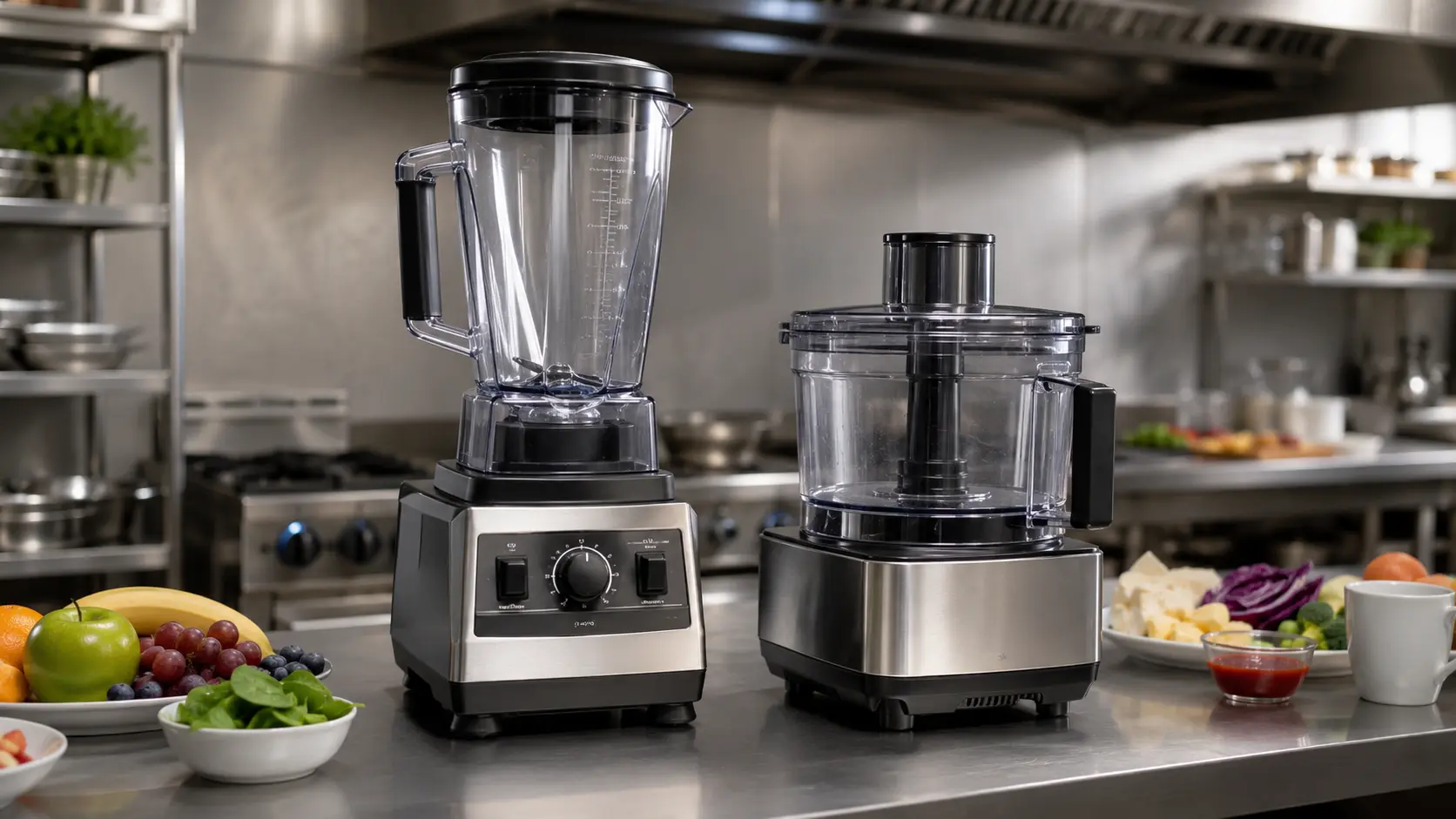
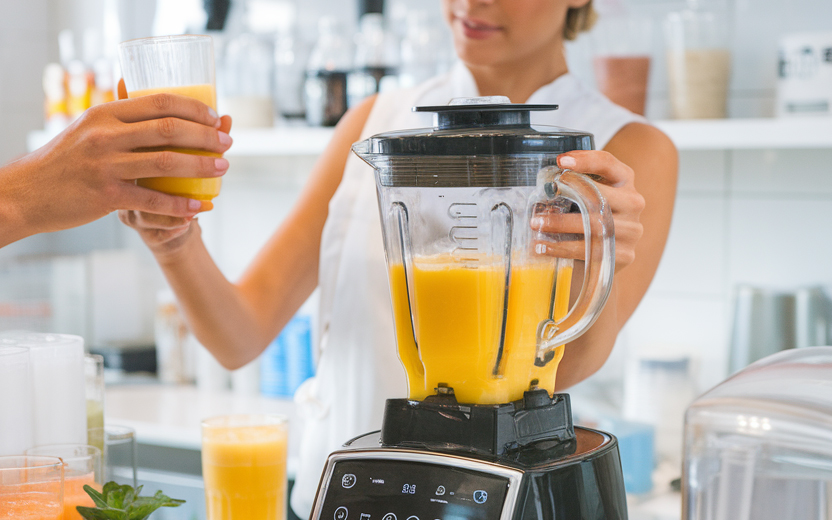
Choosing between a commercial blender and a food processor seems simple at first. Both machines have motors. Both use sharp blades. Both can break down ingredients. In a product photo, they may even look like they serve the same purpose.
In a real business kitchen, however, they solve very different problems.
A commercial blender is built for liquid movement, smooth texture, frozen drinks, sauces, soups, purées, emulsions, and fast beverage preparation. A food processor is built for chopping, slicing, shredding, kneading, grating, and reducing manual prep work with solid or semi-solid ingredients.
For restaurants, cafés, juice bars, hotels, catering kitchens, and equipment distributors, choosing the wrong machine does not only affect texture. It affects labor cost, menu speed, cleaning time, product consistency, and long-term equipment life.
This guide compares commercial blenders and food processors from a business point of view. Instead of asking, “Which machine is better?” the better question is:
Which machine fits your menu, workflow, customer demand, and sourcing plan?
If you are comparing multiple beverage and kitchen equipment options, you can also explore the ElectMix Knowledge Center and our broader Product Comparisons section for related commercial equipment guides.
Quick Answer: Choose a Commercial Blender for Liquids, a Food Processor for Prep Work

A commercial blender is usually the better choice when your business needs smooth, drinkable, pourable, or liquid-based results. This includes smoothies, milkshakes, frozen drinks, sauces, soups, dressings, nut drinks, and fine purées.
A food processor is usually the better choice when your business needs to chop, slice, shred, grate, knead, pulse, or prepare solid ingredients in batches. This includes vegetables, cheese, nuts, dough, herbs, cabbage, pastry ingredients, and thick mixtures.
Here is the simplest way to compare them:
| Business Need | Better Choice | Why |
| Smoothies and frozen drinks | Commercial blender | Better liquid vortex, ice crushing, and smooth texture |
| Sauces, soups, and purées | Commercial blender | Produces a finer, more uniform finish |
| Milkshakes and frappes | Commercial blender | Handles liquid and frozen ingredients efficiently |
| Chopping vegetables | Food processor | Better control over solid ingredients |
| Slicing and shredding | Food processor | Uses discs and attachments designed for prep work |
| Dough and thick mixtures | Food processor | Better suited for dense, semi-dry textures |
| Beverage service | Commercial blender | Faster cycles and more repeatable drink quality |
| Bulk ingredient prep | Food processor | Reduces manual cutting and prep labor |
Many full-service kitchens need both. But if your business is beverage-focused, such as a smoothie bar, café, juice bar, hotel breakfast station, or drink counter, a commercial blender is usually the first machine to prioritize.
This is also why ElectMix focuses heavily on commercial blender and juicer solutions for foodservice buyers, distributors, and OEM projects. You can view our current equipment range through the ElectMix All Products page.
What Is a Commercial Blender?
A commercial blender is a high-power blending machine designed for repeated use in demanding foodservice environments. Unlike a household blender, it is expected to run more frequently, handle harder ingredients, process larger batches, and maintain consistent texture across many cycles.
In commercial kitchens, blenders are commonly used for:
- Smoothies
- Frozen drinks
- Milkshakes
- Frappes
- Sauces
- Soups
- Dressings
- Purées
- Nut drinks
- Ice crushing
- Beverage bases
- Restaurant prep liquids
The key design goal of a commercial blender is circulation. The jar shape, blade angle, speed, and motor output work together to pull ingredients down into the blade area, creating a blending vortex. This is what allows a blender to turn frozen fruit, liquid, ice, and soft ingredients into a consistent texture.
For B2B buyers, the important question is not only “How many watts does it have?” Wattage matters, but it is not the full story. You also need to evaluate motor durability, RPM stability, jar material, blade geometry, cooling design, noise control, lid safety, spare parts availability, and whether the machine is designed for actual commercial duty.
For a deeper explanation of what makes a blender suitable for professional use, you can read ElectMix’s guide on What Makes a Blender “Commercial”. If your main concern is restaurant selection, the Commercial Blender Guides section is also a useful starting point.
What Is a Food Processor?

A food processor is designed mainly for solid and semi-solid preparation. It typically has a wider bowl, a central blade system, and optional discs or attachments for slicing, shredding, chopping, grating, kneading, and pulsing.
A food processor is commonly used for:
- Chopping onions, carrots, herbs, garlic, and vegetables
- Slicing cucumbers, potatoes, carrots, or cabbage
- Shredding cheese or vegetables
- Making dough or pastry mixtures
- Grinding nuts
- Preparing thick dips
- Making coarse purées
- Mixing dry or semi-dry ingredients
- Reducing manual prep time in busy kitchens
The main purpose of a food processor is not to create a smooth drink. It is to save time on prep work. It gives kitchen teams more control over cut size, texture, and batch preparation.
This difference is widely recognized in kitchen equipment comparisons: blenders are usually better for liquid-heavy recipes, while food processors are stronger for wide-bowl prep tasks such as chopping, slicing, shredding, and thicker mixtures. (KitchenAid)
For a restaurant, café, or catering kitchen, this distinction matters. A food processor can support the prep station, but it should not be expected to replace a commercial blender for beverage service, ice crushing, or smooth liquid output.
The Core Difference: Blending vs Processing
The real difference between a commercial blender and a food processor is not just the blade. It is the way ingredients move inside the machine.
A commercial blender pulls ingredients downward into a narrow blending zone. This movement creates a vortex. When there is enough liquid or soft content in the jar, the machine can continuously cycle ingredients through the blade path. This is what creates smooth smoothies, sauces, soups, and purées.
A food processor moves ingredients around a wider work bowl. Instead of pulling everything into a liquid vortex, it cuts, chops, pulses, slices, or shreds ingredients as they move around the bowl.
A simple rule works well:
If the final product is something customers drink, pour, sip, or serve as a smooth sauce, a commercial blender is usually the better fit. If the final product needs to be chopped, sliced, shredded, grated, kneaded, or served with visible texture, a food processor is usually more suitable.
This is where many commercial buying mistakes begin. A buyer may choose a food processor because it looks more versatile. Then the machine struggles to produce smooth frozen drinks. Another buyer may choose a high-speed blender and expect it to slice vegetables or shred cheese. That is not what the machine is designed to do.
For businesses comparing different blending categories, ElectMix has already covered related decisions such as Commercial Blender vs Smoothie Blender and High-Speed Blender vs Low-Speed Blender. Those articles can help build a clearer picture of where each machine type fits.
Texture Result: Smooth Finish vs Controlled Cut
Texture is one of the most important factors in this comparison.
A commercial blender is designed to produce:
- Smooth drinks
- Creamy sauces
- Fine purées
- Liquid emulsions
- Uniform soups
- Smooth nut or grain drinks
- Frozen beverages with consistent mouthfeel
A food processor is designed to produce:
- Coarse chop
- Fine chop
- Sliced vegetables
- Shredded ingredients
- Chunky dips
- Thick mixtures
- Dough-like textures
- Prep-ready ingredient portions
For example, a smoothie shop needs a smooth, drinkable texture. Customers do not want chunks of frozen fruit or ice in the bottom of the cup. A commercial blender is the right tool because it is designed to create fast and consistent liquid movement.
A sandwich shop has a different problem. It may need to shred cabbage, slice vegetables, chop herbs, or prepare fillings. In that case, a food processor can save more labor than a blender.
A restaurant may need both. The sauce station may depend on a commercial blender, while the prep station depends on a food processor.
This is why the question should not be “Which machine is more powerful?” The better question is “What texture does the business need to serve every day?”
Ingredient Type: Wet Ingredients vs Solid Ingredients
Ingredient moisture also changes the equipment decision.
Commercial blenders perform best when there is enough liquid, moisture, or soft material to keep ingredients moving. That is why they work well for smoothies, soups, sauces, drinks, dressings, and purées. Even when a blender crushes ice or frozen fruit, the best results usually come when there is enough liquid to support circulation.
Food processors perform better with solid, dry, or semi-dry ingredients. The wide bowl gives ingredients room to move, while the blade or disc cuts them into the desired size or texture.
Problems happen when businesses use the wrong machine for the wrong ingredient type.
A blender may struggle with thick, dry mixtures if there is not enough liquid. Operators may need to stop the machine, push ingredients down, add liquid, or run longer cycles. This can increase motor stress and slow service.
A food processor may handle thick mixtures better, but it may not create the smooth finish needed for beverages, soups, or fine sauces. It may also be less convenient for pouring liquid products.
This is why foodservice buyers should start from the menu, not from the machine.
Ask:
- Are we preparing drinks or dry ingredients?
- Do we need smooth texture or controlled cut size?
- Will the equipment sit at the beverage counter or prep station?
- How many cycles will it run per day?
- Will the product be served immediately to customers?
- Is cleaning speed part of the business model?
The answers will usually point clearly toward a blender, a food processor, or both.
Blade and Container Design Differences
The container shape is not a small detail. It determines how ingredients move.
A commercial blender usually has a tall jar with a narrower base. The blade sits at the bottom. The jar shape helps pull ingredients downward and circulate them through the blade path. This design is especially useful for liquids, frozen drinks, sauces, and smooth textures.
A food processor usually has a wider work bowl. Its blade or disc works across a broader surface area. This makes it better for solid prep, because ingredients can move around the bowl and contact the cutting surface without needing to form a liquid vortex.
Typical commercial blender design features include:
- Tall blending jar
- Narrower lower section
- Bottom blade assembly
- Vortex-focused jar geometry
- High-speed blending capability
- Ice-crushing blade design
- Pourable output
- Lid design for liquid containment
Typical food processor design features include:
- Wide work bowl
- S-blade or chopping blade
- Slicing and shredding discs
- Feed tube for solid ingredients
- Pulse control
- Better access for prep ingredients
- More removable accessories
This is also why cleaning requirements differ. A blender jar may be faster to rinse between beverage cycles, especially when used for similar recipes. A food processor may require more detailed cleaning because bowls, lids, discs, blades, and pushers can all contact food.
For commercial kitchens, cleaning is not only a hygiene issue. It is a labor cost issue. Equipment that is difficult to clean can slow down the whole station during peak service.
Food equipment design should support cleaning and maintenance. U.S. food equipment rules also emphasize that equipment and utensils should be designed and maintained so they are adequately cleanable and do not contaminate food. (eCFR)
Commercial Kitchen Applications: Which Machine Fits Which Business?
Different business models have different equipment priorities. A smoothie bar, restaurant, bakery, hotel, and distributor should not make this decision in the same way.
Smoothie Bars and Juice Bars

For smoothie bars and juice bars, a commercial blender is usually essential.
These businesses need fast cycles, ice-crushing ability, frozen fruit performance, stable texture, and repeatable drink output. A blender must work during rush periods without creating inconsistent results from one cup to the next.
A food processor may still be useful for preparing toppings, chopping fruit, or handling back-of-house prep. But it is not the core machine for customer-facing beverage service.
If your business compares blended drinks with fresh juice formats, ElectMix’s article Cold Press Juicer vs Centrifugal Juicer for Business can also help clarify which beverage equipment fits different operating models.
Cafés and Coffee Shops
Cafés often use commercial blenders for frappes, iced blended drinks, smoothies, milkshakes, sauces, and seasonal beverage menus.
In these settings, noise and counter space matter. A blender may sit close to customers, so businesses often consider quieter designs or sound enclosures. Food processors are usually less important unless the café prepares fresh food, pastries, sandwiches, or toppings in-house.
For cafés and beverage counters, a blender with stable performance, easy cleaning, and manageable noise may create better daily ROI than a large prep-focused processor.
Restaurants
Restaurants may need both machines.
A commercial blender supports sauces, soups, dressings, marinades, purées, drinks, and dessert bases. A food processor supports chopping, slicing, shredding, dough prep, and bulk ingredient preparation.
For example, a restaurant may use a blender for tomato soup, curry sauce, herb dressing, or fruit purée. The same kitchen may use a food processor to chop onions, shred cabbage, slice vegetables, or prepare dough.
A restaurant that buys only one machine should start with its menu. If sauces, soups, drinks, and purées are central, choose a commercial blender first. If prep labor is the main problem, choose a food processor first.
Hotels and Catering Businesses
Hotels and catering teams often operate across multiple menu types. Breakfast service, buffet preparation, banquet kitchens, and beverage stations may all have different equipment needs.
A hotel breakfast station may need commercial blenders for smoothies and beverage service. A banquet kitchen may need food processors for large-volume prep. Catering teams may need both depending on whether they prepare drinks, sauces, salads, dips, or plated food.
For this type of buyer, the decision should consider daily menu variety, batch size, cleaning time, staff skill level, and storage space.
Bakeries and Patisseries
Bakeries may get more value from a food processor when they need to process nuts, pastry ingredients, dough, fillings, crumbs, or dry mixtures.
A commercial blender can still be useful for fruit purées, creams, sauces, fillings, and liquid bases. But if the main work is dry or semi-dry prep, a food processor is usually more relevant.
Distributors and OEM Buyers
Distributors and OEM buyers should think in terms of market demand.
Commercial blenders are often easier to position for:
- Smoothie shops
- Cafés
- Juice bars
- Hotels
- Restaurants
- Beverage chains
- Health drink brands
- Commercial kitchen equipment dealers
Food processors may be stronger for:
- Restaurant prep kitchens
- Catering companies
- Bakeries
- Central kitchens
- Institutional kitchens
- Food prep service providers
If your customer base includes beverage chains, cafés, restaurants, hotels, and distributors looking for private-label blending equipment, commercial blenders may offer a clearer product story and stronger repeat demand.
ElectMix supports B2B buyers with commercial blending solutions, OEM customization, product selection, and export-oriented supply support. Buyers can start from the ElectMix product range or contact the team through the Contact Us page.
Can a Commercial Blender Replace a Food Processor?
A commercial blender can replace a food processor for some tasks, but not all.
It can often handle:
- Smooth dips
- Sauces
- Purées
- Soft ingredient blends
- Nut or grain drinks
- Smooth soup bases
- Certain emulsions
- Small amounts of soft chopping
But it cannot properly replace a food processor for:
- Slicing vegetables
- Shredding cheese or cabbage
- Grating ingredients
- Kneading dough
- Controlled chopping
- Large-volume dry prep
- Solid ingredient portioning
For example, a blender can make smooth hummus if there is enough liquid or oil. But if the kitchen wants a thicker texture with more control, a food processor may work better. A blender can chop herbs in small amounts, but it is not the best tool for continuous vegetable prep.
Commercial references make a similar point: blenders and food processors overlap in some tasks, but substitution works best only when exact texture is not critical. A blender usually handles smooth liquids better, while a food processor gives more control over thicker blends and chopped mixtures. (WebstaurantStore)
So the answer is practical: a commercial blender can cover some food processor-style work, but it is not a full replacement for prep tasks.
Can a Food Processor Replace a Commercial Blender?
A food processor can replace a blender only in limited cases.
It can make some dips, spreads, coarse sauces, and thick purées. But it is not the best choice for smoothies, frozen drinks, milkshakes, fine soups, emulsions, or liquid-heavy recipes.
There are several reasons:
- It does not create the same liquid vortex.
- It is not optimized for ice-heavy drinks.
- It may not produce a smooth enough beverage texture.
- It is not as convenient for pouring liquid products.
- It may not be designed for repeated customer-facing drink service.
- It usually cannot match a commercial blender’s frozen drink consistency.
For a smoothie bar, café, juice bar, or hotel beverage station, replacing a commercial blender with a food processor would usually be a mistake. Customers expect a smooth texture, not an uneven mixture.
A food processor is valuable, but its value is different. It saves knife work. It improves prep speed. It helps with solid ingredients. It does not replace the beverage role of a proper commercial blender.
Performance Factors to Compare Before Buying
Once you understand the basic difference, the next step is performance evaluation. This is especially important for business buyers and distributors because equipment failure, poor texture, or difficult maintenance can quickly affect profit.
Motor Power and Duty Cycle
Motor power matters, but peak wattage alone can be misleading.
A commercial blender should be evaluated by motor stability, cooling design, torque, RPM behavior, and whether it can handle repeated cycles during real service hours. A food processor should be evaluated by torque, bowl capacity, blade strength, and how well it handles dense prep ingredients.
For commercial use, ask whether the machine can survive the actual workload, not just whether it looks powerful in a catalog.
Speed Control
Commercial blenders often need multiple speeds, pulse control, or programmed cycles. This helps operators achieve repeatable results for smoothies, sauces, frozen drinks, and purées.
Food processors need pulse precision and controlled cutting. The operator may want coarse chop, fine chop, or slices without turning everything into paste.
The same “more speed is better” logic does not apply equally to both machines. Blenders use speed to create smoothness. Food processors use control to manage cut size.
Capacity
Blender capacity matters when preparing drinks, sauces, soups, and batch blends. A small blender may be enough for a compact café, while a large-capacity blender may fit restaurants, catering kitchens, or high-demand commercial operations.
For example, ElectMix offers large-capacity commercial blender options such as the WT-1616 15L Heavy-duty Blender for high-volume blending needs, as well as broader Large-Capacity Blenders for businesses that need bigger batch output.
Food processor capacity should be judged by prep volume. A wider bowl may save time in vegetable prep, but it may not help if the business mainly prepares beverages.
Safety Features
Business buyers should check lid safety, overload protection, thermal protection, anti-slip base design, jar locking, blade handling, and safe operation during repeated use.
For food-contact equipment, cleanability and material safety are also important. Commercial food equipment often needs to meet sanitation expectations, and organizations such as NSF provide sanitation safety certification programs for food equipment markets. (NSF)
For export buyers, certification requirements can vary by market. This is why distributors should confirm target-country requirements before finalizing a product line.
Cleaning and Maintenance
A commercial blender may be easier to rinse between similar recipes. This is important for drink shops where speed matters.
A food processor may require more cleaning time because it has more removable parts. Bowls, lids, feed tubes, discs, and blades can all create cleaning steps.
Maintenance planning is also different. For blenders, buyers should consider spare jars, lids, blade assemblies, couplers, switches, motors, and sound enclosures. For food processors, buyers may need replacement discs, bowls, lids, pushers, and blades.
For distributors, after-sales spare parts can be a selling point. A low-cost machine without spare parts support can create more problems than it solves.
Noise
Noise matters most when the equipment is used close to customers.
Commercial blenders in cafés, smoothie bars, and hotel breakfast areas can create a lot of noise, especially when crushing ice or frozen fruit. In these cases, a quiet blender or sound enclosure may improve customer experience.
Food processors are usually used in back-of-house prep areas, so noise may be less important. But for small cafés or open kitchens, both machine types should be evaluated for operating sound.
Product Material and Food Contact Safety
For B2B buyers, jar and bowl materials should be checked carefully. Commercial blender jars may use materials such as Tritan, PC, glass, or stainless steel depending on the model and market. Food processors may use plastic bowls, stainless blades, and food-contact accessories.
Material selection affects durability, transparency, weight, cracking resistance, cleaning, compliance, and buyer trust. The FDA also maintains food contact material information, including its current perspective on BPA in food contact applications. (U.S. Food and Drug Administration)
For export projects, buyers should not assume one material is suitable for every market. Product positioning, certification expectations, and local buyer preferences should all be considered.
Cost and ROI: Which One Saves More Money?
The lower purchase price is not always the lower-cost decision.
A commercial blender creates ROI when it helps the business sell higher-margin items such as smoothies, frozen drinks, frappes, sauces, soups, or beverage bases. If the blender improves speed and consistency during service, it directly supports revenue.
A food processor creates ROI when it reduces prep labor. If kitchen staff spend too much time chopping, slicing, shredding, or preparing ingredients by hand, a food processor may pay for itself through labor savings and faster prep.
Think about ROI by business model:
- A smoothie bar should prioritize a commercial blender first.
- A juice bar with blended drink options should also prioritize blending performance.
- A café with frappes and iced drinks needs a reliable blender.
- A sandwich shop may get more value from a food processor.
- A catering kitchen may need both.
- A full-service restaurant should evaluate menu volume across sauces, drinks, and prep work.
- A distributor should evaluate which machine has stronger market fit for its sales channel.
For ElectMix buyers, this decision also connects to previous comparison topics. If your market includes beverage-focused customers, the guide on Cold Press Juicer vs Centrifugal Juicer for Business can help you compare juicing ROI, while Vitamix vs Blendtec vs OEM Blenders explains how branded and OEM blender strategies differ for distributors.
Which One Should You Choose First?
The best first purchase depends on the daily menu.
Choose a Commercial Blender First If:
- Your menu includes smoothies, frozen drinks, frappes, milkshakes, sauces, soups, or purées.
- You serve liquid-based products daily.
- You need smooth, consistent texture.
- You process ice or frozen fruit.
- You want fast beverage output.
- Your business serves cafés, hotels, restaurants, smoothie bars, juice bars, or beverage chains.
- You are sourcing equipment for private-label or OEM beverage preparation lines.
For these users, a food processor may be useful later, but the commercial blender is usually the core machine.
Choose a Food Processor First If:
- Your kitchen does heavy solid ingredient prep.
- You need slicing, shredding, chopping, grating, or dough mixing.
- You process vegetables, cheese, nuts, pastry ingredients, or dry foods.
- You want to reduce knife-prep labor.
- Your customers are restaurants, bakeries, catering teams, or central kitchens.
- Smooth beverage texture is not a major part of the menu.
For these users, a blender may still be needed for sauces or drinks, but it may not be the first priority.
Choose Both If:
- You run a full-service restaurant.
- Your menu includes both drinks and prepared food.
- You operate a central kitchen.
- You handle both liquid blending and high-volume prep.
- You need better workflow across multiple stations.
- Your business serves different customer groups with different equipment needs.
Many professional kitchens eventually use both machines. The main question is which one should come first.
For Distributors and OEM Buyers: Which Product Has Better Market Fit?

For distributors, importers, and private-label buyers, the decision should be based on target customer demand.
Commercial blenders are often easier to position when the market includes cafés, juice bars, smoothie shops, restaurants, hotels, beverage chains, and foodservice dealers. The product story is direct: faster drinks, smoother texture, stronger ice-crushing performance, and better commercial durability.
Food processors are stronger when the customer base includes prep kitchens, restaurants, bakeries, catering operations, and central kitchens. The product story is labor saving, prep consistency, and multi-function ingredient handling.
If your brand or distribution channel focuses on beverage preparation, commercial blenders usually offer a cleaner path to market. They can be sold around drink quality, speed, jar capacity, sound enclosure options, OEM branding, and spare parts support.
For OEM and private-label projects, buyers should ask:
- What is the target channel?
- What recipes will the end user prepare?
- What jar or bowl capacity is expected?
- What plug and certification requirements apply?
- Is logo customization required?
- Is packaging customization needed?
- What spare parts should be stocked?
- What price level fits the market?
- Will the product be used front-of-house or back-of-house?
ElectMix focuses on commercial blenders, juicers, and related beverage preparation equipment for B2B buyers. If your market needs private-label commercial blenders, OEM customization, or product selection support, you can contact ElectMix through the Contact Us page.
Common Mistakes Buyers Make
Many equipment problems come from choosing based on appearance rather than workflow.
Here are common mistakes to avoid:
1. Choosing a Blender Only by Wattage
High wattage can be attractive, but motor design, cooling, torque, blade geometry, jar design, and duty cycle matter more in real commercial use.
2. Expecting a Food Processor to Make Smoothie-Quality Drinks
A food processor can blend some ingredients, but it is not designed for smooth frozen drinks or fast beverage service.
3. Expecting a Blender to Slice or Shred Vegetables
A blender can break ingredients down, but it does not replace slicing or shredding discs.
4. Buying a Household Machine for Commercial Use
Household machines may not survive repeated commercial cycles. For business use, choose equipment designed for the workload.
5. Ignoring Cleaning Time
Cleaning can affect labor cost and service speed. Always consider how many parts need to be washed during daily operation.
6. Forgetting Spare Parts
Jars, lids, blades, couplers, switches, bowls, and discs may need replacement. Spare parts support is especially important for distributors.
7. Ignoring Noise
For cafés, juice bars, and hotel counters, blender noise can affect customer experience. Sound enclosure options may be important.
8. Not Matching the Machine to the Menu
The best equipment is not the one with the longest feature list. It is the one that solves the menu’s main workload.
Final Recommendation: Match the Machine to the Menu
A commercial blender and a food processor are not direct substitutes. They overlap in a few tasks, but they are built for different jobs.
Choose a commercial blender when your business needs smoothies, frozen drinks, milkshakes, sauces, soups, purées, emulsions, and smooth liquid output. Choose a food processor when your business needs chopping, slicing, shredding, grating, dough preparation, and solid ingredient prep.
For beverage-focused businesses, a commercial blender should usually come first. For prep-heavy kitchens, a food processor may deliver faster labor savings. For full-service restaurants, hotels, and central kitchens, both machines can play important roles.
For distributors and OEM buyers, the best choice depends on the target market. If your customers include cafés, juice bars, smoothie shops, hotels, restaurants, and beverage chains, commercial blenders may offer stronger product-market fit and clearer selling points.
ElectMix supports B2B buyers with commercial blender options, OEM customization, private-label support, packaging solutions, and product specification guidance for different foodservice markets.
To continue comparing equipment options, visit the ElectMix Knowledge Center, browse our Product Comparisons, or explore available commercial blending products.
Frequently Asked Questions
Is a commercial blender the same as a food processor?
No. A commercial blender is mainly designed for liquid blending, smoothies, sauces, soups, purées, frozen drinks, and emulsions. A food processor is mainly designed for chopping, slicing, shredding, grating, dough preparation, and solid ingredient prep.
Can I use a commercial blender instead of a food processor?
You can use a commercial blender for some overlapping tasks such as sauces, dips, purées, and soft ingredient blends. But it cannot fully replace a food processor for slicing, shredding, grating, kneading, or controlled dry ingredient prep.
Can a food processor make smoothies?
A food processor can mix some soft ingredients, but it is not ideal for smoothies, frozen drinks, or ice-heavy recipes. A commercial blender is usually much better for smooth, drinkable textures.
Which is better for a smoothie shop?
A commercial blender is the better choice for a smoothie shop. It is designed for frozen fruit, liquid circulation, ice crushing, fast service, and consistent drink texture.
Which is better for a restaurant kitchen?
It depends on the menu. Restaurants that prepare sauces, soups, purées, drinks, or dressings need a commercial blender. Restaurants that do heavy chopping, slicing, shredding, or dough prep may also need a food processor.
Do commercial kitchens need both a blender and a food processor?
Many full-service commercial kitchens benefit from having both. A commercial blender handles liquid blending and smooth textures, while a food processor reduces labor for solid ingredient preparation.
Is a commercial blender good for sauces and soups?
Yes. A commercial blender is often a strong choice for sauces, soups, dressings, and purées because it can create a smooth, uniform texture.
Is a food processor better for chopping vegetables?
Yes. A food processor is usually better for chopping, slicing, and shredding vegetables because it is designed for solid ingredient prep and controlled cut sizes.

ElectMix Team provides global e-commerce sellers and distributors with insights on commercial blending solutions, OEM customization, and profitable market opportunities.