Skip to content

- Key Takeaways
- What is a Cold Press Juicer?
- What is a High-Speed Blender?
- Nutrient Retention: A Detailed Comparison
- Use Case Scenarios: Which Is Best for Your Business?
- OEM Insights: What B2B Buyers Should Consider
- ElectMix OEM Models: Customize for Your Market
- Conclusion
- Frequently Asked Questions
Key Takeaways
- Cold press juicers use hydraulic pressure to slowly press fruits and vegetables to extract clear, nutrient-dense juice. This is why they are a perfect fit for businesses with a health and detox agenda.
- High-speed blenders keep the fiber intact, so you can make very thick smoothies and blended drinks. This kind of versatility is ideal for smoothie cafés and restaurants!
- Nutrient retention is generally higher in cold-pressed juices, while blended drinks offer more fiber, so businesses should consider customer health preferences.
- Volume capacity and operational efficiency Continuous extraction juicers work well in high-demand environments, while blenders are ideal for making quick, on-demand, customizable orders.
- Global companies should make certification compliance a priority. Beyond that, they need to think of customization including plug types and private labeling to cater to various market needs.
- Choosing the right equipment requires understanding target audiences, market trends, and total cost of ownership to maximize product appeal and business success.
- ElectMix offers customizable juicers and blenders to match global B2B needs.
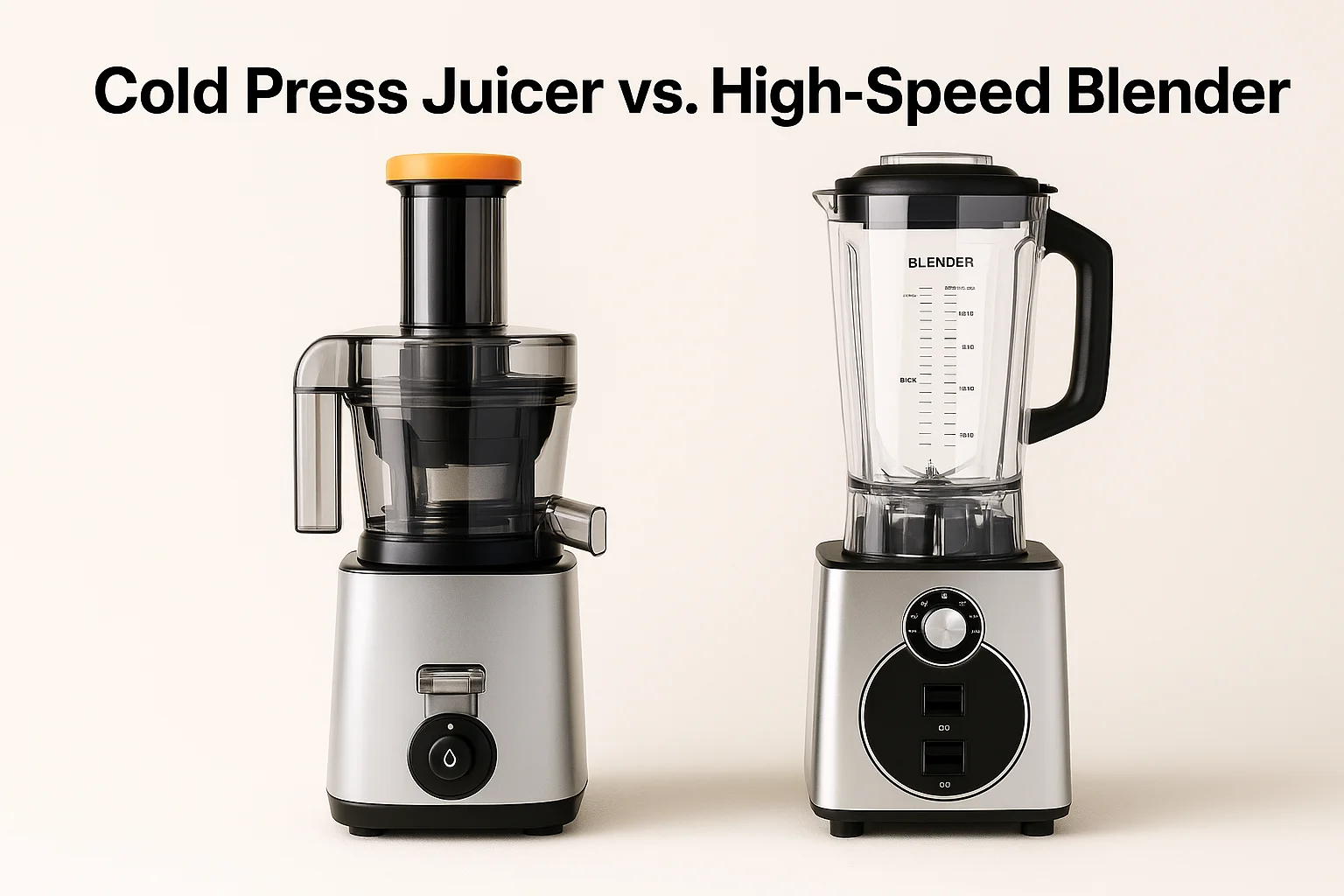
In the growing wellness and health-conscious food industry, the debate between cold press juicers and high-speed blenders has gained momentum—especially for businesses serving juice bars, cafés, or nutritional product lines. For OEM buyers and distributors, understanding the fundamental differences in nutrient retention and product usability can determine market success.
This guide explores the core distinctions between the two technologies, which model better preserves nutritional content, and how ElectMix can help private label clients deliver the right appliance for their audience.
What is a Cold Press Juicer?
Also called a masticating juicer, a cold press juicer uses a slow, grinding motion to extract juice from fruits and vegetables without generating heat. This method is considered ideal for:
- Maximizing enzyme and vitamin retention
- Producing longer-lasting juice (up to 72 hours refrigerated)
- Creating smooth, pulp-free juice perfect for detox programs and wellness menus
Cold press juicers operate at around 40–80 RPM (revolutions per minute), significantly slower than centrifugal or high-speed appliances. The slower extraction avoids oxidation and breakdown of sensitive nutrients such as Vitamin C, B-complex, and antioxidants.
What is a High-Speed Blender?
High-speed blenders are powerful kitchen machines specifically designed to pulverize whole fruits and vegetables with razor-sharp blades. This enables it to blend very hard ingredients into silky smooth mixtures. That’s because a high-speed blender’s one job is to break everything down, including all of the produce’s parts.
It pureés fruits’ skin, pulp and seeds into a smooth, consistent beverage. When you combine together a banana, some spinach and a handful of nuts you get an awesome smoothie. It keeps all the fiber and provides an incredible rich, creamy texture! Unlike juicers, all of the goodness stays in the cup with these blenders, so you’re able to extract more nutrients from each fruit or veggie.
These high-speed blenders are not just for smoothies. They can crush ice for cold drinks, blend nuts into smooth butter, and even make hot soups right in the jar. Most models have the ability to both heat and blend soup in under five minutes, allowing for the fastest meal prep imaginable.
High-speed blenders, often operating at 20,000–30,000 RPM, pulverize whole fruits and vegetables into smoothies or purees. Unlike juicers, they:
- Retain all the fiber and pulp
- Deliver higher satiety due to thicker textures
- Allow blending of seeds, nuts, and frozen items
- Are more versatile for soups, sauces, and multi-use kitchens
While the speed does generate some heat, it’s usually brief and may cause minimal nutrient degradation—often compensated by the fiber content retained.
Nutrient Retention: A Detailed Comparison

It’s one of the first things most users look for when considering the advantages and disadvantages of cold press juicers vs blenders. It is an enormous driver of their decision calculus. Cold press juicers work by crushing and then pressing the juice out of the fruits or vegetables. This unique process retains the maximum vitamins and enzymes in the juice.
In most comparisons, juices produced on cold press machines showed significantly greater amounts of vitamin C, phenolic compounds, and antioxidant capacity. By comparison, juices made with fast-spinning blenders fared worse. Here’s a summary of nutrient retention rates for both methods in a side-by-side comparison.
|
|
|---|
| Nutrient Category | Cold Press Juicer | High-Speed Blender |
| Vitamin C | Preserved (due to low heat) | Slightly degraded (heat exposure) |
| Fiber | Removed | Fully retained |
| Enzymes | Preserved | Partially broken down |
| Antioxidants | Maintained | Maintained but oxidized faster |
| Juice Shelf Life | 48–72 hours (cold-pressed) | Best consumed within 24 hours |
| Satiety & Fullness | Lower (juice only) | Higher (includes pulp & fiber) |
With a juicer, blenders discard the pulp while the drink retains the nutritious fiber. This increases fiber content but can distribute the nutrients more widely. That means you get a creamier beverage loaded with extra fiber!
Some nutrients are likely to degrade more quickly because of the increased air and heat from the blending process. In fact, for certain juices, such as pomegranate, blending retained more antioxidants compared to pressing. Which fruits and vegetables you pick makes a difference, too.
Specifically, carrot and red dragon fruit juices lost their cloud content and oxidized while held cold. Conversely, guava juice showed an increase in particles during storage, possibly due to the size degradation of larger molecules.
How food is stored can make a difference. Cold-pressed juices keep their high nutrient values for around five days max in the fridge. Yet, by the sixth day, most of the nutrients we measured start to drop off.
Cold storage at 4 °C maintained low microbial counts for up to one week. It was more rapid nutrient loss due to room temperature.
Conclusion:
If vitamin preservation and a clean juice experience are the priority, cold press juicers win. If full meal replacement, digestion regulation, or multi-functional appliances are needed, high-speed blenders are superior.
Use Case Scenarios: Which Is Best for Your Business?

Deciding whether to invest in a cold press juicer or a personal blender ultimately depends on your business model, menu objectives, and customer needs. Each kitchen appliance offers unique advantages in various environments, such as coffee shops or health and wellness retailers, making it essential to consider factors like juice yield and the preparation of healthy drinks.
Here’s a brief rundown of what centrifugal juicers and blenders do best, and why they are vital for smoothie lovers and those seeking fresh juice.
1. Juice Bars / Detox Studios
Most juice bars and detox studios prefer to go with the cold press juicers. These machines are cold-pressing machines that extract juice without heat, therefore preserving nutrients and enzymes. The ability to serve customers who appreciate new, pulp-free beverages enhances this.
Juice bars commonly promote the health and purity of cold-pressed juice. Juice recipes might target leafy greens, beets, carrots and seasonal fruit. This range provides consumers with additional choices to meet their personal health goals.
Your marketing can focus on terms such as “nutrient-dense,” “fresh-pressed,” and “detox-friendly,” which instantly attract health-conscious consumers.
2. Smoothie Cafés / Protein Shake Kiosks
These businesses typically opt for high-speed blenders. These protein-packed smoothies whip up fruits, veggies, milk, yogurt and nut butters into thick, creamy drinks. This process makes for easily customizable, filling options loaded with protein powders or supplements.
Several cafés offer gluten-free or vegan options, and with blenders on-hand, it’s simple to customize a recipe. Personalized smoothies allow operators to accommodate various customer preferences and dietary restrictions.
Blenders are better at handling higher volume and require less maintenance, which is important for high-traffic locations.
3. Restaurants / Meal Services
Restaurants rely on blenders for more than cocktails. These modifiers greatly assist in the production of soups, purees and sauces in large volumes. This increases value perception on menus and allows chefs to be much more creative when plating or programming courses into tasting menus.
4. Wellness Stores / Retail Chains
Cold-pressed juices are increasingly becoming the go-to health beverage of choice at wellness stores and retail chains. Others partner with regional brands for quickly available, organic options.
With consumers increasingly seeking beverages with unequivocal health benefits, providing educational content goes a long way to educate and establish credibility.
OEM Insights: What B2B Buyers Should Consider
Just as choosing between a cold press juicer and a blender is about more than specs, so too is comparing their performance. For OEMs, it starts with a thorough understanding of customer expectations. They look at things like how a product will fit into their long-term business plans and how easily they can keep operations running.
Each machine serves a distinct purpose. Blenders are great for smoothies, shakes and frozen drinks. Juicers are meant to extract pure juice. Knowing the real cost, keeping up with regulations, and picking the right supplier can make a big difference for any business.
Target Audience
Access to markets vary significantly. Demand for high-fiber beverages in North America has been strong, making centrifugal blenders a hot commodity. They retain more fiber, which aids digestion and promotes feelings of fullness.
In countries such as Germany and Japan, cold-pressed juice has been a big hit, riding the coattails of booming health trends such as juice cleanses. Here, consumer preference tends towards cold press juicers. B2B buyers must align their product selections with these trends.
Even when it comes to boring old market research, knowing what consumers are looking for—on everything from texture to taste—can inform effective marketing.
Certifications
When it comes to selling globally, compliance is the name of the game. Certifications such as CE, CB, LFGB, and ETL indicate that a product complies with recognized safety and quality standards. This transparency helps build trust and opens doors, especially in stringent markets.
Engaging with the right testing organizations early in the process can help prevent issues and federal complications, and facilitate consistent exports.
Customization Options
Customization beyond a standard one-size fits all approach allows manufacturers to better address local demands. Providing multiple colors, plug types, and motor power options ensures that products are more compatible across various markets.
Providing manuals in local languages and being able to private label products provides buyers with additional brand authority and customer experience management.
Volume Handling
| Feature | Blender | Cold Press Juicer |
|---|---|---|
| Jar Size | 1.5–2 L | Up to continuous extraction |
| Output Style | Batch | Continuous flow |
Especially for consolidated, large-scale operations, they require equipment that won’t cause delays. For smaller, more diverse batches, blenders can be highly effective.
Juicers with continuous configurations are more ideal for locations with high-volume needs, such as juice shops.
ElectMix OEM Models: Customize for Your Market
ElectMix (https://electmix.com) stands out as a maker and supplier of personal blenders and juicers built for different markets. These OEM models provide enterprises the opportunity to customize the machines for what their market needs, such as a centrifugal juicer for higher juice yield. Individual companies can partner with ElectMix to modify the design, add features, or otherwise customize the appearance.
An OEM model for a juice bar in Europe may require a cold press juicer to comply with rigorous safety codes. On one end, for example, a café in Asia might need a blender designed to process hard roots or dense tropical fruit, ensuring they can create refreshing beverages like carrot juice or green smoothies.
Creating a customized ElectMix model will give your business a competitive edge. They decide the colors, the strength of the motor, the type of blades, etc. By doing so, every one of these manufacturers can cater to local trends, health concerns, and flavor, enhancing their offerings of fresh juice and blended smoothies.
Collaborating with the ElectMix team—engineers, designers, project leads—the design process moves quickly to meet both regulations and client desires. Costs can increase, and lead times can lengthen. In the end though, the product is a highly specialized machine tailored for the local market.
Cold Press Juicer – WT-J001
- 85mm wide chute
- BPA-free materials
- Juice & pulp separation
- Custom branding & color options
The WT-J001 cold press juicer is designed to preserve more vitamins and nutrients in each batch. Its innovative slow press system extracts more juice and less waste, with every use. The pieces break down for quick cleaning, a plus for hectic kitchens or juice counters.
Its design translates to less mess, less downtime and superior juice quality. Companies can promote the WT-J001 as an eco-friendly option, as it reduces food waste and consumes less power.
Product Page: WT-J001
👉 Contact us to receive the full OEM specification sheet and pricing.
High-Speed Blender – WT-G830
- 2.0L Tritan jar with noise enclosure
- 2200W peak motor
- Touch control panel
- Perfect for smoothie bars
With the WT-G830 high-speed blender, even tough ingredients and ice turn into smooth beverages. With its powerful motor and robust blades, it blends quickly, allowing shops to serve more customers.
This customizable model allows users to provide their own smoothie or beverage, accommodating a wide array of dietary needs and preferences. With easy cleanup, it’s ideal for areas with a lot of foot traffic.
Product Page: WT-G830
👉 Contact us to receive the full OEM specification sheet and pricing.
Conclusion
Both cold press juicers and high-speed blenders serve distinct needs and audiences. As an OEM buyer, selecting the right model requires understanding your end customers’ usage habits and nutritional priorities.
At ElectMix, we offer tailored solutions for both categories, helping your brand stand out with market-proven features and global certifications.
Looking for a structured way to explore ElectMix insights? Visit the ElectMix Knowledge Center to browse all categories, featured articles, and B2B resources in one place.
📝 Interested in OEM partnership or pricing? Contact ElectMix today.
Frequently Asked Questions
Q1: What is the difference between a cold press juicer and a high-speed blender?
A cold press juicer slowly crushes fruits and vegetables to extract juice without heat, preserving more nutrients. A high-speed blender pulverizes whole ingredients at high RPM, including fiber, ideal for smoothies and soups.
Q2: Which retains more nutrients: juicing or blending?
Cold press juicing retains more heat-sensitive vitamins like vitamin C and enzymes due to minimal oxidation and low temperature. Blending retains dietary fiber and supports satiety and digestive health.
Q3: Is a cold press juicer better for juice bars?
Yes. Cold press juicers are preferred in premium juice bars and wellness centers due to high juice quality, better flavor, and longer shelf life without preservatives.
Q4: Can I OEM a cold press juicer or blender with ElectMix?
Yes. ElectMix provides full OEM services for juicers and blenders, including logo printing, packaging design, voltage customization, and plug options for global markets.
Q5: Which markets are growing faster: juicers or blenders?
Blenders dominate in commercial foodservice and smoothies globally, while cold press juicers are growing in health-focused markets like the US, Germany, and UAE wellness sectors.
ElectMix Team provides global e-commerce sellers and distributors with insights on commercial blending solutions, OEM customization, and profitable market opportunities.