Skip to content

A commercial cold press juicer should be selected around a production workflow, not around a “best juicer” list. The right machine for a juice bar preparing bottles before opening may be different from the right machine for made-to-order drinks, a hotel breakfast station, a health-food retailer or a distributor building a private-label product line.
Before comparing wattage, feed-chute size or headline yield, define what must be juiced, how many servings are required, how quickly staff must clean the machine, and what service support is available after the sale.
This guide provides a practical evaluation method for commercial buyers. It does not claim that ElectMix independently tested and ranked every brand or model on the market. Instead, it explains how to build a repeatable sample test and how distributors and OEM buyers can translate operating needs into a product specification.
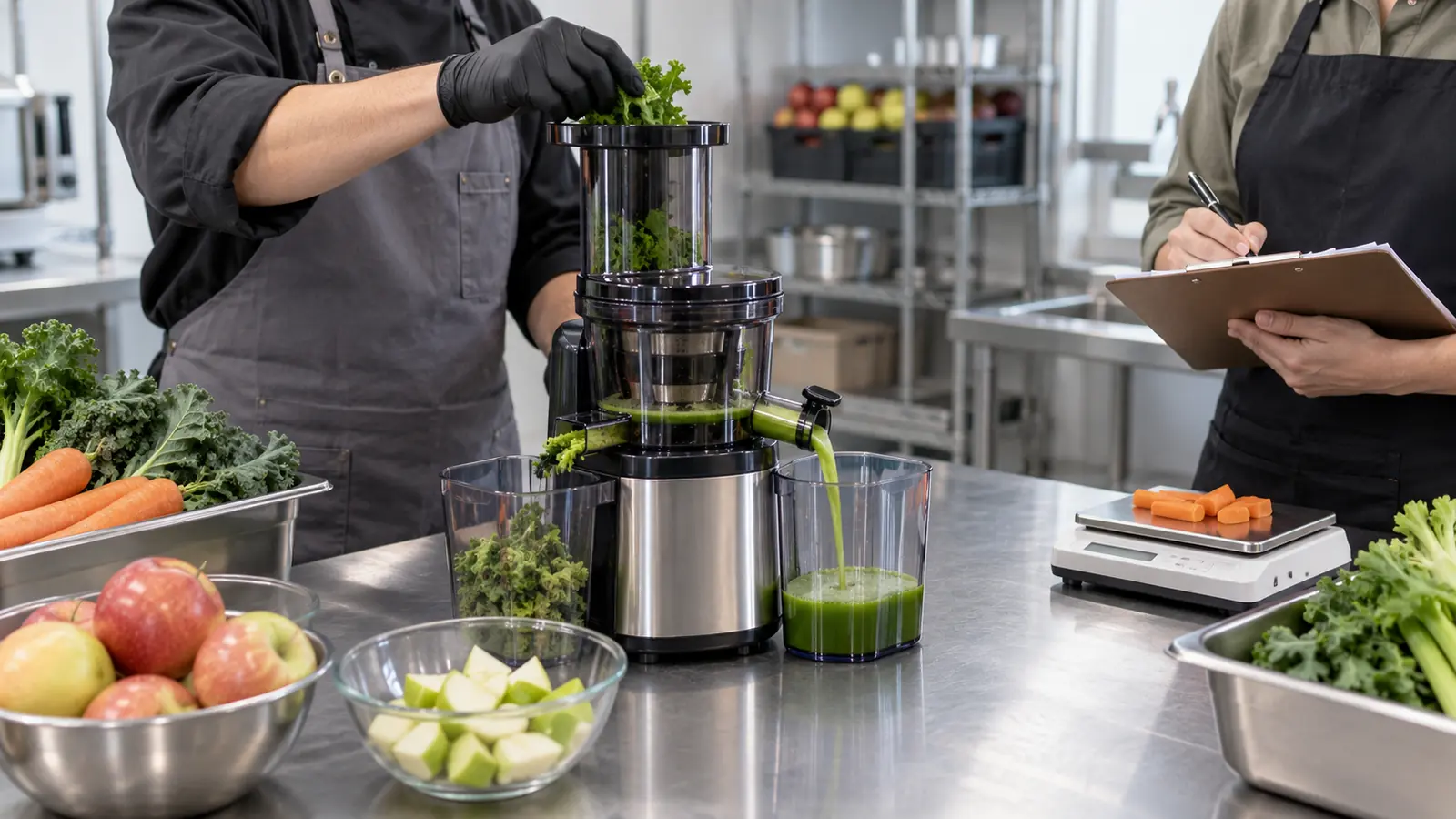
A repeatable sample evaluation should measure the complete workflow, not rely on a single specification.
Quick answer: select by workflow, produce and verified throughput
Evaluate a commercial cold press juicer in this order:
- Define the menu and produce mix.
- Decide whether production is batch or made to order.
- Measure output per hour, including preparation and cleaning.
- Test yield using the same weighed ingredients and procedure.
- Evaluate clogging, pulp discharge and juice consistency.
- Record cleaning and reassembly time.
- Check food-contact materials, cleanability and required certifications.
- Review duty cycle, protection and service parts.
- Compare total operating cost, not only purchase price.
- For OEM projects, verify the platform with production-intent samples before branding or tooling changes.

A commercial sample should be evaluated as an operating system, not by one headline specification.
What “commercial cold press juicer” should mean
The word “commercial” is often used loosely. A machine should not be selected for business use only because it has a large feed chute, stainless-steel appearance or high power rating.
For the intended business, a commercial-ready juicer should offer a suitable combination of:
- repeatable output;
- stable operation under the target load;
- manageable preparation and cleaning time;
- durable food-contact parts;
- safe construction;
- accessible wear parts;
- clear operating limits;
- documentation for the target market;
- service and warranty support;
- a product configuration that can be supplied consistently.
A domestic machine may perform well for occasional use but become inefficient when staff must prepare many batches, clear fibrous produce repeatedly or clean the unit during a service rush. Conversely, a large batch machine may be unnecessary for a café with a small made-to-order menu.
Start with the business model
Made-to-order juice bar
The machine must fit the time between order and delivery. Priorities may include:
- quick startup;
- short ingredient preparation;
- predictable serving output;
- simple changeover between recipes;
- low interruption from clogging;
- manageable noise near customers;
- rapid rinse or cleaning between allergen-sensitive recipes;
- compact counter footprint.
A slow extraction mechanism can still support made-to-order service if the overall workflow is efficient. Measure the complete order time rather than only auger RPM.
Batch production before opening
The business prepares juice in planned batches and stores or dispatches it under its food-safety program.
Priorities may include:
- continuous feed and pulp discharge;
- larger hopper or feed capacity;
- stable output over repeated batches;
- fast disassembly and sanitation;
- documented batch and cleaning procedures;
- reliable cooling or duty cycle;
- consistent juice and pulp separation.
Restaurant or hotel station
The juicer may be one part of a wider kitchen. Staff training, counter space and cleanup can matter more than maximum output.
Priorities may include:
- simple controls;
- clear assembly;
- stable footprint;
- easy-to-identify parts;
- low risk of incorrect reassembly;
- service access;
- appropriate noise and appearance for guest-facing use.
Bottled-juice operation
The juicer is only one step in a controlled process. The business must evaluate produce handling, sanitation, time and temperature, filling, storage, labeling and applicable regulatory requirements.
In the United States, FDA Juice HACCP guidance addresses hazard analysis and control for juice processing. Buyers planning bottled products should review the rules that apply to their operation rather than assuming the juicer itself establishes compliance. See the FDA Juice HACCP Hazards and Controls Guidance.
Distributor or private-label program
The buyer must define channel fit, price tier, expected recipes, documentation, spare parts and warranty exposure across many end users.
Priorities may include:
- stable platform and controlled BOM;
- target voltage and plug variants;
- packaging for the sales channel;
- product and carton labeling;
- regional compliance plan;
- spare-part availability;
- service instructions;
- repeatable sample-approval criteria;
- realistic MOQ.
Cold press, slow juicer and masticating juicer terminology
These terms are frequently used interchangeably in marketing, but buyers should examine the actual mechanism.
Many “cold press” countertop machines use an auger that crushes and presses produce through a screen at relatively low rotational speed. “Masticating juicer” commonly describes the same general family. Some larger commercial presses use a separate grinding and hydraulic or pneumatic pressing process.
Do not assume two machines are equivalent because both say cold press. Compare:
- vertical or horizontal auger arrangement;
- single or twin mechanism;
- feed and cutting method;
- pressure and screen design;
- pulp discharge;
- batch or continuous operation;
- actual produce performance;
- cleaning procedure.
For the distinction between slow extraction and high-speed centrifugal systems, see Cold Press vs Centrifugal Juicer.
Define the produce mix before testing
A machine that performs well with apples may struggle with celery, pineapple fiber, leafy greens or soft berries. Prepare a representative test plan based on the real menu.
Group ingredients by behavior:
- hard roots: carrot, beet, ginger;
- firm fruit: apple, pear;
- citrus: peeled orange, lemon, grapefruit;
- fibrous produce: celery, pineapple core;
- leafy greens: kale, spinach, wheatgrass;
- soft fruit: berries, ripe mango;
- mixed recipes: alternating hard, soft and fibrous ingredients.
Define ingredient maturity, storage temperature, cut size and recipe order. These factors can change yield and clogging.
A fair comparison uses the same ingredient lot or equivalent condition, the same preparation, the same operator method and the same measurement method.
Throughput: measure the complete operating cycle
Catalog throughput can be misleading if it excludes preparation, clearing and cleaning.
Measure:
- ingredient washing and trimming;
- cutting required to fit the feed system;
- active feeding time;
- interruptions to clear bridges or fiber;
- juice and pulp container changes;
- final discharge;
- disassembly;
- cleaning and reassembly.
Calculate useful output per labor hour, not only milliliters produced while the auger turns.
For made-to-order service, record time per serving. For batch production, record kilograms of produce and liters of acceptable juice per complete cycle.

A controlled mass-balance method makes yield comparisons more meaningful.
Yield: use a controlled mass-balance test
“High yield” has no meaning without a method.
A practical comparison can record:
- starting produce mass;
- trimming waste;
- prepared produce mass entering the juicer;
- collected juice mass;
- collected pulp mass;
- residue remaining in the machine;
- foam or solids removed after extraction;
- acceptable final juice mass.
One useful calculation is:
Juice recovery percentage = collected acceptable juice mass ÷ prepared produce mass × 100
Keep the units consistent. Weight is normally more repeatable than reading volume through foam.
Yield is only one outcome. A machine can produce more liquid while also producing unwanted solids, foam or texture. Evaluate the juice against the menu and customer expectation.
Do not claim nutritional superiority from extraction speed alone. Ingredient freshness, oxygen exposure, time, temperature and storage also matter, and broad health claims require appropriate evidence.
Juice quality and consistency
Define the characteristics that matter to the business:
- visible pulp level;
- separation over time;
- foam;
- color;
- texture;
- temperature rise;
- flavor consistency;
- serving appearance;
- sediment acceptable for the recipe.
Use the same container, lighting and observation times. If the product will be bottled, assess it under the actual storage and handling plan, not only immediately after extraction.
The juicer does not determine safe shelf life by itself. The operation’s validated process, sanitation, packaging, temperature control and applicable rules are critical.
Feed system and preparation labor
A wide chute can reduce cutting, but opening size is not the only factor.
Check:
- whether whole produce is actually permitted;
- hopper capacity;
- self-feeding behavior;
- bridging with leafy or irregular ingredients;
- need for a pusher;
- risk of overloading;
- interlocks and access prevention;
- whether hard items strike or stall the mechanism;
- how staff clear a blockage safely.
A large opening that leads to inconsistent feeding may not improve labor productivity. Test with the intended produce and trained operating method.
Motor, gearbox and duty cycle
Low auger speed does not mean low mechanical demand. Dense and fibrous ingredients require torque. The complete drive system includes the motor, gearbox, shaft, bearings, couplings and protection devices.
Ask:
- rated power and supply requirements;
- operating speed under load;
- recommended maximum run time;
- rest or cooling guidance;
- overload protection;
- reverse or anti-jam function;
- thermal protection;
- allowed ambient conditions;
- service access;
- expected wear parts.
Do not select only by wattage. A higher number does not prove better loaded performance or longer duty cycle.
Test repeated batches until the intended service pattern is represented. Record temperature, interruptions, protection events and output consistency without opening the motor base or bypassing safeguards.
For a deeper explanation of motor selection, see Juicer Motor: RPM, Torque and Lifespan.
Vertical and horizontal configurations
Vertical machines often use gravity-assisted feeding and a compact footprint. Horizontal machines may provide a long feed path and can suit particular fibrous or leafy ingredients. Actual results depend on auger, screen, pressure, pulp discharge and recipe.
Compare:
- counter width and height;
- feeding posture;
- ingredient preparation;
- leafy-green and fiber handling;
- pulp outlet access;
- screen removal;
- cleaning time;
- replacement-part availability;
- service access.
Avoid universal statements such as “vertical always yields more” or “horizontal is always better for greens.” Verify with a controlled produce test.
Cleaning time is an operating-cost metric
The best-performing extraction system can become the wrong commercial choice if staff cannot clean it correctly within the workflow.
During evaluation, time and document:
- safe shutdown;
- number of removable parts;
- tools required;
- screen brushing time;
- access to pulp channels;
- gasket removal and inspection;
- areas where fiber becomes trapped;
- rinse water and cleaning method;
- drying and storage;
- reassembly mistakes;
- time until the machine is ready to operate again.
Inspect the machine after cleaning. A fast procedure is not successful if residue remains in seals, screens, corners or outlets.
FDA guidance defines food-contact surfaces broadly to include equipment surfaces that contact food or allow drainage onto food-contact areas. See the FDA guide on microbial food-safety hazards for fresh fruits and vegetables.
Food-contact materials and cleanable design
Ask the supplier to identify the materials used for:
- feed chute and hopper;
- auger;
- screen;
- juice bowl;
- seals and gaskets;
- juice and pulp outlets;
- collection containers;
- pusher;
- any lubricant or component that could contact food under foreseeable conditions.
“BPA-free” is not a complete material specification. Buyers may also need grade identification, supplier declaration, migration or food-contact evidence, restricted-substance information and change control appropriate to the market.
Look for:
- smooth, accessible surfaces;
- no unnecessary crevices;
- seals that can be inspected;
- parts that drain and dry;
- materials compatible with approved cleaners;
- joints that do not trap pulp;
- clear replacement instructions.
NSF/ANSI 8 covers commercial powered food preparation equipment and establishes food-protection and sanitation requirements. Current NSF listings include commercial blenders and juicers under this equipment category. See NSF food equipment certification.
Certification requirements vary by market and installation. Confirm the exact model and listing rather than relying on a supplier logo or a report for a different construction.
Safety and compliance questions
The required route depends on target country, voltage, sales channel and product classification.
Ask for evidence relevant to:
- electrical safety;
- mechanical access to moving parts;
- interlocks;
- overload and thermal protection;
- food-contact materials;
- cleanability;
- electromagnetic compatibility;
- cord, plug and grounding;
- labels, warnings and manual;
- commercial food-equipment requirements;
- factory and model consistency.
Do not ask only, “Does it have CE, UL or NSF?” Ask:
- Which exact model was evaluated?
- Which standard and edition applies?
- Who is the certificate holder?
- Does the report cover the selected voltage, plug and components?
- Which manufacturing location is included?
- What changes require review?
- Is a current public listing available?
For private-label programs, determine whether the brand, model designation and applicant relationship require additional action.
Noise, footprint and counter integration
Cold press systems are often quieter than high-speed centrifugal equipment, but the real sound includes motor, gearbox, produce fracture, vibration and the surrounding counter.
Test in a representative location and record:
- sound during hard and fibrous produce;
- vibration transmitted to the counter;
- movement during stalls or reverse;
- operator communication nearby;
- guest-facing acceptability;
- clearance for feeding and disassembly.
Measure footprint with containers, opened hoppers and parts-removal space, not only the motor base.
Check outlet location, cord routing, splash area, drainage and where wet parts will dry.
Controls and operator error
Simple controls can be an advantage in multi-shift operations.
Evaluate:
- clear start, stop and reverse functions;
- visibility of status indicators;
- behavior after power interruption;
- jam-clearing instructions;
- overload reset;
- whether incorrect assembly is prevented or detected;
- language and symbols;
- resistance to wet hands and cleaning;
- training time.
A machine that depends on one experienced operator may perform poorly when staff turnover is high.
Wear parts and serviceability
Ask which parts are expected to wear:
- screens;
- augers;
- seals;
- wipers;
- bearings;
- gears;
- couplings;
- containers;
- switches;
- feed components.
For each part, ask:
- recommended inspection point;
- typical replacement trigger;
- user-replaceable or service-only status;
- current price;
- lead time;
- model compatibility;
- expected availability period.
Distributors should calculate spare-parts inventory and warranty handling before setting the retail price. A low-cost machine with unavailable screens or seals can create expensive full-unit replacements.
A repeatable sample evaluation protocol
Use the same protocol for every candidate.
Step 1: document the sample
Record model, serial number, voltage, included accessories, configuration and visible condition.
Step 2: inspect assembly
Have an operator assemble the unit from the manual. Note unclear steps, excessive force and incorrect combinations that the design allows.
Step 3: prepare controlled produce batches
Weigh produce, control cut size and record ingredient condition. Use at least one hard, one fibrous, one leafy and one mixed recipe relevant to the business.
Step 4: measure full-cycle time
Include preparation, feeding, interruptions, container changes, disassembly, cleaning and reassembly.
Step 5: measure mass balance
Record prepared produce, acceptable juice, pulp and retained residue.
Step 6: evaluate juice
Record texture, foam, visible solids, separation and temperature using the same method.
Step 7: repeat batches
Represent the expected peak workload. Record protection events, clogging, heat and output change.
Step 8: inspect after use
Look for leakage, wear, trapped residue, difficult seals, loose parts and cleaning damage.
Step 9: review documentation
Verify manuals, parts list, reports, labels, model identity and target-market evidence.
Step 10: calculate operating impact
Estimate labor, cleaning time, produce yield, replacement parts, downtime and packaging or freight cost.
Do not create a single score that hides tradeoffs. A made-to-order café and a batch producer should weight criteria differently.
Sample comparison table
| Evaluation area | What to record | Why it matters |
| Produce preparation | Cut size and minutes | Labor and service speed |
| Juice recovery | Mass from controlled batch | Ingredient economics |
| Throughput | Acceptable output per full cycle | Capacity planning |
| Fiber handling | Stoppages and clearing | Workflow stability |
| Cleaning | Minutes, residue and reassembly | Labor and sanitation |
| Repeated operation | Heat, protection and variation | Peak-service suitability |
| Juice result | Texture, foam and separation | Menu fit |
| Parts | Wear items, price and lead time | Lifecycle cost |
| Documentation | Model-specific evidence | Compliance and sourcing control |
| Packaging | Damage protection and cube | Distribution cost |
Total cost of ownership
Compare more than purchase price.
Include:
- machine price;
- import, freight and tax;
- operator preparation time;
- ingredient yield;
- cleaning labor;
- screens, seals and other wear parts;
- downtime and backup capacity;
- service labor;
- warranty replacements;
- expected useful life under the intended load;
- disposal or end-of-life inventory.
A faster machine may use more labor for cleaning. A high-yield machine may produce a texture the customer does not want. A low-price machine may need frequent parts. The business case should reflect the complete workflow.
Questions distributors should ask an OEM supplier
- Which usage scenarios was the platform designed for?
- What ingredients and repeated-use conditions have been tested?
- What is the recommended run and rest pattern?
- Which parts are common across models?
- Which parts are considered wear parts?
- What material evidence is available?
- What certifications or reports apply to the exact model?
- How are component changes controlled?
- Can the voltage, plug and label be changed without affecting the evaluated construction?
- What is the MOQ per color and market variant?
- Which packaging is proven for the shipping route?
- What inspection and functional tests are performed in production?
- Is a production-intent sample approved before mass production?
- How are complaints and replacement parts handled?
- How long will the platform and its parts remain available?
Use How to Choose a Custom Manufacturing Partner when the project requires tooling, components and coordinated production beyond a standard product platform.
Common buying mistakes
Selecting by RPM alone
Low speed describes only one operating characteristic. Torque, pressure, screen, feeding, pulp discharge and cleaning design determine the usable result.
Comparing yield from different ingredients
Yield claims are not comparable when produce, preparation and measurement differ.
Ignoring preparation and cleaning labor
The complete cycle determines commercial capacity.
Assuming “BPA-free” proves all food-contact compliance
Material identity, intended use, temperature, chemicals, evidence and change control may all matter.
Choosing a wide chute without testing feeding behavior
Opening size does not guarantee stable self-feeding or less cutting.
Buying one unit without a spare-parts plan
Screens, seals and augers can stop production if replacements are unavailable.
Applying a certification from a different model
Verify model, construction, voltage and manufacturing location.
Launching too many variants
Colors, plugs, labels and cartons can multiply MOQ and service inventory.
How ElectMix supports juicer and custom appliance projects
ElectMix works with distributors, importers and private-label brands evaluating commercial blender and juicer platforms. Project review can include target-user definition, motor and drive considerations, food-contact parts, controls, packaging, branding, sample approval and production planning.
ElectMix also supports broader custom product development involving metal and plastic structures, tooling, components, assembly and coordinated manufacturing resources. Depending on the project, selected processes may be managed directly or coordinated through qualified production partners, with responsibilities and quality requirements defined in the project plan.
For a juicer product-line request, provide target markets, recipes, expected batches per day, preferred configuration, voltage, plug, packaging channel and forecast volume.
To discuss an OEM juicer or custom appliance project, use the ElectMix Custom Manufacturing RFQ.
Frequently asked questions
Is a cold press juicer always better than a centrifugal juicer for business use?
No. Cold press machines can suit yield, texture and noise priorities, while centrifugal machines may support faster made-to-order service for some menus. Compare the full workflow, produce mix and customer expectation.
What RPM is best for a commercial cold press juicer?
There is no universal best RPM. Low-speed extraction must be evaluated with torque, auger and screen design, feed behavior, pulp discharge, duty cycle and actual produce performance.
How should juice yield be compared?
Use the same weighed produce, preparation, operator method and collection rules. Record acceptable juice mass, pulp and retained residue. Do not compare unrelated catalog claims.
How important is feed-chute size?
It affects preparation, but hopper design, self-feeding, safety, bridging and clogging also matter. Test the actual produce rather than relying on diameter alone.
What parts usually need replacement?
Depending on the design, screens, seals, wipers, augers, containers, gears or couplings may wear. Obtain a model-specific parts list and replacement triggers.
Does a juicer need NSF certification?
Requirements depend on the market, authority, installation and sales channel. For commercial food-service use, buyers should verify applicable sanitation standards and the exact model’s current listing rather than relying on a general claim.
Can a domestic slow juicer be used in a juice bar?
Only if its intended use, duty cycle, cleanability, documentation, service support and local acceptance fit the business. A good household result does not automatically establish commercial suitability.
How many samples should an OEM buyer test?
Begin with enough engineering samples to compare and correct the design, then approve production-intent samples and verify a pilot run. The number depends on variants, destructive tests, laboratories and risk.


ElectMix Team provides global e-commerce sellers and distributors with insights on commercial blending solutions, OEM customization, and profitable market opportunities.