 Skip to content


A commercial blender product line should not be built by collecting several machines with different wattage labels. It should be built around distinct customer jobs, price positions, operating environments and service expectations. For a distributor, importer or private-label buyer, the strongest range is usually not the range with the most SKUs. It is the smallest range in which every SKU has a clear reason to exist.
That distinction matters because two blenders can look different in a catalog yet compete for exactly the same order. The result is duplicated inventory, slower stock rotation, confused dealers and a spare-parts burden that grows faster than sales. At the other extreme, a range with only one generic blender may be easy to manage but too narrow for cafés, smoothie bars, restaurants and institutional kitchens with different workflows.
This guide explains how to design a commercial blender product line from a distributor’s point of view. It covers channel segmentation, SKU roles, specification control, landed cost, compliance, packaging, warranty planning, service parts, supplier assessment and pilot launch. It is intentionally different from our guide to what makes a commercial blender heavy duty, which focuses on workload capability and equipment qualification. Here, the main question is not “Is this blender powerful?” It is “Does this product earn a defensible place in the line, and can we support it after sale?”
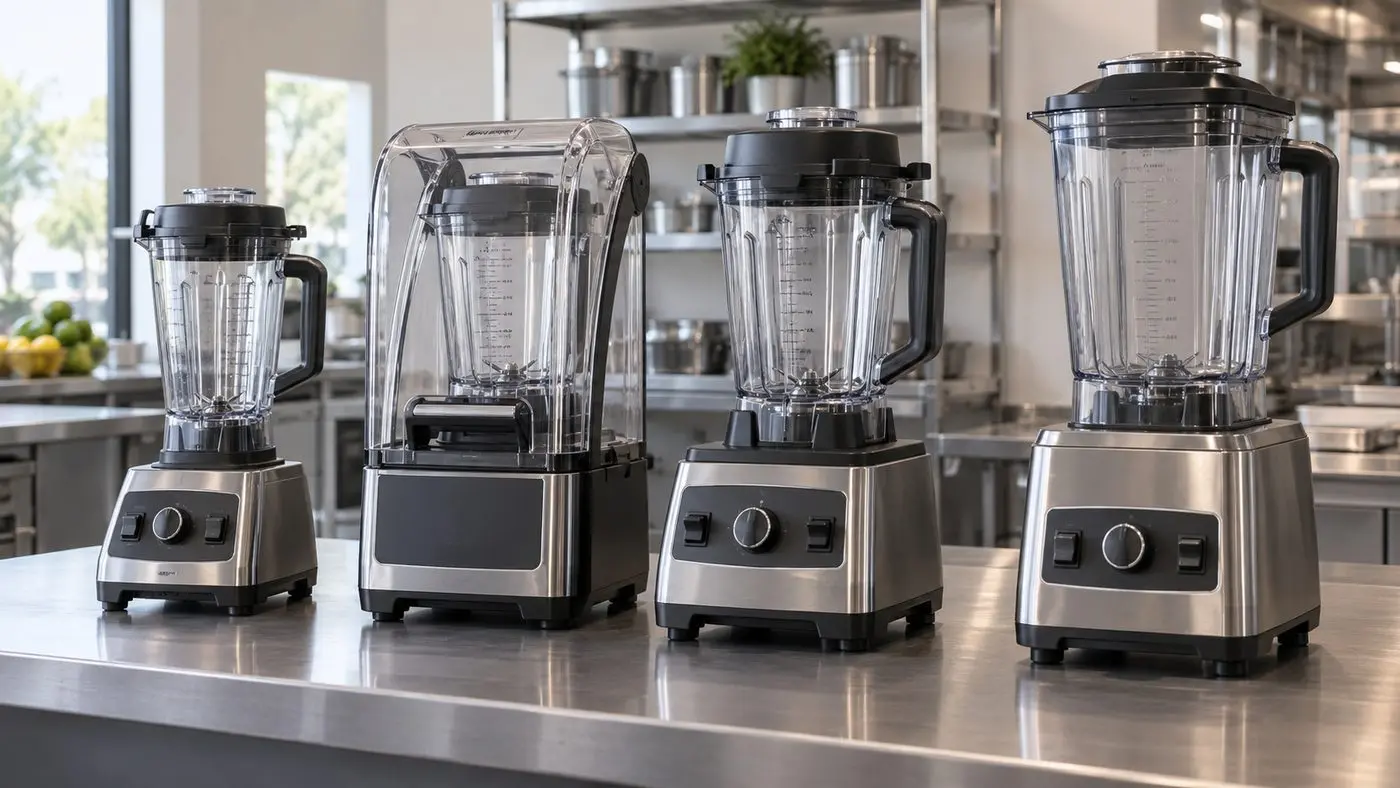
Four realistic commercial blender SKU roles for a distributor product line
Quick Answer: Build the Line Around Distinct Customer Jobs
For many distributors, a practical starting architecture contains three clearly separated roles:
- Core commercial model: the main-volume unit for cafés, restaurants and general drink preparation.
- Quiet front-of-house model: a sound-enclosure unit for bars, coffee counters, hotel lounges and other customer-facing locations.
- High-demand model: a more robust system for smoothie bars or operations with difficult recipes and repeated peak-period cycles.
A fourth, higher-capacity batch-prep model may be justified when the distributor has confirmed demand from central kitchens, catering or back-of-house preparation. It should not be added merely to make the catalog appear complete.
Each SKU needs its own target user, recipe range, jar configuration, duty profile, price band, warranty logic and sales message. If the sales team cannot explain the difference between two models in one sentence, the range probably has unnecessary overlap.
| SKU role | Best-fit channel | Main buying reason | Key risk to control |
| Core commercial | Cafés, restaurants, bars, equipment dealers | Versatile everyday performance and manageable ownership cost | Being specified too broadly for every workload |
| Quiet front-of-house | Coffee shops, hotel bars, open counters | Lower disruption at the service counter | Treating an enclosure as proof of low sound without a test method |
| High-demand | Smoothie bars, frozen-drink operations | Better tolerance of difficult recipes and repeated cycles | Selling peak power instead of verified workload capability |
| Batch-prep | Catering, central kitchens, back-of-house prep | Larger batches and fewer loading steps | Adding capacity that customers do not need or cannot clean efficiently |
The product-line decision should therefore begin with market evidence and operating scenarios, not a supplier’s model list.
Start with Customers, Channels and Recipes

A distributor rarely sells into one uniform market. Even within foodservice, the person paying for a blender may be a café owner, a restaurant purchasing manager, a hotel group, an equipment dealer, an online buyer or a chain’s technical team. Their decision criteria differ.
Segment by operating environment
Start by documenting where the blender will physically operate:
- front counter or back kitchen;
- low, moderate or sustained order volume;
- customer-facing or staff-only environment;
- individual drinks or batch preparation;
- fixed menu or frequently changing recipes;
- trained operator or high-turnover staff;
- local service coverage or return-to-distributor repair.
This information affects more than performance. A front-counter blender may need a compact footprint, visually clean enclosure, simple controls and a credible sound comparison. A back-kitchen model may place greater emphasis on rapid loading, jar interchangeability and cleaning flow. An online channel may create stricter packaging and return-management requirements because the unit travels through parcel networks rather than palletized dealer distribution.
Define recipe families, not one demonstration recipe
The distributor should define the recipes that represent the intended market. Useful groups may include liquid beverages, fruit smoothies, ice-heavy drinks, frozen-fruit recipes, sauces, purées or selected food-preparation tasks allowed by the model’s instructions. The purpose is not to claim that every commercial blender should process every ingredient. It is to create a test set that separates the planned SKU roles.
Record ingredient weights, liquid ratio, starting temperature, batch size, cycle sequence and acceptable result. A supplier demonstration using an easy recipe proves very little about the planned line. Production-intent samples should be tested with recipes that reflect the actual customer mix.
For a general equipment-selection workflow, use the commercial blender buying guide. It explains how to translate recipes, workload, workspace and service conditions into a purchase specification. The product-line plan should use the same evidence, but apply it across several distinct offers.
Give Every SKU a One-Sentence Role
SKU architecture is the bridge between market research and the supplier request. Before asking for samples, write a one-sentence role for every planned model. For example:
- “The dependable main-volume blender for independent cafés and restaurants.”
- “The enclosed front-counter blender for locations where customer conversation matters.”
- “The high-demand blender for frozen recipes and repeated peak-period use.”
- “The larger batch-prep blender for trained back-of-house teams.”
These statements are internal decision tools, not marketing copy. They prevent the project from drifting when suppliers offer attractive additional functions.
Set non-negotiables and optional features
For each role, divide requirements into three groups:
- Required: without this feature or verified capability, the SKU cannot serve its intended channel.
- Preferred: valuable if cost, feasibility and schedule permit.
- Optional: a possible future variant, not required for launch.
This protects the core project from feature inflation. A programmable cycle, alternate jar, sound enclosure or digital control may be useful for one SKU and unnecessary for another. Every added option affects components, software or controls, labels, manuals, packaging, test scope, stock planning and service training.
Separate visible differentiation from operational differentiation
Colors, control panels and housing finishes create visible separation. More important differences often sit behind the catalog image: cooling architecture, jar and blade configuration, enclosure behavior, control logic, service access, replacement-part availability and verified workload. A distributor needs both types of differentiation.
Cosmetic changes alone may not justify a second SKU. Conversely, two machines that look similar may deserve separate roles when their duty profile, noise treatment or jar system is materially different. The specification and dealer training must make that distinction clear.
Prevent Cannibalization and Catalog Confusion
Adding a SKU has a real operating cost. It consumes forecasting attention, shelf space, cash, spare-parts inventory, content-production time and sales training. The question is not only whether a model can sell. It is whether it adds profitable coverage that the existing range does not provide.
Use a simple overlap test before approving a model:
| Question | Evidence to review | Warning sign |
| Does it serve a new customer or job? | Account interviews, lost-order reasons, dealer feedback | Same buyers and recipes as an existing SKU |
| Is the price step understandable? | Landed-cost model and target margin | Small price gap with no meaningful operational benefit |
| Can sales explain the difference quickly? | Draft line card and sales script | Explanation depends on vague “more professional” language |
| Does it require unique parts? | Service BOM and compatibility map | Many unique low-volume items |
| Can demand support the MOQ? | Forecast by channel and region | Supplier MOQ exceeds realistic sell-through |
A range of three disciplined SKUs can cover more usable demand than six poorly separated ones. When two models overlap, improve the stronger role or create an accessory option instead of automatically launching both.
Use a Price Ladder Without Designing to Price Alone
Entry, core and premium positions can help customers understand a range, but the labels must correspond to real differences. The core model usually deserves the most attention because it often carries the broadest demand and becomes the reference point for dealer conversations.
The entry model should not be a weakened product that creates disproportionate warranty claims. It may instead use simpler controls, fewer accessories, a different jar package or a narrower approved workload. The premium model should solve a higher-value problem, such as front-of-house sound management, difficult recipe capability, faster workflow or stronger service provisions. Decorative upgrades alone are easy for competitors to copy and difficult for dealers to defend.
Do not use an arbitrary retail multiplier as the full business case. The price ladder must reflect landed cost, channel discounts, promotions, warranty reserve, returns, spare parts, local compliance activity, content and sales support. A SKU can carry an attractive gross margin on paper and still be unprofitable if returns are high or common repair parts are unavailable.
Build One Controlled Specification for Each Market Version
After the SKU roles are clear, create a controlled product specification rather than relying on a supplier quotation or catalog page. The document should identify the exact market version and link each claim to a measurable requirement or approved record.
Include at least:
- target channels and applications;
- permitted recipes and operating boundaries;
- rated electrical information for the destination market;
- motor and thermal-protection requirements;
- jar material, working capacity, lid and tamper configuration;
- blade, bearing, seal and drive-coupling configuration;
- control functions and cycle behavior;
- sound-enclosure requirement where applicable;
- cleaning and food-contact requirements;
- dimensions, weight and counter-clearance limits;
- label, manual, carton and accessory requirements;
- inspection points and acceptance criteria;
- service parts and revision compatibility;
- compliance documents required for that market.
The specification should avoid using a single impressive number as a substitute for system performance. The commercial blender motor guide explains why input power, torque behavior, cooling, protection and the load path must be assessed together. The blender jar materials guide covers visibility, impact risk, weight, heat and cleaning tradeoffs among Tritan-type copolyester, stainless steel and glass. Link to those technical decisions rather than duplicating their entire explanation in the line plan.
Control variants at the document level
A different plug, voltage, frequency, rating label, manual language or certification mark can create a different market version. Treat those differences as controlled configuration data. A carton label or power cord selected informally near shipment can break an otherwise well-managed project.
Use a version table with model code, electrical version, plug, jar set, label revision, manual revision, packaging revision and applicable market. The same identifier should appear in purchase orders, inspection records, service documentation and spare-parts references.
Model Landed Cost and the Cost to Support the SKU

The quoted unit price is only one component of the distributor’s cost. A useful commercial model separates one-time project costs, per-unit landed costs and post-sale support costs.
One-time and pre-launch costs
Depending on the project, these may include:
- engineering or customization work;
- tooling, fixtures or branded components;
- production-intent samples;
- laboratory testing and certification activity;
- artwork, manual and packaging preparation;
- inspection setup;
- initial spare-parts stock;
- photography, line cards and dealer training.
These costs should be allocated using a conservative sales forecast, not an optimistic multi-year volume that has not been validated.
Per-unit landed costs
Calculate the product price together with inland freight, export handling, international freight, insurance, duty, brokerage, inspection and destination handling. The correct variables depend on the trade lane and commercial terms. Do not assume that a supplier’s unit price can be compared directly across quotations with different Incoterms, packaging density or included accessories.
Post-sale costs
Estimate a warranty reserve using available evidence from samples, pilot units and comparable products. Include expected diagnostic labor, replacement parts, shipping, full-unit replacements and dealer credits. Also consider stock held for service parts and the cost of supporting obsolete revisions.
Life-cycle cost is a useful general framework because it asks decision-makers to compare costs over the useful period rather than purchase price alone. The NIST Life-Cycle Costing Manual is not a blender-specific purchasing standard, but it explains the underlying economic method. A distributor can adapt that principle using its own verified freight, labor, failure and inventory data.
Plan Compliance Before Confirming Tooling or Packaging
Compliance is market- and configuration-specific. A report for one voltage or construction does not automatically cover every derivative, and a supplier statement is not a substitute for reviewing the relevant certificate, report scope and model identification.
For powered commercial kitchen machines, the applicable electrical-safety route can involve the IEC 60335 family and national or regional deviations. IEC lists the current commercial electric kitchen machine test-report framework against IEC 60335-2-64 and IEC 60335-1. The exact standard edition and conformity route must be confirmed with a competent laboratory or certification body for the destination market; see the IEC commercial kitchen machine reference.
Food-zone construction also requires deliberate review. NSF commercial food-equipment standards describe sanitation-focused requirements for materials, design and construction, including NSF/ANSI 8 for powered commercial food-preparation equipment. Whether certification is required depends on the target market, buyer and installation context, but cleanability and food-contact documentation should never be left until after mass-production packaging is complete.
The distributor’s file should connect the marketed model to its:
- certificate or declaration, where applicable;
- test report and listed construction;
- critical component list;
- food-contact material declarations;
- rating label and warning labels;
- user manual and cleaning instructions;
- packaging marks and local-language content.
Use the ElectMix overview of commercial blender certifications as a planning starting point, then obtain project-specific advice. Avoid advertising “certified” without confirming the exact model, holder, scope, market and validity of the supporting document.
Treat Packaging as Part of the Product System
Packaging protects the appliance, but it also controls accessory completeness, dealer handling, parcel damage, presentation and customer setup. A product designed for palletized dealer deliveries may not survive an e-commerce parcel route without a different packaging system.
Document carton dimensions, gross weight, stacking orientation, handle requirements, internal supports, bagging, surface protection, accessory locations and label positions. Check that the jar, lid, tamper, manual and cord cannot migrate into damaging contact during transport. Heavy components need controlled support, while brittle or transparent parts need protection from point loading and abrasion.
Use a distribution test that matches the actual shipment system. ISTA’s official test procedures provide recognized packaged-product testing options, but the correct procedure and assurance level should be selected for the product and distribution route. Passing one laboratory sequence does not guarantee zero field damage; combine testing with pilot shipments, damage records and packaging-change control.
Packaging changes must be revision controlled. A small reduction in foam density, carton strength or insert geometry can alter damage risk. The approved packaging specification, supplier, material grade and packing method should be part of the controlled product record.

Commercial blender after-sales parts, compatible jars and protective packaging on a service bench
Build the After-Sales System Before the First Shipment
After-sales capability is a product-line feature even though it may not appear on the retail specification sheet. For distributors, the practical questions are straightforward: Can the problem be diagnosed safely? Is the correct part available? Does the replacement fit this revision? Can the issue be resolved locally, or must the unit be returned?
Define support levels
Separate tasks into clear levels:
- Operator tasks: cleaning, correct loading, jar seating, approved reset procedures and checks described in the user manual.
- Distributor triage: verify model and serial or batch code, reproduce the symptom, inspect external parts, confirm power and operating conditions, and select the correct service path.
- Qualified service work: electrical diagnosis, internal repair and safety-related replacement performed only by trained or authorized personnel.
The commercial blender troubleshooting guide provides a safe first-line framework. It should not be used to encourage operators to open the motor base. The distributor’s warranty policy and service manual determine what work is permitted.
Create a service-parts matrix
List the parts that fail, wear, become lost or are damaged through normal commercial operation. These commonly include jars, lids, cap plugs, tampers, drive couplers, selected seals or jar assemblies, switches and power cords, subject to the service design. Classify each item as customer-replaceable, dealer-replaceable or qualified-service-only.
For every part, record:
- part number and description;
- compatible model and revision range;
- safety or food-contact significance;
- expected lead time;
- minimum stock level;
- replacement instructions;
- supersession relationship when a revision changes.
Compatibility is especially important when a visual change hides a dimensional or electrical difference. Do not use “fits all” descriptions unless compatibility has been verified across the listed revisions.
Use failures to improve the line
Warranty and return records should use standardized symptom and cause codes. “Blender not working” is not enough. Useful categories may include no power, intermittent control, thermal interruption, jar leakage, drive wear, unusual sound, packaging damage, missing accessory or customer misuse. Confirmed causes must be separated from reported symptoms.
Trend the data by SKU, production batch, market and age at failure. Feed recurring issues into supplier corrective action, packaging improvement, manual updates, dealer training and the next product revision. The overheating prevention guide can support operator education, but it should not be used to dismiss repeated thermal events that require engineering investigation.
Align MOQ, Forecasting and Spare Parts
Minimum order quantity is not merely a supplier constraint. It should be evaluated against expected sell-through, cash cycle, container utilization, variant count, service obligations and component commitments.
Forecast demand by SKU and channel, not only for the total range. A mixed order can look healthy in aggregate while leaving one slow variant with excessive stock. Discuss whether colors, plugs, jars, control panels and cartons create separate component MOQs even when the final-assembly MOQ appears manageable.
A practical first-order plan may prioritize the core model, use smaller evidence-based quantities for premium or specialized units, and include service parts from the same approved revisions. Reorder points should reflect manufacturing lead time, transport time, sales variability and buffer policy. Avoid promising continuous availability until the replenishment model has been tested.
For private-label development, ElectMix can evaluate project requirements through direct resources and coordinated manufacturing partners, while maintaining clear responsibility for the agreed deliverables. Feasibility, customization depth, tooling, MOQ, schedule and compliance must be confirmed for the specific project. See custom manufacturing for the broader development approach.
Evaluate the Supplier Beyond the Sample
A strong sample is necessary but not sufficient. The distributor is buying a repeatable supply system. Supplier assessment should examine how the approved product will be controlled across future production.
Review:
- responsibility for design files, tooling and critical specifications;
- incoming component controls;
- assembly and in-process checks;
- end-of-line functional and safety tests;
- traceability of key components and production batches;
- treatment of nonconforming material;
- engineering-change approval;
- calibration and maintenance of relevant test equipment;
- capacity, lead-time assumptions and peak-season planning;
- service-parts continuity;
- packaging and label control;
- communication and corrective-action discipline.
Ask to see records that match the proposed product and process. A generic quality certificate or factory presentation does not by itself show how the specific blender is controlled.
Require written change notification
Motors, controllers, thermal protectors, bearings, polymers, blades, switches, power cords and packaging materials can change during a product’s commercial life. Some substitutions may appear equivalent yet change noise, heat, performance, durability, compliance or service compatibility.
The supply agreement and specification should define which changes require prior written approval and what evidence is needed. Depending on risk, that evidence may include drawings, samples, comparison tests, updated declarations, laboratory review or renewed certification activity. Approved changes should update the bill of materials, revision code, inspection plan, service matrix and marketing claims where applicable.

Commercial blender SKU samples, jar options and packaging evaluated for a distributor launch
Approve Samples and a Pilot Before Launch
The sample process should progress from concept confirmation to production-intent validation. A hand-built demonstration unit may contain different components or workmanship from the planned production process, so label each sample stage clearly.
Use a controlled sample evaluation
Evaluate all proposed SKUs using a shared test structure, while keeping role-specific acceptance criteria. Record:
- model, revision and sample identification;
- electrical version and accessories;
- ingredient recipe and batch size;
- cycle sequence and recovery time;
- texture or processing result using defined criteria;
- leakage, movement and abnormal behavior;
- external temperature observations where relevant;
- cleaning steps and elapsed time;
- enclosure use and sound-test conditions where relevant;
- visible quality, labels, manual and packaging;
- issues, corrective actions and retest result.
Quiet models require a repeatable comparison. The quiet commercial blender guide explains why distance, room, counter, recipe and test procedure must accompany any sound value. Do not make an absolute “silent” claim.
Run a pilot that tests the business system
A pilot is not only a smaller production order. It is a controlled opportunity to test production repeatability, inspection, documentation, packaging, warehouse handling, dealer materials, installation, customer onboarding, spare-parts identification and warranty triage.
Define pilot acceptance criteria before shipment. Review defects, process deviations, packaging observations and field feedback before authorizing scale-up. If the pilot reveals a change, record the revision and confirm whether the evidence, artwork, compliance documents or service stock must also change.
Prepare Dealer and Marketplace Content from Evidence
A distributor needs consistent product content across line cards, listings, quotations, training and after-sales documents. The master data record should control model names, dimensions, rated electrical information, jar capacity, included accessories, permitted applications, warnings, warranty terms and verified performance statements.
Avoid copying unqualified supplier claims into public listings. Terms such as “heavy duty,” “quiet,” “professional,” “unbreakable,” “maintenance-free” and “continuous use” can create expectations that the evidence does not support. Explain the intended job and the conditions under which it was evaluated.
For each SKU, prepare:
- a short role statement;
- a verified specification table;
- approved product and accessory images;
- a model-comparison table;
- setup, operation and cleaning instructions;
- warranty and service route;
- compatible spare-parts list;
- compliance statements appropriate to the market;
- documented answers to common dealer questions.
Product pages should help the buyer self-select without presenting every difference as universally superior. ElectMix’s current commercial blender product range can provide a starting point for discussing available configurations; project-specific specifications still require confirmation.
Common Product-Line Mistakes

Launching too many SKUs
More models increase complexity before they prove demand. Begin with roles supported by customer evidence and a realistic forecast. Add a model when it covers a documented gap, not because a supplier has another housing available.
Comparing only wattage or peak horsepower
Label values do not describe the full system, workload or durability. Use recipe and cycle tests, thermal behavior, jar system, drive path, controls and protection to qualify the product for its role.
Using the same model for every channel
A successful general café blender does not automatically fit a quiet hotel bar, high-demand smoothie counter, online parcel channel and central kitchen. Channel conditions change the equipment, packaging, service and content requirements.
Leaving compliance until the order is ready
Late compliance review can force changes to critical components, labels, manuals or construction. Confirm the target markets and evidence route before final tooling, artwork and production commitment.
Treating spare parts as an afterthought
Without a parts list, compatibility control and stock policy, minor issues become full-unit returns. Approve service parts with the production version and include them in the launch plan.
Accepting substitutions without change control
An “equivalent” component may alter performance or documented construction. Require notification, evidence and approval before production use.
Promising results from an uncontrolled sample
A favorable demonstration does not prove production consistency. Identify sample status, record the test method and confirm the result in production-intent and pilot units.
Distributor Product-Line Checklist
Before placing the launch order, confirm that the team can answer “yes” to the following:
- Each SKU has a distinct customer, channel and one-sentence role.
- The recipe set and workload reflect real buyers.
- Required, preferred and optional features are separated.
- The price ladder corresponds to operational value.
- Unit economics include landed and post-sale costs.
- Every market version has a controlled specification and identifier.
- Compliance evidence matches the exact model and destination market.
- Production-intent samples passed documented tests.
- Packaging was reviewed for the real distribution route.
- A pilot has acceptance criteria and a review gate.
- Service levels and warranty triage are defined.
- Spare parts have codes, compatibility and stock rules.
- Supplier change notification is written into the control process.
- Public product claims can be traced to evidence.
- Forecast and MOQ are workable by SKU, not just in total.
If several answers are still “no,” reducing the launch scope is often more effective than adding features or rushing the purchase order.
Frequently Asked Questions
How many commercial blender SKUs should a distributor launch?
There is no universal number. Many distributors can begin with three distinct roles: a core commercial model, a quiet front-of-house model and a high-demand model. Add a batch-prep or specialist SKU only when customer evidence, margin, MOQ and service capacity justify it. Every model should cover a clear gap rather than duplicate an existing offer.
Should an entry-level commercial blender simply have a lower-power motor?
Not necessarily. Reducing system capability without narrowing the approved job can create failures and warranty cost. An entry model can instead use simpler controls, fewer accessories or a more focused application while retaining appropriate safety, cooling, jar integrity and serviceability for its specified workload.
Can the same blender be sold in every country?
Do not assume so. Voltage, frequency, plug, power cord, rating label, language, safety standards, food-contact expectations and certification routes vary. Treat each market version as a controlled configuration and confirm the applicable requirements with competent local specialists or certification bodies.
How should two similar blender models be differentiated?
Differentiate them by customer job, operating environment, verified workload, workflow, sound treatment, jar system, control functions, service package or another meaningful benefit. If the distinction is only cosmetic and the same buyers would choose either model, maintaining both may create avoidable inventory and sales confusion.
What costs belong in a commercial blender landed-cost model?
Include the quoted product, inland and international freight, export handling, insurance, duty, brokerage, inspection, destination handling and applicable warehousing. Separately account for one-time development and compliance costs plus post-sale warranty, returns, replacement shipping and spare-parts inventory.
Which spare parts should be stocked at launch?
Stocking should reflect the product design, lead time and service model. Common planning items include approved jars, lids, cap plugs, tampers, drive couplers and selected service assemblies. Record part codes, revision compatibility and whether replacement is permitted for the customer, dealer or qualified technician.
Is a sound enclosure enough to market a blender as quiet?
No. An enclosure can reduce airborne sound, but the measured result also depends on recipe, cycle, room, counter, distance and measurement method. Compare production-intent samples under controlled conditions and describe the conditions behind any published sound statement. Avoid claims such as “silent.”
When should compliance be checked in an OEM blender project?
Check the destination markets and likely compliance route before freezing construction, tooling, labels or packaging. Review again when critical components or market variants change. Late review can cause redesign, retesting, documentation changes and launch delays.
What is the purpose of a pilot order?
A pilot verifies more than product function. It tests production repeatability, inspection, packaging, documentation, warehouse handling, dealer setup, service-part identification and warranty processes. The pilot should have written acceptance criteria and a formal review before mass-production scale-up.
What information should a distributor send when requesting a commercial blender proposal?
Provide target countries, channels, expected annual and first-order quantities, recipe families, batch size, peak workload, jar preference, control and noise needs, compliance expectations, packaging route, warranty model, branding scope, target schedule and required service parts. Clear inputs make feasibility and quotation discussions more reliable.
Final Recommendation
Build the commercial blender product line from the market backward. Define customer jobs, give each SKU a distinct role, qualify production-intent samples, calculate the full support cost and establish compliance, packaging, service parts and change control before scale-up. Technical performance remains essential, but it only creates a sustainable distributor offer when the surrounding supply and after-sales system is equally deliberate.
ElectMix can help assess a commercial blender or private-label product-line brief, identify the information needed for feasibility review and coordinate suitable development and manufacturing resources for the agreed project scope. Capabilities, quantities, tooling, schedule, testing and compliance are confirmed case by case. To begin, contact ElectMix with your target market, channel, recipes, quantity and required SKU roles.

Marketing & Product Lead at ElectMix | Innovating Commercial Blenders & Home Appliances | Driving Growth & Development


