Skip to content

The better commercial juicer is not automatically the slower one, the faster one or the one with the highest advertised yield. It is the machine that produces an acceptable beverage from your actual produce mix at a cost and pace your operation can sustain. Cold press and centrifugal juicers create different workflows, but extraction type alone does not determine profit, food safety or shelf life.
For a juice bar, café, restaurant, hotel or distributor, the decision should be based on a controlled comparison: usable juice yield, preparation and processing time, cleaning labor, texture and foam, recipe compatibility, wear parts, downtime, compliance and the sales channel. Bottled juice introduces additional process controls that cannot be solved by choosing a machine category.
This guide replaces universal nutrition, yield and shelf-life claims with a repeatable business evaluation. It explains what each system does, how to test candidates fairly and how to calculate total cost before approving a juicer or private-label program.
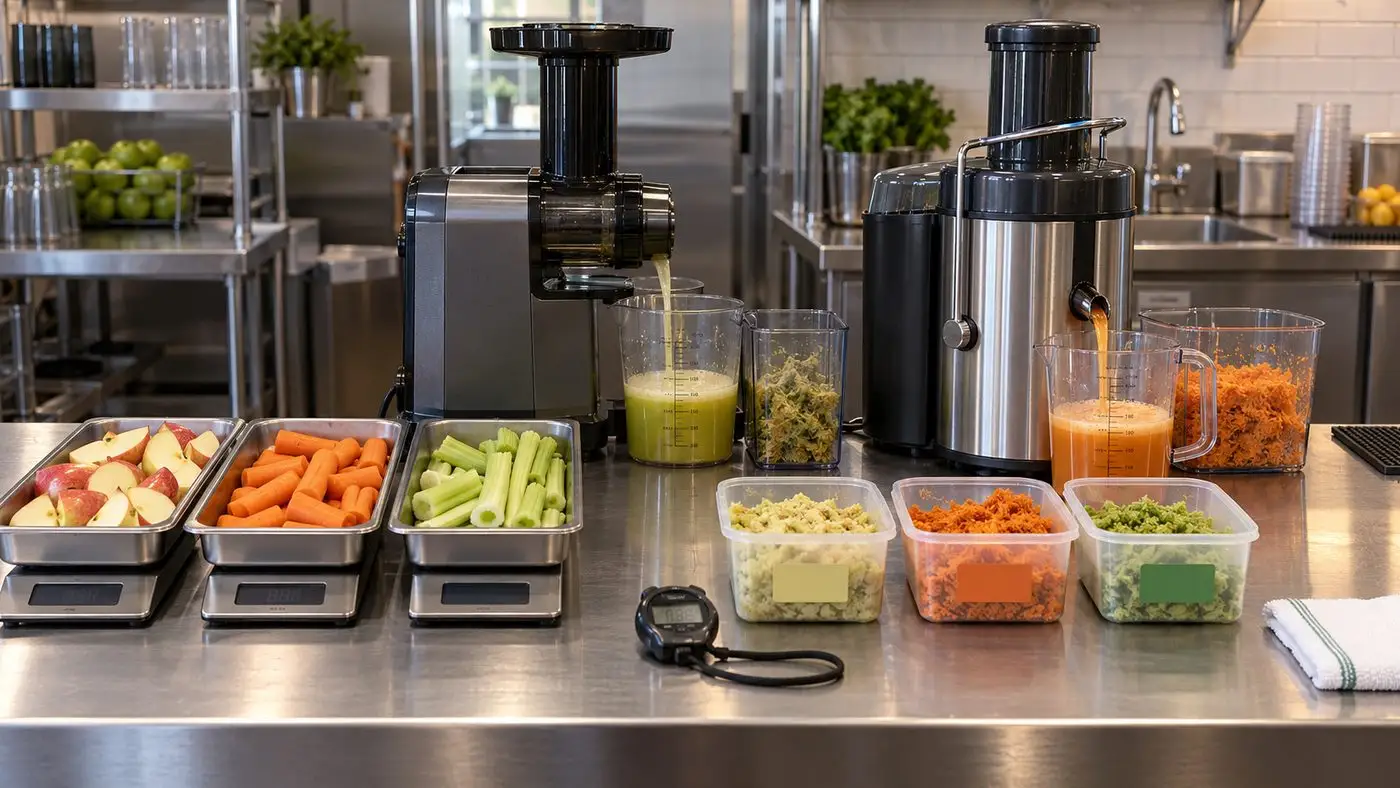
Cold press auger juicer and centrifugal juicer compared at realistic commercial countertop scale
Quick Decision: Which Juicer Fits Which Business?
Choose a cold press candidate first when the menu relies heavily on leafy greens, celery, ginger or other fibrous produce; when juice texture and lower visible foam support premium positioning; or when production can be organized in controlled batches. Then verify actual yield, throughput, cleaning and sanitation with the selected machine.
Choose a centrifugal candidate first when customers wait for made-to-order juice, the menu centers on produce that processes efficiently in a spinning basket, and line speed matters more than a cold-pressed product claim. Then verify feed preparation, basket loading, pulp handling, noise and cleaning during the busiest service period.
Do not choose either system only because a supplier publishes one RPM range, one yield percentage or one storage claim. Those figures may describe a different machine, recipe and test method.
| Business model | Likely starting point | What can reverse the decision |
| Premium juice bar | Cold press | Slow preparation, frequent clogging, difficult cleaning or insufficient peak output |
| Café adding made-to-order juice | Centrifugal | Green-heavy menu, front-counter noise or unacceptable produce cost |
| Restaurant preparation station | Either | Recipe range, batch size, sanitation and how often juice is made |
| Hotel breakfast service | Either | Staff training, noise, pulp handling, downtime and service simplicity |
| Short-batch bottled program | Cold press often considered | Food-safety process, hold time, packaging, validated controls and distribution plan |
| Distributor or private-label line | Often more than one platform | Market positioning, compliance, spare parts, packaging and after-sales capability |
The table indicates where to begin testing. It does not replace product-specific validation.
How the Two Extraction Systems Work
Understanding the mechanism helps predict workflow, but finished performance still depends on the entire product.
Cold press or masticating juicer
A countertop cold press juicer typically uses an auger to crush and move produce against a screen. Juice passes through the screen while pulp exits through a separate path. Vertical and horizontal arrangements can behave differently, and screen geometry, outlet resistance, auger clearance, motor control and ingredient preparation all influence the result.
Lower rotational speed is characteristic of many auger systems, but RPM alone does not establish extraction quality. Two slow juicers can produce different yield, foam, pulp moisture and throughput because their feed, pressure, screen and outlet designs differ.
Centrifugal juicer
A centrifugal juicer normally uses a rapidly rotating cutting basket or grating disc. Produce is reduced and juice is separated through the basket by centrifugal force. Feed-chute design, pusher use, basket geometry, motor behavior and pulp-ejection path affect throughput and consistency.
Higher basket speed can support fast processing, but a no-load RPM number does not tell a buyer how quickly staff can prepare, feed, empty and clean the machine. Pulp buildup or poor feeding can reduce the apparent advantage during real service.
The mechanism is only one part of the system
For both categories, evaluate the motor and controller, transmission where applicable, auger or basket, screen, seals, bearings, bowl, outlets, cover, interlocks, containers and cleaning tools together. The juicer motor guide covering RPM, torque and lifespan explains why the drive system must be matched to load rather than ranked by one motor number.
Define the Business Workflow Before Testing
Write a short application profile before requesting samples. It should answer four groups of questions.
First, what will be juiced? List the highest-volume recipes and the most difficult ingredients. Record variety, ripeness, temperature, washing, trimming, peeling and cut size. Apples, carrots, celery, spinach, ginger and soft ripe fruit can expose different strengths and limitations.
Second, how will the juice be sold? Made-to-order service prioritizes queue time and rapid changeover. Batch preparation can accept a longer extraction cycle but increases the importance of sanitation, controlled holding and labeling. Bottled distribution introduces a separate hazard-control and shelf-life program.
Third, when does demand occur? State average servings per hour, peak servings per hour, peak duration, serving volume and batch strategy. A daily total hides rush conditions. Include staff count and the other tasks those employees must perform.
Fourth, what happens after extraction? Define pulp removal, washing, sanitation, drying, reassembly, waste handling and storage. The machine must fit the sink, counter, water access and cleaning schedule.
Minimum application profile
- Business type and sales channel
- Daily and peak-period serving volume
- Recipe and produce matrix
- Produce preparation method
- Made-to-order, batch or bottled workflow
- Required texture, clarity, foam and pulp level
- Cleaning frequency and available labor
- Counter, sink, drainage and noise constraints
- Destination country and electrical version
- Required documentation, spare parts and support
Without this profile, suppliers may demonstrate different ingredients under favorable conditions and leave the buyer with results that cannot be compared.

Controlled business juicer test with produce, collected juice, pulp, scale and timing tools
Juice Yield: Use One Definition and One Method
Yield matters because produce is a recurring cost, but published percentages are often incomparable. A yield may be calculated by mass, volume or an unclear estimate. It may include foam, suspended pulp or liquid left in the collection system. Produce variety, ripeness, temperature and trimming can change the result before the juicer starts.
For practical purchasing, define usable mass yield:
Usable juice yield (%) = mass of accepted collected juice ÷ mass of prepared produce fed into the machine × 100
Weigh prepared produce after removing parts that your normal operation would discard. Use the same scale, produce lot, preparation and starting temperature. Weigh the collection vessel empty, then again with juice. State whether strained pulp or foam is included in the accepted product.
Run at least three replicates for each important recipe on each machine. Alternate the test order where possible so produce condition does not consistently favor one candidate. Report the range and average instead of selecting the best run.
Collect and weigh expelled pulp as a diagnostic, but do not assume drier pulp always means a better beverage. Screen design and suspended solids can move mass between juice and pulp while changing texture. Also inspect liquid retained in the bowl, screen and outlets.
Yield test record
| Field | What to record |
| Produce | Type, variety, supplier or lot, ripeness and starting temperature |
| Preparation | Washing, peeling, trimming, cut dimensions and prepared mass |
| Machine | Model, sample ID, screen or basket, program and production-intent parts |
| Process | Feed sequence, pusher or operator method, interruptions and total time |
| Output | Accepted juice mass, foam or strain rule, pulp mass and retained liquid |
| Quality | Texture, visible pulp, separation, color and recipe-specific acceptance |
| Repeatability | Individual replicate results, average, range and abnormal events |
Do not copy a pineapple, apple or vitamin percentage from another machine into a sales claim. It only becomes relevant if the material, preparation, equipment and measurement method match the product being sold.
Throughput Is More Than Liters per Minute
Customers experience total service time, not extraction speed in isolation. Measure the complete process from prepared produce to an accepted serving and a ready machine.
Include final cutting, loading, pushing or tamping, extraction, pulp-container management, pouring, clearing blockages, rinsing and resetting. If the machine must pause, cool or be partially cleaned, that time belongs in the throughput calculation.
Use two metrics:
- Accepted juice output per staffed hour, including normal operating tasks.
- Orders completed during the defined peak period, using the actual serving size and recipe mix.
A centrifugal machine may process hard produce quickly but lose time when its basket or pulp path requires attention. A cold press machine may extract more slowly but support steady batch work with one operator preparing the next load. The best workflow depends on station design.
Test the bottleneck, not the brochure
Observe which action limits output. It may be cutting produce to fit the chute, waiting for fibrous pulp to clear, changing collection containers, brushing a screen, washing parts or finding a lost seal. Equipment selection cannot fix a badly arranged station, but a good trial makes the bottleneck visible.
For made-to-order service, record customer wait time and the operator’s ability to perform another task. For batch production, record kilograms of produce processed, accepted liters or kilograms of juice, active labor minutes and cleaning minutes per batch.
Produce and Recipe Compatibility
No juicer is equally efficient with every ingredient. Test the actual menu rather than a generic fruit basket.
Leafy greens and herbs
Many auger systems can handle fibrous greens more effectively than centrifugal systems, but performance still varies. Check whether leaves feed without wrapping, whether stems block the pulp path, and whether the screen loads with fine fibers. Record yield and cleaning time together.
Celery and other long fibers
Celery can expose outlet design and cutting requirements. Follow the supplier’s approved preparation, then test the cut size staff can realistically maintain. Long fibers may wrap around parts or bridge an outlet in either poorly matched system.
Hard produce
Apples, carrots, beets and similar ingredients can favor rapid feeding, but hardness, size and ripeness matter. Watch for excessive vibration, basket imbalance, overload behavior, produce bounce and inconsistent pusher force.
Soft or overripe fruit
Soft fruit may create puree, screen loading or low separation rather than clear juice. A blender, pulper or different recipe may be more appropriate. Do not force every beverage into a juicer category.
Ginger, roots and concentrated ingredients
Small hard pieces can create high local load or escape normal feeding. Test the intended dosage and sequence. A machine that processes a large apple batch may respond differently to repeated ginger shots.
The complete cold press juicer business-use guide expands the cold press selection criteria for juice bars, cafés, hotels and distributors. Use it after this comparison if the initial test favors an auger platform.
Foam, Texture, Separation and Sensory Acceptance
Cold press systems are often associated with lower air incorporation and foam, while centrifugal systems can introduce more visible foam. These tendencies are useful hypotheses, not universal acceptance results.
Control the recipe and collection method, then observe foam height immediately after processing and after a defined short interval. Record whether foam is served, skimmed or excluded from yield. Assess visible pulp, mouthfeel, sediment, separation and color using the same lighting and containers.
If sensory evaluation is important, use coded samples and a consistent procedure. Staff should not know which machine produced each sample when scoring appearance, aroma, mouthfeel and overall acceptance. A small blind comparison is more credible than assuming a mechanism determines taste.
Avoid claiming that one extraction method always preserves a fixed percentage more vitamins or enzymes. Nutrient measurements depend on produce, handling, oxygen exposure, time, temperature and laboratory method. If a brand wishes to make a nutrient-retention claim, it needs product-specific evidence and regulatory review.
For many businesses, operationally visible qualities—foam, separation, texture, color and customer acceptance—are more useful purchasing criteria than broad nutrition language.

Cold press auger and screen parts compared with centrifugal basket and cleaning components
Cleaning and Sanitation: Measure the Entire Routine
Cleaning time can eliminate a theoretical throughput or yield advantage. Time the procedure staff will actually follow, including safe shutdown, disassembly, pulp removal, pre-rinse, washing, sanitizing where required, rinsing where applicable, drying, inspection and reassembly.
Cold press machines often include an auger, screen, bowl, seal, cap and pulp outlet that need attention. Centrifugal machines often require careful cleaning of a fine basket or cutting assembly. The number of parts alone does not determine difficulty; surface access, sharp features, retained fibers and correct reassembly matter.
Inspect grooves, seals, screen joints, outlet corners, covers, pushers and container interfaces. Use the supplied brush and approved cleaning tools. Operators should not touch sharp parts unnecessarily or improvise tools that damage screens.
Test cleaning after the ingredients most likely to stain, clog or create allergen concerns in the intended menu. Check whether parts fit the available sink and drying rack. Record small components that are easy to lose and determine whether spares should be stored on-site.
The FDA Food Code is a model framework for food safety in retail and foodservice settings in the United States. Local requirements and the operation’s own approved procedures govern actual cleaning and sanitation. For equipment evaluation, NSF food equipment standards show why material safety, cleanability and hygienic design need finished-product attention.
Food Safety and Shelf Life Are Process Questions
Extraction method does not assign a universal refrigerated shelf life. Microbial risk and product stability depend on the produce, washing, facility, sanitation, time, temperature, packaging, process controls and distribution. A cold press juicer does not make untreated juice safe for a predetermined number of days, and a centrifugal juicer does not impose one universal consumption deadline.
Made-to-order juice should be handled under the applicable retail food rules and the operation’s procedures. A batch or bottled product needs a defined hazard analysis and validated controls. In the United States, FDA’s Juice HACCP Hazards and Controls Guidance helps processors identify reasonably likely hazards and control measures under the relevant regulation.
High-pressure processing, thermal treatment and other preservation approaches are separate process decisions. Their effectiveness and shelf life must be validated for the exact formulation, package, process and distribution conditions. HPP is not a feature that a countertop juicer can certify, nor should a supplier promise a general 30- or 90-day life because cold press extraction was used.
When comparing juicers, limit the equipment claim to what the test establishes: output, yield, texture, foam, processing time, cleanability and other measured factors. Refer shelf-life, nutrition and pathogen-control claims to qualified food scientists, laboratories and regulatory specialists.
Noise, Footprint and Counter Integration
Centrifugal systems often produce a higher-pitched operating sound, while many auger systems operate with a lower mechanical tone. Actual sound depends on the machine, produce, counter, room and distance. Compare candidates with the same recipe in the intended layout rather than relying on an unexplained decibel value.
Measure width, depth, total operating height and clearance needed to remove the pusher, cover, auger or basket. Check the path from produce preparation to feed chute, juice container, pulp container, sink and waste bin. A compact footprint can still create an inefficient station if parts cannot be removed without moving the appliance.
Check stability and movement during hard produce. Confirm that feet remain effective on the actual counter and do not block ventilation. Review cord routing, plug access and protection from splash. The station should allow safe shutdown and cleaning without lifting a heavy machine repeatedly.
For guest-facing areas, consider not only sound but also pulp handling, splatter and the visual condition of the machine during service. A premium process story loses value if the counter is difficult to keep clean.
Motor, Protection and Duty Pattern
Cold press systems require usable torque through the auger and resistance created by produce and outlet pressure. Centrifugal systems require stable basket speed and safe response to loading or imbalance. The relevant engineering details are different, so a direct wattage or RPM ranking can mislead.
Define a duty test using the recipe matrix and peak period. Record starts, stalls, speed changes, protection events, odor, vibration and restart behavior. Follow the instructions for run and rest limits. Do not defeat interlocks or protective devices.
A reverse function can help some auger machines clear a blockage, but it should not be needed continually during approved recipes. Repeated reversal suggests that preparation, feed rate, outlet, screen or platform fit needs review.
For centrifugal candidates, inspect basket seating and cleanliness before operation. Stop and remove a unit from service if there is damage, unusual vibration or contact. Operators should never attempt live adjustment or internal electrical diagnosis.
After cycling, inspect auger surfaces, screens, baskets, seals, couplings, containers and outlets. Changing sound, leakage, cracks, rubbing or persistent movement should be recorded and investigated.
Wear Parts, Downtime and Serviceability
A juicer that performs well in a sample test can still be a poor business purchase if essential parts are unavailable. Ask for a controlled spare-parts list, drawings or photos, compatible revisions, minimum quantities, lead times and the expected support period.
Cold press wear or damage items may include screens, augers, seals, caps, brushes, bowls and containers. Centrifugal items may include baskets, cutting assemblies, pushers, covers and pulp containers. Actual replacement policy depends on the design and should distinguish operator tasks from qualified service.
Track the cost of downtime. If juice is a core product, the plan may require a spare machine or complete working assembly at each site. If juice is an occasional add-on, centralized parts or a replacement-unit process may be enough.
Warranty length is not a substitute for support. Confirm what evidence is required, who pays freight, whether a failed unit is repaired or replaced, how recurring defects are analyzed and how corrective actions reach future production.
For distributors, part identification must survive product revisions. A replacement screen that looks similar but has a different mesh, fit or material can change yield, cleaning and safety. Use part codes and change control instead of visual matching.
Calculate Total Cost per Accepted Serving
Compare the two systems using the same menu and time period. Include both capital and operational inputs:
- Machine, accessories and required installation
- Produce purchased and prepared
- Usable yield for each important recipe
- Active labor for preparation, extraction and cleaning
- Waste disposal and pulp handling
- Water, cleaning chemicals and approved brushes
- Screens, baskets, seals, containers and other replacement parts
- Service, freight, downtime and backup equipment
- Food-safety controls, testing and packaging for batch or bottled programs
- Distributor warranty and return handling
A useful recipe-level formula is:
Produce cost per accepted serving = prepared produce cost ÷ number of accepted servings produced
Then add labor, cleaning, parts and downtime allocations. Do not assume a higher yield automatically wins. If the added extraction and cleaning labor exceeds the produce savings, the lower-yield machine may still cost less per serving. Conversely, a small improvement in yield can matter greatly when high-cost ingredients dominate the menu.
Use a range for uncertain inputs and run a sensitivity check. Change produce price, hourly labor, daily volume and downtime. The decision is stronger when it remains favorable across realistic scenarios rather than one optimistic forecast.
A Controlled Sample Test Plan
Stage 1: Confirm production-intent configuration
Record model and sample ID, voltage, frequency, plug, motor or controller revision, auger and screen or basket, seals, containers, instructions and cleaning tools. Photograph the product and packaging.
Stage 2: Inspect and operate safely
Check external damage, cord, plug, parts seating, interlocks, outlets and stability. Perform basic operation according to the instructions. Stop for abnormal vibration, scraping, smell or leakage.
Stage 3: Run the produce matrix
Use controlled lots, preparation, starting temperature and mass. Test the highest-volume recipe, hardest recipe and ingredients most likely to clog or stain. Perform multiple replicates.
Stage 4: Measure yield and accepted quality
Weigh prepared produce and accepted juice. Record foam rule, pulp, retained liquid, texture, separation and any failed output. Keep calculation definitions identical.
Stage 5: Measure complete throughput
Time final preparation, feeding, extraction, container handling, clearing, pouring and resetting. Run the real peak pattern and record active labor.
Stage 6: Clean, sanitize and reassemble
Follow the documented procedure. Time every step, inspect retained residue and record sharp, awkward or easily lost parts. Confirm the machine is correctly reassembled.
Stage 7: Inspect for wear and repeat critical tests
Examine auger, screen or basket, seals, outlets, containers and drive interfaces. Repeat a critical recipe to identify performance change. Preserve the records for supplier review.
Distributor and Private-Label Evaluation
A distributor must decide not only which mechanism works, but which product can be documented, shipped and supported.
Define the intended-use statement carefully. “Commercial juicer” can imply requirements that differ from a household appliance occasionally placed in a business. A qualified compliance specialist should determine the applicable standards for the exact product and market. For household and similar electric kitchen machines, the current IEC 60335-2-14 publication includes auger and centrifugal juicers in its scope; different intended-use and commercial classifications may require another route.
Request evidence that matches model, voltage, plug, critical components and materials. Confirm food-contact documentation for the exact auger, screen, basket, bowl, seals, containers, lubricants, coatings and colorants where relevant.
Review packaging with all removable parts. Screens and baskets can be damaged by movement even when the housing arrives intact. The pack-out should keep components separated, prevent cosmetic rubbing and provide an obvious unpacking and assembly sequence.
For private label, freeze the product specification, artwork, manual, rating label, packaging and golden sample. Define which component changes require notification, a new sample, document review or testing. A silent change to screen geometry, outlet resistance, motor control or seal material can alter performance and compliance.
Buyers can review the ElectMix product range for available juicer platforms. A project requiring non-standard housing, controls, accessories or market configuration can be assessed through the ElectMix custom manufacturing process, subject to feasibility, quantity, compliance and validation requirements.
Common Comparison Mistakes
Copying universal yield percentages
Yield belongs to a defined produce lot, preparation, machine and calculation. Test the exact candidates.
Assuming lower RPM guarantees better juice
RPM describes one operating variable. Auger, screen, outlet, feed and handling determine the finished result.
Measuring extraction but ignoring preparation and cleaning
Business throughput includes all staffed work needed to deliver an accepted serving and reset the station.
Treating dry pulp as the only yield evidence
Weigh accepted juice and define foam and solids. Pulp feel is a useful observation, not a complete calculation.
Publishing nutrition claims without product-specific evidence
Produce and methods vary. Strong claims require appropriate laboratory and regulatory support.
Assigning shelf life from the juicer type
Shelf life and pathogen control are properties of the complete formulation, process, package and distribution system.
Ignoring screen, basket and seal availability
A low-cost machine can become expensive when a small essential part causes weeks of downtime.
Keeping two pages with the same comparison intent
Duplicate pages divide links, updates and search signals. ElectMix should consolidate this comparison into one strong historical URL.
Final Buyer Checklist
- Business model and sales channel are defined.
- Recipe and produce matrix reflects actual purchasing and seasonality.
- Preparation, mass, temperature and feed method are controlled in testing.
- Yield uses one written definition and multiple replicates.
- Foam, texture, separation and sensory acceptance are recorded.
- Throughput includes preparation, processing, container handling and reset.
- Peak-period workflow is tested with realistic staff.
- Cleaning and sanitation are timed and inspected.
- Shelf-life and safety claims are separated from the extraction mechanism.
- Motor, protection, interlock and abnormal-condition behavior are acceptable.
- Screens, baskets, seals and other parts have controlled codes and supply plans.
- Electrical, food-contact and compliance documents match the exact market version.
- Packaging protects all removable components through the intended route.
- Production changes require written notification and appropriate review.
- Pilot units repeat the critical yield, throughput and cleaning checks.
Frequently Asked Questions
Is a cold press juicer always better for a juice business?
No. Cold press can suit green-heavy recipes, premium texture and batch workflows, while centrifugal can suit fast made-to-order service. The better choice depends on tested yield, labor, cleaning, output and business positioning.
Which type of juicer produces a higher yield?
Many cold press systems perform well with leafy or fibrous produce, but the result varies by machine and recipe. Compare candidates using identical prepared produce, a written yield formula and multiple replicates.
Are centrifugal juicers always faster?
Their extraction stage can be fast, but business throughput also includes cutting, feeding, pulp handling, pouring, clearing and cleaning. Measure accepted servings per staffed hour during the actual workflow.
Does cold press juice have a fixed longer shelf life?
No. Extraction method alone does not establish shelf life. Formulation, sanitation, time, temperature, process controls, packaging and distribution must be evaluated and validated for the specific product.
Does cold press juice always contain more nutrients?
No universal percentage applies. Nutrient results depend on produce and handling, and commercial claims require product-specific evidence and regulatory review.
Which juicer is easier to clean?
It depends on screen or basket design, access, retained fibers, sharp parts, tools and reassembly. Time the complete documented cleaning and sanitation routine after the real recipes.
What should a juice bar test before buying?
Test important produce, usable yield, accepted texture, complete throughput, peak workflow, cleaning, blockage behavior, noise, protection, wear parts and spare-part availability.
What spare parts should a distributor plan for?
Depending on the design, these may include screens, baskets, augers, seals, caps, containers, pushers, covers and cleaning tools. Each should have a controlled code, compatible revision and lead time.
Is HPP part of a cold press juicer?
No. High-pressure processing is a separate preservation process. Its performance and shelf-life effect must be validated for the formulation, package, process conditions and distribution system.
How should a distributor compare total juicer cost?
Include equipment, produce yield, preparation and cleaning labor, parts, sanitation, service, freight, downtime, returns and any food-safety or packaging costs required by the sales channel.
Final Recommendation
Run the same controlled produce and workflow test on both technologies before choosing. A cold press machine should earn its place through acceptable yield, quality, batch fit and total cost. A centrifugal machine should earn its place through verified service speed, simple operation and manageable cleaning—not through speed language alone.
Protect the business by separating equipment evidence from food claims. The juicer test can establish output, yield, texture, foam, labor and cleanability. Nutrition, safety and shelf life require their own evidence and qualified review.
If an auger platform is the stronger candidate, continue with the cold press juicer business selection guide and the juicer motor guide. Buyers ready to compare platforms can browse ElectMix products, while distributors and private-label brands can contact ElectMix with the application profile and test requirements described above.

Marketing & Product Lead at ElectMix | Innovating Commercial Blenders & Home Appliances | Driving Growth & Development