Skip to content

- Key Takeaways
- Industrial Juicers: Extraction Focus for Raw Nutrition
- Industrial Blenders: Versatility for Solid + Liquid Recipes
- OEM Considerations: Which One Fits Your Product Strategy?
- Use Case Scenarios
- Global OEM Trends: Juicers vs Blenders
- Why Choose ElectMix as Your OEM Partner?
- Conclusion
- Frequently Asked Questions
Key Takeaways
- Understand the core differences between industrial juicers and blenders.
- Learn which equipment suits different OEM customer profiles.
- Get insights into custom branding options and global market trends.
In the competitive beverage and food processing industry, choosing the right commercial equipment can make or break your product line. For OEM buyers, the decision between an industrial juicer and an industrial blender is more than just about features—it’s about long-term brand positioning, application scope, and ROI.
This guide provides a deep comparison of both machines, helping OEM distributors, importers, and brand owners determine the best fit for their private-label needs.
Industrial Juicers: Extraction Focus for Raw Nutrition
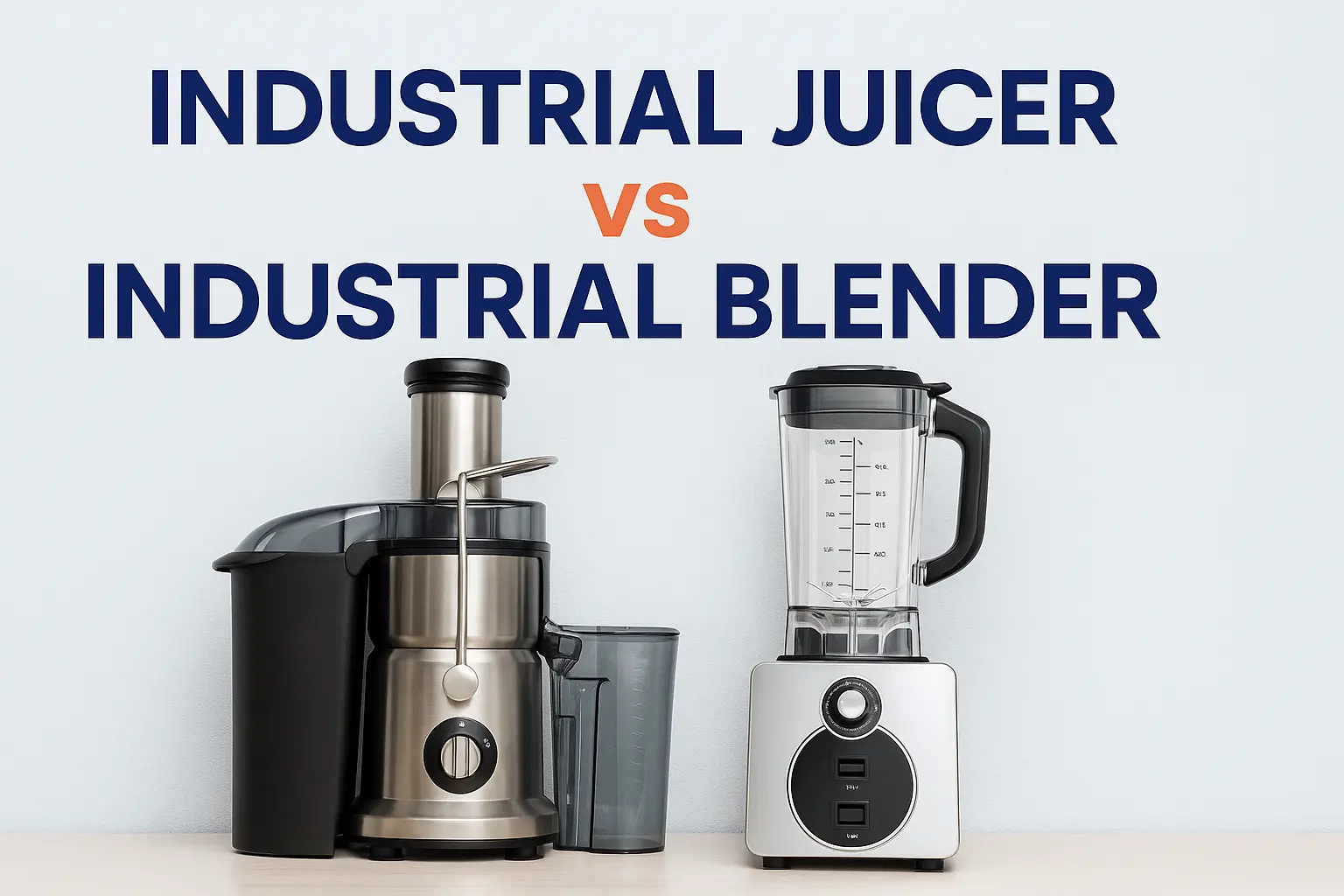
Industrial juicers, especially commercial juicers, focus on extracting juice from raw fruits and vegetables, providing you with a nutrient-packed beverage in an easily absorbable format. With their extraction, they can concentrate the vitamins and minerals of multiple servings of fruits and vegetables into a single glass of fresh juice.
How They Work
Juicers crush down vegetables to obtain the juice, but depending on how they do it, they might alter the flavor, consistency, and nutritional value. There are three main kinds: auger (also called cold-press or slow juicers), centrifugal, and masticating juicers.
Auger juicers pulverize the fruit or vegetable and then use pressure to extract the juice. This slow action preserves more nutrients and enzymes, but it can be slow.
Centrifugal juicers, in contrast, utilize a high-speed blade against a mesh filter, extracting the juice by centrifugal force. This sort is fast; however, the velocity generates heat which can eliminate some enzymes or nutrient loss.
Masticating juicers, such as auger types, utilize a slow grind to extract juice, typically producing a drier pulp and a more nutrient-dense yield.
Common Applications
Industrial juicers are found at juice bars, restaurants, and factories where you require a massive amount of juice quickly. You find them in hospitals and wellness centers, where nutrient-dense juice is administered to patients for easy absorption.
Veggie juices, aside from carrot, are typically selected due to their low sugar and high nutrient density. Factories can use big juicers to create juice concentrates, which are shipped to stores around the globe.
Juicing can help you get more out of your food. It pulverizes the fiber, facilitating the absorption of vitamins and minerals and increasing the bioavailability of phytochemicals. Juicers are perfect for quick-nutrient-fix enthusiasts.
Pros
Juicers are a nutrient concentrator, plant tissue converter, putting the nutritional power of multiple cups of produce into a single glass. This is important for folks looking for more vitamins and minerals without consuming ponderous quantities of produce.
Juicing makes many nutrients more bioavailable, particularly vitamin C, and aids your body in absorbing plant compounds. It extracts most of the fiber, so the nutrition reaches your bloodstream more quickly.
Many juicers restrict sugar in vegetable juices, which makes them great for sugar-conscious individuals. The juice is luscious, of course, and easy to consume and digest.
Cons
✘ Juicing takes out the fiber.
✘ You could lose some enzymes or vitamins if the juicer heats up.
✘ Juice can oxidize fast after making.
✘ Juicers can be costly and hard to clean.
Industrial Blenders: Versatility for Solid + Liquid Recipes

Industrial blenders are unique in that they pulverize solids as well as liquids, making them essential for smoothie shops and juice bars. Not just for drinks, you can create everything from nut butters to purées and sauces. Their versatility is key when you need to process multiple types of ingredients or recipes in a large-scale environment.
How They Work
Industrial blenders combine heavy-duty motors and aggressive blades to blend or pulverize food. You add solids or liquids, shut the lid and the blades spin at lightning speed to slice, crush and blend all at once.
Most units allow you to control speed and time, so you can rough chop or turn your ingredients to a silky purée. This allows you to select the ideal consistency, whether you need a chunky salsa or a smooth soup base.
Common Applications
You spot industrial blenders in every food factory, commercial kitchen, and beverage plant. They easily take on thick blends, such as nut butters or hummus, with as much finesse as delicate smoothies and fruit purées.
Others employ them for emulsified sauces and dips — even frozen desserts. The big advantage: you can process raw vegetables, leafy greens, and tough fruits without much prep, saving time for high-output operations.
Blenders are a big player in health-forward product lines. Think plant-based protein shakes, energy bars and custom meal kits. For you functional foods/meal replacement folks – these babies are a must!
Pros
Industrial blenders provide you with real muscle and authority. You get to play with all sorts of ingredients—hard, soft, wet or dry.
Which translates to more menu flexibility and less equipment clutter. Just like with our immersion blenders, these models can accommodate big batch sizes, so you gear up without sacrificing blend quality.
High-powered components designed for everyday use and cleaning ensure efficiency.
You get consistency. Every batch comes out the same, which is key for brands or businesses requiring dependable texture and flavor. Automation minimizes employee vigilance.
Cons
✘ Noise is a problem.
✘ They consume a lot of energy and can be costly, particularly for start-ups.
✘ Not ideal for pure juice extraction.
✘ Maintenance takes time.
OEM Considerations: Which One Fits Your Product Strategy?
Because whether you decide to go with an industrial juicer or a blender, it depends on what you want to give your customers and how you are going to satisfy them. If you’re targeting a market that demands clear juice from carrots, apples or leafy greens, peepers, look elsewhere – check out juicers.
| Factor | Industrial Juicer | Industrial Blender |
| Target Market | Cold-pressed juice brands, wellness chains | Smoothie shops, foodservice, cafes |
| Customization | Transparent juice jugs, pulp outlet redesign, plug variations | Jar size, blade type, motor housing branding |
| OEM MOQ | 1000 units depending on complexity | 300-500 units depending on configuration |
| Certifications | CE, CB, LFGB for food contact safety | CE, EMC, RoHS, UL (if required) |
| After-Sales Support | Replacement filter kits, motors | Blade replacements, jar covers |
ElectMix supports full-spectrum OEM customization for both categories. Whether you want a quiet commercial blender or a heavy-duty juicer with branded packaging, our engineering and export teams deliver.
Use Case Scenarios
Understanding which machine to use—an industrial juicer or a commercial juicer—is all about your needs, the texture you desire, and the health goals you are trying to accomplish. Both food blenders and juicers scale to a wide variety of lifestyles and diets, making it simpler to hit your goals.
✅ Choose an Industrial Juicer if:
- You’re targeting health & wellness consumers
- Your market emphasizes detox, cold-pressed benefits
- Shelf-stable juice is important for logistics
✅ Choose an Industrial Blender if:
- Your buyers operate smoothie cafés or meal-prep kitchens
- You need versatility (ice, sauces, dry ingredients)
- Cost-effectiveness and rapid blending are priorities

Global OEM Trends: Juicers vs Blenders
Industrial juicers and drink blenders cater to different markets’ needs. Preferences for quality juice are influenced by nutrition trends, local diets, and how populations prioritize convenience or health. Your pick might be influenced by these worldwide trends and their impact on your smoothie shop or lifestyle.
North America: Higher demand for high-speed blenders in smoothie chains
A majority of the smoothie chains in North America use high-speed blenders. These blenders pulverize ice, fruit and seeds quick. They create thick pulp-and-fibre-inclusive drinks, oftentimes with added healthy fats such as nuts or avocado. This satisfies them more, which resonates with hurried individuals.
Meanwhile, most Americans still consume less than three servings of fruits & vegetables daily. Blending can help close this gap by simplifying adding more whole fruits. The catch is, the blade’s high rpm generates heat. That can kill some enzymes and might oxidize nutrients.
Blending increases the antioxidant capacity of certain fruits. If you combine grapefruit with pulp, you’ll retain naringin, the flavonoid, at levels up to 7x that of juicing.
Europe: Cold-press juicers preferred in organic and detox product lines
In Europe, there is a strong preference for cold-press juicers, especially for creating organic or detox drinks. These cold-press juicers crush and press produce, maintaining the juice’s cool temperature and minimizing nutrient loss. This method is beneficial for preserving vitamin C and other heat-sensitive compounds, making it ideal for those who prioritize quality juice.
Juicers usually come in three types: auger/low-speed, centrifugal, and masticating. Auger and masticating are typical of Europe’s health-conscious market. They work slower and quieter, and foam less.
Juicing enhances vitamin C bioavailability, aligning perfectly with the demand for crisp, fresh juices. While juicing results in the loss of most fiber, the vibrant flavors and easy digestion attract health-conscious consumers seeking clean-label fare.
Middle East & Asia: Combo use in hospitality; blenders often paired with grinders
Both blenders and juicers have a place in Middle East/Asian hospitality. Hotels and cafes usually combine blenders with grinders for covering both drinks and sauces. This combo setup allows kitchens to cater to a variety of preferences.
Some guests desire smooth blended concoctions, others desire pure juice. Blenders and juicers help increase phytochemical bioavailability by reducing food particulates to a smaller size. That market values versatility.
Take India and the Gulf for instance – where blenders are used for fruit shakes and purees but juicers for fresh citrus. The demand for both tools remains steady, fueled by the desire to accommodate varying palates and wellness objectives.
According to Statista, the global kitchen appliance market is projected to reach USD 313 billion by 2026, with commercial blenders and juicers among the fastest-growing segments.
Why Choose ElectMix as Your OEM Partner?
If you choose an OEM partner for industrial juicers or blenders, you need someone who understands the industry, who cares about your requirements, and who supports you as your company ascends. ElectMix checks all these boxes. You have a partner who cares about your brand and your users, not just a transaction.
As ElectMix:
- ✅ In-house mold design for both juicer and blender parts
- ✅ Private-label support: logo printing, box design, manuals
- ✅ 20+ years OEM export experience with global certifications
- ✅ Fast lead times: 7–15 days for sample delivery
- ✅ Dedicated account manager + after-sales service team
Conclusion
There’s no one-size-fits-all in food and beverage equipment. But for OEM brands, the clarity lies in application, audience, and brand promise. Industrial juicers and blenders each offer unique strengths—and ElectMix equips your business with both.
📩 Contact us to discuss your OEM goals and request our full catalog.
Frequently Asked Questions
Q1: What’s the main difference between industrial juicers and blenders?
Juicers extract juice and separate fiber, while food blenders process whole ingredients into thick blends.
Q2: Which is better for OEM food equipment brands?
It depends—commercial juicers are ideal for juice-focused lines, while drink blenders offer flexibility for smoothies and food prep.
Q3: Can I customize the motor and plug type for either equipment?
Yes. ElectMix provides full OEM customization for commercial juicers, including motor specs, plug types, branding, and packaging.
Q4: Which markets prefer industrial juicers vs blenders?
Europe favors juicers for organic markets, while North America prefers drink blenders in smoothie shops; Asia sees demand for both.
Q5: Does ElectMix offer OEM support for both types?
Absolutely. ElectMix specializes in OEM industrial blenders and commercial juicers with complete customization services.
ElectMix Team provides global e-commerce sellers and distributors with insights on commercial blending solutions, OEM customization, and profitable market opportunities.