 Skip to content

Introduction
In the current competitive commercial blending industry, increased processing and manufacturing processes have made it extremely important to choose the proper blender jar to ensure the required level of performance, durability, and customer satisfaction.

Whether you’re looking for a blender jar OEM for a heavy-duty commercial blenderapplication or you’re seeking just theright commercial blending jar with lid to fit your product line, it’s important that you know as much about the nuances of jar design, material, and functionality as possible. From small commercial blending jars specifically designed for more limited applications to huge commercial blending jars designed for high-volume applications, the correct blending jar plays a role in blending efficiency, safety, and longevity.
With a variety of markets, such as the USA, Brazil, and the UAE, seeking higher quality and reliable solutions in the market, brands must carefully consider options ranging anywhere from blender plastic jars to blender with glass jar, ensuring compatibility with different commercial requirements like milkshake making and other blending purposes. This article examines some of the most important elements of choosing a method for the use of the perfect blending jar covering shape or material, use details, branding, quality control, and more that can help OEM buyers and commercial operators make informed decisions for their blending equipment.
Design of Jar & Efficiency of Blending
Blending Performance Effect of Jar Shape
A blender jar is a definition of geometry to impart a vertical movement to the material being processed in the blend jar and, alternatively or in combination, improves the horizontal movement to the blended material. By fitting one or more agitators on the floor of a jar, the laminar flow or symmetric flow of material around the jar is broken.
The material is forced in an upwards direction in the jar and hence into more frequent contact with the cutter blades in the jar turning. A dispensing blender jar has a hole in the wall of the jar that connects to a spout for dispensing. The hole is located (at least in part) on the leading edge of a vertical bump in the sidewall of the jar.
The container of a high speed blender, often referred to as the jar or the pitcher, is much more than a silly little container in which to place ingredients. It is an integral and highly engineered part of the blending system. Its shape determines how it flows the ingredients, and its material determines safety and durability.
Blade and Jar Interaction
Most ideal placement for mixing with the blades
In the case of commercial blending systems, the effectiveness of a blender jar OEM design is highly dependent on the precision of interaction between the design of the blade and the design of the jar. There are also practical in vitro steps that can be performed to ensure optimal blade positioning taking into account the continuous pulling of ingredients to the cutting zone to reduce dead spots and increase consistency.

When the blade angle, height, and distance from the jar base are properly engineered, the blender is capable of handling dense mixes, frozen ingredients, and high viscosity formulas that are important for countertop commercial blenders and applications such as commercial blenders for milkshakes. Proper placement of the blade also improves interaction with ingredients, which results in little or no blending time, but maximizes product uniformity in both small commercial blending jars and large commercial blending jars.
How does the shape of the jar influence the implementation of the vortex and the circulation of the ingredients ?
Jar geometry is directly related to the strength of the vortex, the ability of the ingredients to be pulled down, and the flow dynamics of the product. Square and multi-sided jars assist in breaking circular flow, trying to back up ingredients with the blade to provide good processing, and tapered/cylindrical jars to make a more liquid vortex, which is great for a liquid-based blend. For the OEM who is buying a commercial blending jar with a lid or a commercial blending jar for countertops, it makes sense to see how these flow differences can radically ensure maximum performance.
A properly designed blending jar will ensure efficient channeling of ingredients from the top to the bottom, for better speed and less motor strain, especially when you are changing your older-sized unit with a blender jar replacement or opting for a blender plastic jar for high-volume applications such as the USA, Brazil, UAE, etc.
Dimensions and Capacity Issues
Balancing size of jar commodity throughput commercial vs. blending consistency
Choosing the right jar capacity is vital in determining the right ratio between the size of batches and the quality of the blend. While large commercial blending jars are good for achieving a higher throughput in cafes, restaurants, and juice bars, there is a risk that they will be less precise if over-filled. On the other hand, size commercial blending jars provide more control when blending specialty items, single serve formats, and accurate formulations. OEM decision-makers need to evaluate the intended usage to plan the ideal size commercial blending jar with regard to performance, speed of the process flow, and product category. The right capacity for consistency in smoothies, sauces, frozen drinks, and milkshakes.

Effect of the volume of jar used on motor loads and blending time
Jar volume has a significant influence on the amount of load imposed on the motor. Runnyness: overfilling a jar creates more resistance, makes the motor work harder, and may increase blending time. This is important in heavy duty commercial blenders that run unattended, constantly in high-demand applications such as the USA and UAE. Underfilling, on the other hand, may minimize vortex-inducing uneven blends.
The choice of a blender jar OEM or jar commercial design allows for appropriate torque balance and motor protection while keeping the efficiency. The correct volume with a matching commercial blending jaror blender jar that is glass, plastic, or stainless steel helps to meet the results of faster cycles, stable motor performance, and the lifespan of equipment.
Material Comparison
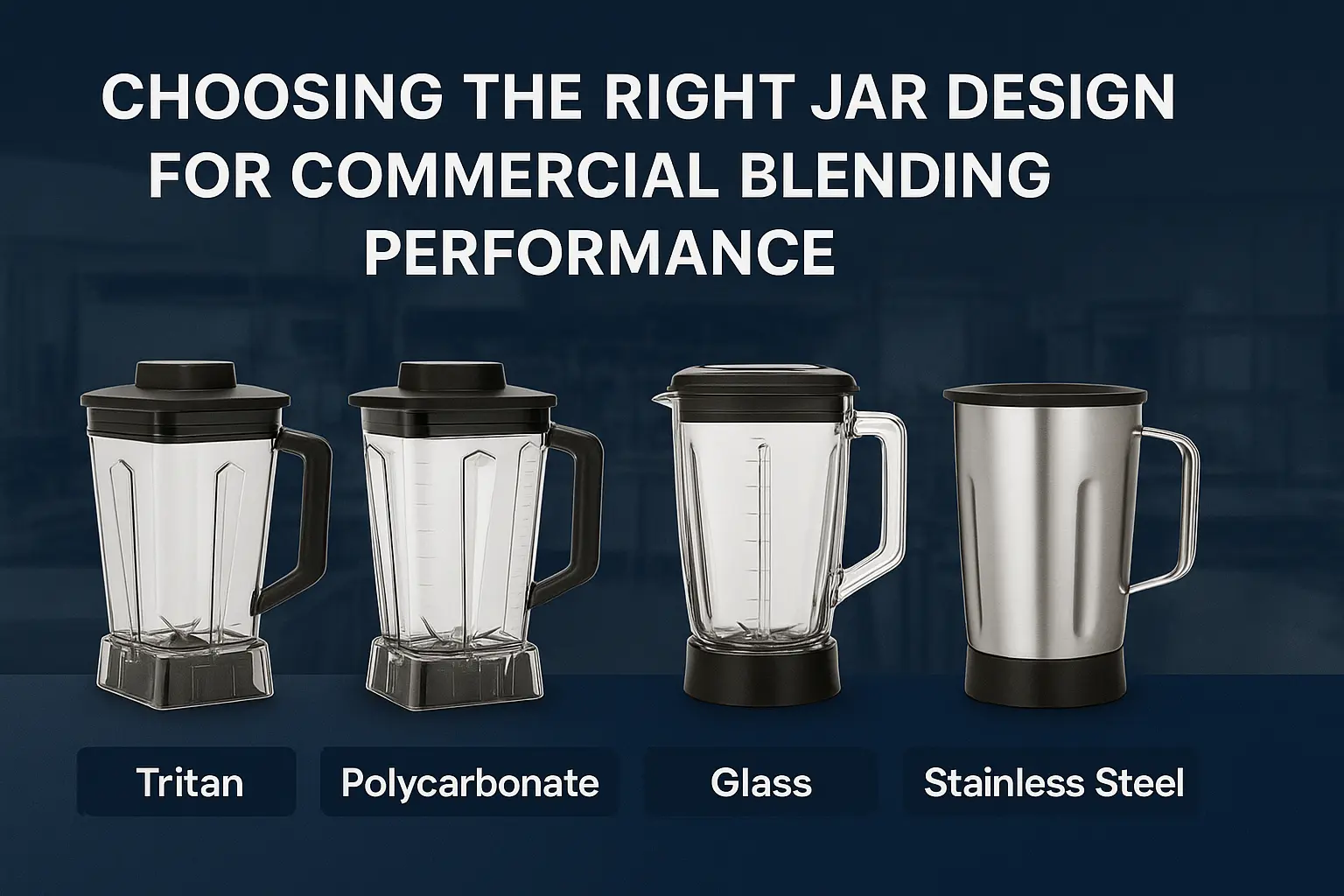
Common Jar Materials in types of Commercial Blender.
American: polycarbonate -Durable, transparent.
The wide usage of our polycarbonate blends than jars can be attributed to their good resistance to hits, as well as to their light structure. It is very transparent so that the operator can easily monitor the blending process – a system of cafes, juice bars, and food service USA, Brazil, or the UAE.

Being one of the most preferred forms of blender plastic jars, polycarbonate has a very comfortable combination of toughness against price that can fit heavy-duty blenders like commercial blenders, in which the blender needs to be used frequently. OEM purchasers are willing to settle on polycarbonate in terms of producing inexpensive, blender jar OEM-based products that can perform well and last long.
Tritan – BPA-free and a high impact strong resistant.
Tritan is a high-quality material that is identified to be BPA-free, crystal clear, and cannot even break after being it to a heavy workload. It maintains the clarity even when subjected to repeated wash cycles, and with good chemical stability, is preferred by the operator to have a durable and hygienic commercial blending jar with a lid.
The Tritan jars are marketable in the global markets, which demand food contact materials meeting the standards of the FDA as well as the EU. When the OEMs are selling replacement parts, Tritan will make a final option in selling the blender jar replacement products because of the durability of the product and its professional performance.
Glass – heat resistant and glass scratch resistant.
Glass jar blenders are popular in both consumer and commercial types of environments, where cleanliness and resistance to scratch are also of interest. They do not contain any odors or stains and can therefore be used in the recurring mixing of scented products. Glass jars are also more resistant to heat than plastics, hence they are appealing to markets that appreciate the use of a blender with glass jars like Oster, KitchenAid, and Hamilton Beach, as replacements.
Glass is heavier and less impact-resistant than other materials, but it is still preferred in those cases where its use is necessary because it is clear and gives the person better hygiene. To increase durability, OEMs designing blender jars that customers like using traditional glass can use tempered or reinforced glass.
Stainless steel – Sedation and the preservation of temperature.
The stainless steel jars are the best for rough and high-intensity commercial use. These possess an unmatched durability, sufficient heat retention, and no chance of breaking, so it suit the high-demand stand out blenders of cold beverages, sauces, and milkshakes.
The materials of stainless steel are another material that keeps track of the contents during UV exposure, and where safety and products are concerned. Although it is not very transparent, its power adequately qualifies it to be used in large commercial blending jars or high- throughput where long-term performance is essential. OEMs usually provide stainless steel as a professional alternative to demanding markets in all parts of the globe.
Comparison of Common Jar Materials
| Material | Durability | Clarity | Heat Resistance | Safety | Typical Uses |
| Polycarbonate | High | Transparent | Moderate | Varies | Cost-effective, durable jars |
| Tritan | Very High | Crystal Clear | High | BPA-free | Premium BPA-free jars |
| Glass | Moderate | Excellent | Very High | BPA-free | Heat-resistant, scratch-proof |
| Stainless Steel | Extremely High | Opaque | Excellent | BPA-free | Heavy-duty, temperature-stable |
Benefits and Costs of every Material

Polycarbonate
Polycarbonate jars are cheap, lightweight, durable, and they are used in commercial blending jars.
Pros: Good impact strength, Superior to handle, Easy to use, made cheaply.
Cons: An individual can easily scratch the surface, has a high tendency to lose its clarity when washed in high-heat water frequently.
Tritan
Tritan contains no BPA and Tritan is long term clear, and cannot be heavily used in commercial application.
Pros: safe material,Wednesday resistance to impact is very good, no effect on clarity.
Weaknesses: it cannot be applied on heavy stock because it is more costly; it can cause it to turn rather cloudy after a few years of being used.
Glass
Glass jars are resistant to scratches, heat and do not absorb color and also do not stain.
Pros: makes sure that the blend has not become cloudy and is also non-smelling, which is good in hot blends.
Cons: bulkier, delicate, more costly to transport and carry.
Stainless Steel
The stainless steel is the most reasonable in terms of durability and temperature.
Pros: very durable, it cannot break, it works great in combinations of hot/cold.
Cons: not transparent, usually more expensive.
Effect of Materials to Product Quality and Safety

Chemical leaching risks
Tritan and glass are not characterized by high leaching propensity and poor safety performance in the commercial blending process. Polycarbonate requires the food contact standards to be checked. Stainless steel is completely non-reactive and ensures maximum resistance to the transfer of chemicals.
Difficulty with staining and the olfactions
The glass and stainless steel are the least affected by stains and odors. Tritan also does well in maintaining clarity and avoiding discoloration. Polycarbonate becomes not as efficient in storing odours over years as micro-scratches during active use are formed.
The Jar is selected based on its usage
Jars to be used in commercial use at high volume
In case of commercial settings where large volume is a requirement of juice bars, cafes, and food service chains would need jars that are designed to swim continuously and heavily used. The usage of such jars also predisposes the usage of impact-resistant materials like Tritan, polycarbonate, and stainless steel so that they will not crack during the frequent blending rotas.
Where there is a need to handle hot soups, sauces, or hot ingredients, materials that resist heat like glasses, Tritan, and stainless steel are employed as they remain stable even during the action of change of temperature, and the motor is not overworked by the heat. The selection of the kitchenaid blender jar will mean that work will be done regularly every hour of the long shifts.
Jar where Various ingredients are put
Various ingredients need varying types of jars so as to produce smooth and consistent results. Thick or thick mixtures, just like nut butters and other pureed disengagements and frozen mixtures, will be best in jars with narrow bases that drag the ingredients down so that the blade can maintain firm contact.
A jars with larger vortex development need to facilitate lifted ingredients back into circulation, usually by the use of smaller tapered and/or multi-sided walls. The combination of the appropriate blender jar glass design and ingredient-specific work flows could allow OEM buyers to maximize their performance.
Cleanability and Easiness of cleaning and maintenance
Hygiene and expediting the work process make cleaning easy in the commercial environment. Jars with smooth internal walls, replaceable blade assemblies, and few crevices reduce the formation of residue and facilitate the process of washing. Tritan, stainless steel, and tempered glass are some of the materials that I would prefer to work with due to their anti-dish washer qualities and durability in terms of clarity.
The lids, gaskets, and bases are also well sealed to prevent leakage and to guarantee that the jar will last through the repetition of sanitation cycles that both the blending jar and operator will have to undergo in the commercial blending jar and the operating volume.

Branding on Jars (Logo, Measurement)
Branding Jars (Measurement, Logo)
OEMs are also able to make their product more visible and build brand recognition through the direct application of custom logos onto the commercial blending jar. Ordinary ways of branding include screen printing that uses bold and durable graphics, laser cuts used to produce graphics that are difficult to wear off and are expensive to buy, and adhesive and heat transfer labelling that offer flexibility and cost effectiveness when it comes to customisation. The location is normally optimized at the forefront of the jar, near arches, or measuring markers, or where the handle is typically located to reduce uniform sighting during use.
Labeling of the jar assists the OEMs to identify their products in the competitive markets, assists the brand recognition of their products among the commercial kitchen, as well as to contribute to the perceived value of the final users. The custom logos also make it easy to identify the replacement jars by matching compatible blender jar OEM parts due to the ease of identification of products with the help of the custom logos.
Getting Markings of Measurements to be convenient to the users
Commercial blending jars with accurate and visible volume markings are considered very important as they enable the operator to be accurate in measuring the contents and allow them to control the quality of the product.
These markings are typically in milliliters or in ounces or both, based on the taste of regional markets like those of the USA, Brazil, and the UAE. Measurement scale customization allows OEMs the choice of a jar client to design (to fit a specific customer requirement in their area), which is more convenient to use and less prone to errors when making food in a busy commercial kitchen.
Long-lasting and high-contrast markings are long-lasting and durable and have a high readability that will guarantee long-life readability upon repeated cleaning cycle or heavy use. There are also some OEMs where measurements have been raised or embossed so that they can be recognized accurately by the visually impaired, or other tactile feedback. A focus on obvious and unchanging measurements indicators allows manufacturers to better utilize the working process and help with an ideal blending, of paramount significance in such commercial applications as milkshakes, sauces.
Developing Brand Identity as Jar Design
Beyond logos and measurements, customizing the design of the jar is a potent means for OEMs to establish a good brand image in addition to appealing to the market. Other color options include transparent color, tuned color, or opaque color in making standout products between commercial kitchen counters or retail shelves. Textural differences, including matte finishes or rubberized grips or patterned surfaces, do not only complement the beauty aspect, but it increases the safety of handling wet or sticky ingredients or any ingredients that will complicate the handling process.
These are design features that show brand personality and quality to make OEMs differentiate their commercial blending jars in competitive marketplaces like the USA, Brazil, and the UAE. Moreover, the tailor-made jar designs can be a representation of the cultural inclination or branding motive in their business or assist the firms to develop distinctive and recognizable products that they can relate to their end-users and establish a more substantial market base.
Quality Control Jar Production ElectMix

Standards in manufacturing and Certifications
ElectMix is also very keen on international manufacturing standards to determine that all commercial blending jars are up to or beyond safety and quality standards. Ensure that the material in use is non-toxic, BPA and contact-safe, and adherence to international food standards, i.e. CDC, FDA, RSV, etc. is guaranteed.
The materials supplied in the process of dyeing products of the company are checked and tested in order to prevent the occurrence of contamination, and the supply is of consistent quality. Environmental sustainability is also included in the design of ElectMix as they select materials that are friendly and recyclable where they can, as per the demands of the markets in the USA, Brazil, and the UAE.
Quality Assurance Processes
Quality assurance at ElectMix is a process involving many phases, starting with the inspection of the raw materials up to the final products. It will make sure that every jar component will be perfectly fitted with blades, lids, and base units that are important towards upholding the effectiveness of the blender and avoiding the blender leakage as well. Detection of flaws on the surface, stress point, or unevenness in the material is achieved through both automated and manual inspection methods used in detecting the defects.
Durability tests involve years of use simulation involving such parameters as impact resistance, thermal, and chemical exposure test to determine that jars sustain high volumes and intensive application of cleaning routines. This is where quality interventions come into play to minimize the chances of early failures to assist the clients to save on their operations and increase customer satisfaction.
Among all the different goals of each and every plant, there is definitely no one-size-fits-all solution to biotech control.
Customization Capabilities and OEM Support
ElectMix realizes that the OEM clients require the liberty to distinguish their products in the various markets. The company offers numerous options of customization e.g., personalized jar shapes and sizes, shapes and materials, and fully customized branding options like logo and measurement marks.
ElectMix works with the clients through several design process cycles with prototype and testing stages to ensure that the finished product is a combination of functionality and brand aesthetics. The firm is eager to fulfill the challenging production schedules and dependable logistical services to be delivered on time in all parts of the world. In addition to production, ElectMix has superior after sales services, supply of spare parts, technical services, and warranty programs, which aid in developing long term relationships with OEM purchasers and business enterprises of blenders.
Conclusion
The choice of the appropriate jar design is the solution to the commercial blending optimum. Discussed by the industry analysts, the geometry of the jar directly influences blending efficiency by its influence on the creation of the vortex and circulation of the ingredient. One of the factors in durability is given in the aspect of material selection, which includes: the materials that can be blended, such as Tritan, polycarbonate, glass, and stainless steel, all of which have their advantages.
The adjustment of the capacity and design of the jars to the application peculiarities, such as blending jars of small size that would be required in performing specific operations and commercial blending jars with lids that would be necessary in safe storage, guarantees the uniformity of the results, maximum load on the motor, and maximum productivity. Additionally, proper branding and use of proper marks when making measurements, as well as giving a better experience to the users, further creates an impression of the product among competitors in the markets.
What is a combination of these critical factors, coupled with obsessive quality control and their customization capability, is a key contributor to ElectMix becoming a significant force in providing oyster blender jars to fulfill various OEM and commercial requirements. Is it that you need a tough, jarring jar to carry out heavy duty work, but at the same time, you need an exclusive design to suit certain use, then the ElectMix has got the answer you need that can glorify your products.
Contact ElectMix today and learn the way our know-how and new jar technologies can give you better performance out of the commercial blending process, and how they can help you differentiate your brand in the world market.

Marketing & Product Lead at ElectMix | Innovating Commercial Blenders & Home Appliances | Driving Growth & Development


