 Skip to content

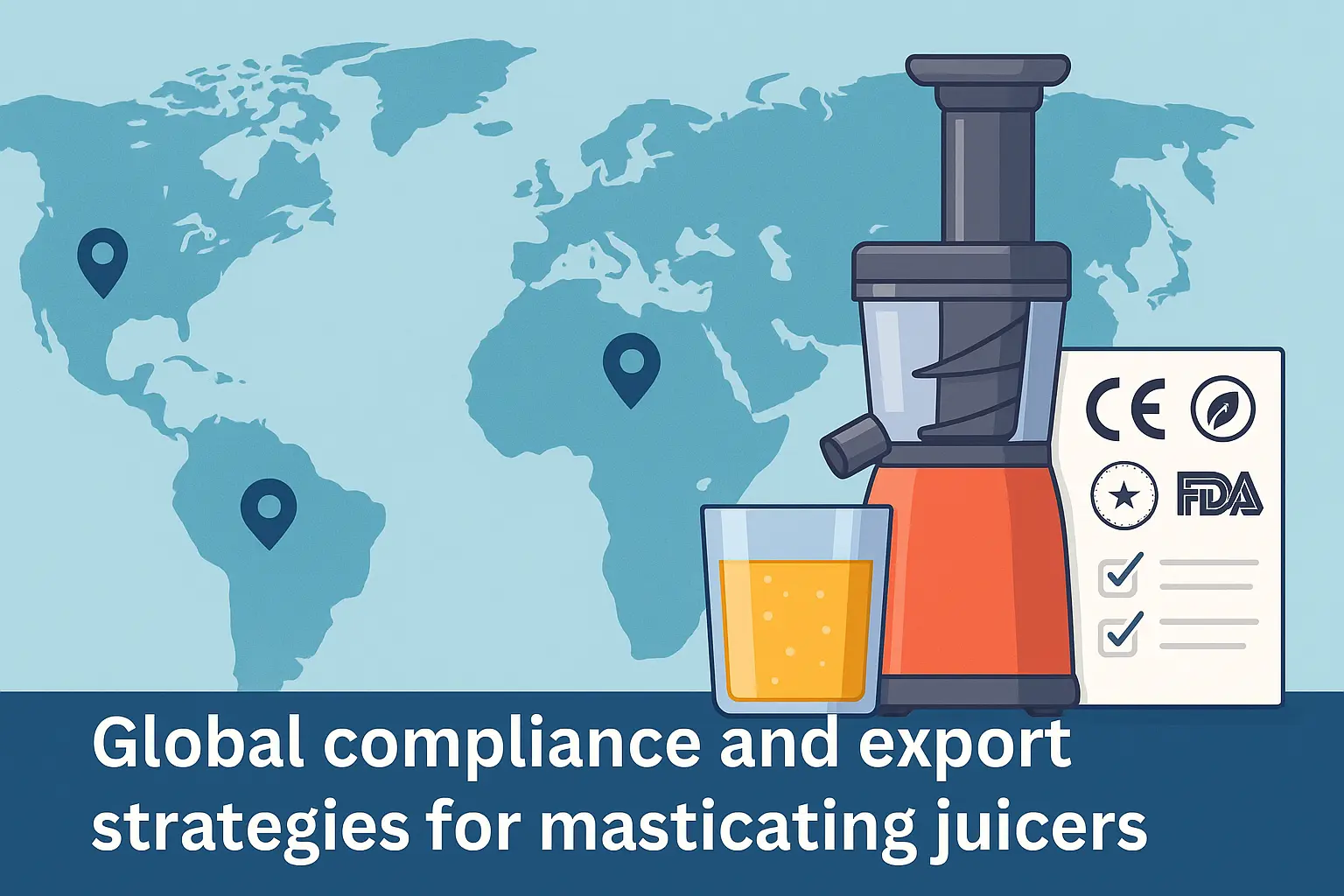
Masticating juicer export refers to the export around the world of slow-speed, cold-press juicers made with auger-based extraction. Popularity surges in markets that appreciate maximum juice extraction, minimum oxidation and quiet operation.
Key markets are North America, Europe, and parts of Asia with units rated at approximately 150 to 250 watts and 40 to 80 RPM. Purchasers evaluate stainless steel components, BPA-free plastics, and CE or ETL markings.
To frame decisions, the core addresses criteria, logistics, pricing and supplier verification.
Why These Regions Matter for Juicer OEM Buyers
By mapping demand by region, OEM buyers can plan SKUs, price bands, and channel strategy with fewer missteps. Understanding local regulations and consumer habits can greatly impact the success of appliances like centrifugal juicers, ensuring excellent juice yields and maximizing product fit.
UAE, South Africa, and Latin America: high-growth, different playbooks

The demand in the UAE is significantly driven by wellness tourism, luxury hotels, and a tight-knit juice bar ecosystem. Buyers are increasingly opting for mid-to-high-end juicer machines that feature quiet motors, compact footprints, and fashionable finishes, making them ideal for open-counter use. These machines are designed to deliver excellent juice yields, catering to the growing preference for high-quality juice among health-conscious consumers.
In South Africa, rapid growth is evident in urban centers, where home users seek robust, easy-to-clean machines capable of handling leafy greens and hard roots. The demand for slow juicers that provide maximum juice extraction while maintaining juice quality is on the rise. Latin America showcases diversity, with Mexico and Colombia favoring mid-price home units sold online, while Brazil addresses commercial needs such as sugarcane-capable rotors for street vendors and cafés.
Asia-Pacific is another growth engine. An estimated 7.87% CAGR is driven by increasing urban incomes and health consciousness, with the need for compact models with low noise and durable, easily available parts post-sale.
Europe remains a strong market, holding 36.7% market share in 2023, sustained by juice bars and health cafés promoting home juicing. France and Italy are experiencing robust replacement cycles, prioritizing both design and performance in their juicer selections. Meanwhile, Scandinavia continues to focus on eco-design and energy efficiency, often influencing pan-European norms.
Sizing the opportunity and ranking priorities
Europe and parts of APAC have the largest market size and import frequency, with commercial sites being replenished routinely. The UAE and South Africa, on the other hand, import in smaller, more frequent batches connected to tourism seasons and retail promotions.
Latin America’s volume spikes, and the Brazil commercial channel takes rugged builds. Consumer preferences differ. Mediterranean buyers want citrus-optimized augers for oranges and lemons. Brazil favors high-torque drives and easy service access.
Scandinavia rewards low standby power and recyclable materials. Price sensitivity is uneven. In lower-income markets, premium cold-press units can equal months of disposable income, so offer tiered pricing, refurbished lines, or extended financing.
Demand drivers by region
- Health trends: Social media pushes detox and fresh juice habits in UAE, APAC cities, and Europe.
- Food culture: Citrus use in the Mediterranean, sugarcane in Brazil, and greens and roots in South Africa.
- Channel mix: Hotels and cafés in UAE, modern trade and e-commerce in Latin America, specialty retail in Europe.
- Climate and seasonality: Cold climates favor rental programs during peak produce cycles.
- Regulation and sustainability: Scandinavia’s eco rules ripple across Europe. APAC cities extend noise and safety thresholds.
Compliance and hardware fit
Modify to 220 to 240 V regions with appropriate plugs (Type G – UAE, Type M/D – South Africa, Type N – Brazil, Type C/F – most of Europe). Comply with EU eco-design and energy labeling, food contact rules, and local warranty standards.
Provide citrus kits for Mediterranean markets and industrial strength rotors for Brazilian sugarcane. Keep spares localized to reduce downtime and satisfy service level agreements.

Compliance Basics: Safety, Labeling, Certification
Exports of masticating juicers, including the popular amzchef slow juicer zm1501, must have a clear, well-documented route that addresses electrical safety, food-contact regulations, and local labeling to ensure quality juice and excellent juice yields.
Ensure all masticating juicer exports meet each region’s electrical safety standards, including voltage compatibility (e.g., 220V/50Hz for UAE).
Meet supply specs for each market, ensuring that appliances like the centrifugal juicer operate efficiently. The UAE and much of the Middle East operates at 220 to 240 volts and 50 hertz, while South Africa uses 230 volts and 50 hertz. Additionally, several Latin American countries operate at 127 volts to 220 volts and 60 hertz.
It is crucial to provide region-specific SKUs, plugs, and fuses, and to list input ratings on the rating label and manual. For kitchen appliances, including juicer machines, provide CB Scheme test reports for IEC 60335-1 and IEC 60335-2-14. Furthermore, maintaining EMC reports to conform with market standards, such as CISPR 14-1 and CISPR 14-2, is essential.
Conduct lot-level hi-pot and earth continuity tests while logging results. Ensure that parts touching juice, such as sealing rings and juice cups, are food-contact compliant and BPA-free, adhering to the EU Framework Regulation 1935/2004 or equivalent to guarantee quality juice preparation.

Prepare accurate labeling in required languages, including product details, importer address, and compliance marks for UAE, South Africa, and Latin America.
Use legible, durable labeling in metric units. For the UAE, include Arabic and English, model, voltage and frequency, importer name and address in the UAE, G Mark if applicable, and country of origin.
For South Africa, use English and any official language used by the importer, NRCS or SABS mark when required, local distributor address, and safety warnings. In Latin America, provide Spanish or Portuguese as applicable, INMETRO mark for Brazil, importer CNPJ in Brazil, and NOM mark for Mexico if sold there.
Add safe-use icons, noise level in dB, and steps for cleaning. Manuals should correspond to label languages and have spare parts information.
Obtain and document necessary food contact and appliance certifications (CE, CB, SABS, INMETRO) for juicers, blenders, and accessories.

Hold CB certificates and test reports as the base, then apply for national marks: CE (Low Voltage, EMC, RoHS), UKCA if routing to the UK, SABS/NRCS LOA for South Africa, and INMETRO for Brazil via an OCP and factory audits.
Maintain food-contact declarations of conformity for all wet-path parts. Adhere to CGMP in 21 CFR Part 110 as the foundation for juice-specific HACCP efforts. If making juice samples or concentrates, HACCP under Part 120 identifies hazards per § 120.7(a), confirms 5-log reduction with validated controls and maintains only § 120.12 records for FDA inspection.
Importers into the U.S. Need to satisfy § 120.14 or import from an MOU country. Do non-allergen runs first, then allergen runs with complete clean in-between.
List all required documentation and certifications in a table to streamline customs clearance and avoid shipment delays.
- Technical file: schematics, BOM, risk assessment, IEC reports, EMC reports.
- Certificates: CB, CE DoC, SABS/NRCS LOA, INMETRO certificate, RoHS.
- Food-contact: material specs, migration tests, DoCs.
- Labels/manuals: translations, importer addresses, marks artwork.
- Factory files: IQC/OQC records, hi-pot logs, CAPA.
- Logistics: commercial invoice in EUR, packing list, HS code, COO.
- HACCP (if exporting juice or concentrate): plan, validation, five-log proof, required records as per § 120.12.
Logistics & Packaging Tips for Export to UAE, South Africa, Latin America

Think solid pack, smart load plans, and clear handoff to carriers who know home appliances like juicer machines. Match each market’s regulations, last-mile standards, and price ceilings to minimize claims and ensure excellent juice yields.
Select robust packaging materials and designs to protect masticating juicers, centrifugal juicers, and accessories during long-distance shipping.
Double-wall corrugate outer cartons (7 mm minimum) and molded pulp or EPP foam bracing. Add edge protectors and a crush-tested inner tray to secure the motor base. For heavy masticating units (8–12 kg), specify 3 cm foam around auger housings and reinforced handle areas.
Seal with water-activated tape and add humidity barrier bags for sea freight. Place spare parts—filters, augers, brushes—in separate small cartons to prevent scuffing and rattling. Drop-test to 80 cm and 1 m edges and vibration-test to ISTA 3A. Add obvious “this side up” and tilt and shock labels for claim leverage.
Adapt packaging sizes and palletization for efficient container loading and cost-effective freight to each destination port.
Right-size master cartons to fit 1,000 to 1,100 mm pallet footprints common in LATAM and 1,000 by 1,200 mm in UAE and South Africa. Stick unit carton girth plus length to under 3 m for air lanes. Target cube efficiency: a 20-foot container is approximately 28 to 30 m³; a 40-foot HC is approximately 67 m³.
Stack 4 to 5 layers, interlock and use slip sheets to minimize voids. Strap and wrap with 23 µm film and cap with a top sheet. For U.A.E., prepare for doorstep delivery, so include hand holes and individual unit shippable cartons that can survive courier handling.
For SA, blend sea bulk and air promo SKUs to align with hyper e-commerce growth, as the market was over USD 2 billion in 2020 while maintaining cost per order.
Create a checklist to ensure all necessary items are included in the packaging for each region.
- Core: motor base, auger, juice screen, pulp cap, hopper, pusher, juice and pulp cups, cleaning brush, power cord type, user guide, quick-start card, warranty.
- UAE: Air Waybill, Commercial Invoice, HS code, declared value noting De Minimis USD 270. VAT 5% applies below this. Above De Minimis, duty 5% plus VAT 5% for both B2C and B2B. Arabic/English labels for voltage and safety. “Organic-ready” messaging fits strong demand for organics.
- South Africa: English user guide, SANS plug spec, local service info, barcodes readable in dim light. Cod-safe seals for few couriers.
- Latin America: Spanish and Portuguese guides, country-level plug and voltage notes, sticker sets for Spanish and Portuguese claims, and space for local warranty stamps.
Coordinate with reliable freight forwarders experienced in handling kitchen appliances, ensuring timely delivery and minimal damage.
Select forwarders that have appliance lanes into Jebel Ali (UAE), Durban, Cape Town (South Africa), and LATAM hubs such as São Paulo, Santiago, and Panama. Check they do AWB and commercial documents for UAE clearance.
B2C importers don’t need ID in Dubai, but B2B might do customs registration. In Latin America, schedule buffers for ports and inland trucking where infrastructure is patchy, as this extends lead times and inflates costs.
Set KPIs: damage rate less than 1%, on-time delivery greater than 95%, and claim cycle less than 15 days. Utilize cargo insurance with “all risk” and book peak season space early to avoid rollovers.
Market Preferences & Customization by Region
Export schemes fare best when product fit reflects local flavor, voltage requirements, and service standards. In regions like Europe and North America, the demand for appliances like centrifugal juicers and slow juicers is rising, driven by wellness brands and café processes, while Asia-Pacific and Latin America are also embracing these juicer machines.
Offer region-specific color options and branding for masticating juicers and blender juicers to match local consumer tastes and retail trends.
Color and finish guide shelf appeal and brand recall. Matte black, brushed steel, and slate grey have all been popular sellers in Germany, France, and the UK. Shoppers in these countries tend to drift toward clean lines and pro-grade signals associated with health-centric kitchens.
In North America, premium white, deep navy, and stainless blends suit café counters and wellness menus, supported by increased small-appliance spending. Latin America skews warm reds and popping turquoise in modern retail. Meanwhile, the Middle East prefers pearl white, gold trim, and high-gloss black for luxury retail.
Co-branding with cafes and hotel groups aids commercial sell-in. Add subtle logo panels and color-matched cable sleeves for front-of-house applications.
Customize user manuals, warranty cards, and quick-start guides in Arabic, Portuguese, Spanish, and English as appropriate for each market.

Well-defined, concise instructions minimize support calls and returns. Arabic packs are suitable for the UAE and wider Gulf, Spanish for most of LATAM, and Portuguese for Brazil. Retain English defaults for North America and numerous African countries.
Incorporate metric units, straightforward schematics, QR codes for video setup, and locally customized warranty terms with local repair partners. Additionally, add food safety notes pertinent to hospitality, such as daily sanitation measures and busy hour cleaning.
Adjust product features such as plug type, voltage, and included accessories (e.g., citrus attachments, pulp containers) based on regional demand.
Match voltage and plug standards: 220–240 V Type G for UAE, 230 V Type C/M for South Africa, 127/220 V Type N for Brazil, and 120 V Type B for North America. Add citrus attachments in the Middle East and South Africa where fresh citrus is a staple.
Larger pulp containers and continuous-feed hoppers are needed for North America’s café rush. Compact footprints and quieter motors are important for dense European sites. Easy-to-wash parts are essential for Asia-Pacific growth marketplaces.
Energy-efficient motors are important in Germany and France, where performance and energy consumption are key purchase factors. Capacity and serviceability should be next to menu strategy and peak-hour intensity.
Present a table comparing preferred juicer models, colors, and packaging styles for UAE, South Africa, and Latin America to guide OEM buyers.
- UAE: Mid- to high-capacity masticating units, pearl white or gloss black with gold accents, premium rigid box with Arabic/English print, tamper-evident seals.
- South Africa: Durable mid-capacity units with strong torque, matte black or charcoal, tough corrugate with water-resistant coating and prominent recycle symbols.
- Latin America: Versatile models with citrus kits, red or turquoise or stainless, bilingual (Spanish/Portuguese) graphics, and shelf-ready cases for hypermarkets.
German buyers desire top-performance, highly efficient units that they can integrate into contemporary hospitality infrastructure. North America’s café culture and wellness menus drive commercial-grade features and express service.
Europe’s appetite is diverse, with France set to shine on gastronomic lineage and fresh produce emphasis. Asia-Pacific adoption jumps on growing awareness. Around the globe, preferences depend on technology, environmental impact, and versatility.
ElectMix’s Export‑Ready Workflow: From Factory to Distributor
Transparent processes eliminate risk for purchasers and minimize hold ups. This workflow demonstrates how the OEM masticating juicer machines export at scale while fulfilling regional regulations and deadlines, ensuring excellent juice yields.
Step-by-step export process, from OEM order to final shipment

Orders begin with selecting a juicer model, motor specifications, voltage/plug type, color, and forecast. A signed proforma invoice and 30% deposit secure the berth for the juicer machines. Engineering verifies torque, ensuring noise levels are below 65 dB, and continuous run time of 20 to 30 minutes to guarantee optimal juice quality.
Our pilot build of 10 to 30 units undergoes life tests at 220 to 240 V and 110 to 120 V, including thermal cut-off checks and food-contact safety assessments on augers and strainers. After approval, mass production begins with station QA: incoming inspection of motors and PCBs, IPX1 drip tests on housings, and a comprehensive 100% power-on test for each juicer.
AQL sampling (for example, II, 0.65/1.0) is conducted, with batch holds if any unit fails. Cartons are made of 5-ply board, inner foam, and drop-tested from 80 cm on six faces, ensuring the safe delivery of your juicing appliance. Logistics books space 2 to 3 weeks in advance, with humidity indicator cards in every pallet to maintain quality during transport.
Support for custom branding, labeling, and documentation by region

ElectMix ensures quality juice packaging by taking care of color match with Pantone chips, silk-screen or pad print logos, and private-label cartons featuring multi-language text. For the EU, user manuals and labels highlight compliance with the CE mark, importer address, WEEE bin, and RoHS note, with translations in French, German, Spanish, or Italian as required. The attention to detail in packaging aligns with the standards of juice companies that prioritize juice quality and consumer safety.
In the U.S., the UL or ETL control number is listed, and the FCC SDoC is provided where motors have electronics, ensuring that appliances like juicer machines meet necessary regulations. The California Prop 65 notice is included if needed. For the UK, UKCA and a UK RP are provided, while the Middle East requests Arabic labeling and SASO compliance.
The HS code is on the packing list, typically 8509.40. Additionally, MSDS for lubricants, food-contact DOCs, and LFGB or FDA 21 CFR test reports are included, ensuring the country of origin is clearly indicated as ‘Made in China’ according to customs regulations. This thorough process reflects the commitment to quality that is essential for both traditional juices and innovative juicing technologies.
After-sales service: parts, tech support, and warranty handling
Spare parts ship within 5 to 7 days: augers, strainers, seals, motors, gears, and PCBs. A parts matrix tracks failure rates so partners keep the right SKUs. Technical assistance arrives by email or ticket with a 24 to 48 hour response, wiring diagrams, and teardown guides.
The standard warranty is 12 months on the machine and 5 years on the motor for most models. The target for the DOA rate is less than 0.5 percent. With photo or video proof, distributors credit or replace units. Root-cause reports arrive within 10 days.
Managing bulk orders, on-time shipments, and ongoing communication

ElectMix plans capacity by week and shares Gantt views, booking vessels early in peak seasons. Split-ship options handle rush lanes. Weekly updates display yield, scrap, and ETA.
EDI or simple spreadsheets match ASN data. For a 2,000-unit order to the EU and 1,500 units to SE Asia, the team shipped in two waves to meet launch dates, maintained the same lot code, and coordinated promo manuals across languages.
Conclusion
The way is open. Choose target markets with consistent demand. Match specs to local power, food laws, and buyer habits. Save papers tidy and nearby. Prepare for heat, dust, and extended journeys. Establish reasonable lead times. Price with taxes in mind.
True gains appear in tiny shifts. Pulp knob for Brazil. Provide spare filters for UAE. Use bold watt labels for SA. Ship 220 to 240 V stock with explicit plug notes. Share test reports up front. Have only one export SKU per region to reduce confusion.
Want a next step. Request a region map, sample BOM, or an Arabic, Spanish, or English label pack. Contact us to initiate your export run today.
Frequently Asked Questions
What makes UAE, South Africa, and Latin America attractive for masticating juicer exports?
These areas have increasing health consciousness and a growing demand for reliable appliances such as juicer machines. OEM buyers benefit from less competition in niche SKUs and regional incentives, as distributors seek long-life products like the amzchef slow juicer zm1501, which offers excellent juice yields and easy cleanup.
What compliance standards should an export-ready masticating juicer meet?
Ensure compliance with electrical safety (IEC/EN 60335) and food-contact safety (LFGB/FDA) standards, especially for appliances like juicer machines. Maintain proper voltage, labeling, and native language manuals, while collaborating with cert labs for quality assurance.
How should I package juicers for safe export to these regions?
Utilize drop-tested packaging and moisture barriers to ensure the safe transport of juicer machines. Incorporate bilingual labels and scannable barcodes for easy identification. For retailers, fit carton sizes and stack height rules, while including spare parts kits for efficient juicing processes.
What voltage and plug types are required by region?
UAE: 220–240 V, 50 Hz, Type G plugs. South Africa: 230 V, 50 Hz, Type M or new ZA Type N. Latin America varies: many use 110–127 V, 60 Hz, Type A/B; some use 220 V. CHECK PER COUNTRY PRIOR TO PRODUCTION TO AVOID REWORK.
How do market preferences differ across these regions?
UAE buyers prefer juicers with ultra-premium finishes, quiet motors, and Arabic/English manuals, while South Africa values durability, parts-in-a-snap access, and generous warranties. In Latin America, price-performance for juicer machines, small sizes, and Spanish/Portuguese content are favored, as juice yield, pulp dryness, and easy cleaning matter everywhere.
What labeling is essential for customs and retail compliance?
Show model/rating (V/Hz/W)/plug type/country of origin/serial/lot/CE/SASO/NRCS marks, where applicable, and importer for the masticating juicer export. Include safety icons, food-contact symbols, and recycling marks to ensure quality juice production. Compare carton and unit labels to packing lists for juicer machines.
How does ElectMix manage export from factory to distributor?
ElectMix manages compliance testing for various appliances, including juicer machines and centrifugal juicers, alongside regional SKUs and packaging. We oversee factory QA, pre-shipment inspection, and forwarder booking while handling documents such as CI, PL, COO, and test reports for juice companies and appliance distributors.

Marketing & Product Lead at ElectMix | Innovating Commercial Blenders & Home Appliances | Driving Growth & Development


