 Skip to content

- Key Takeaways
- Understanding the B2B Import Process
- Common Certifications for Blenders & Juicers
- MOQ (Minimum Order Quantity) Explained
- Lead Times and Production Planning
- OEM & ODM Capabilities
- How ElectMix Handles Quality Inspection
- Shipping: FOB vs. CIF vs. DDP
- Common Documents & Export Checklist
- Conclusion
- Frequently Asked Questions
- What is the typical MOQ when ordering from a blender manufacturer in China?
- Which certifications are important for blenders imported from China?
- How long does production usually take for custom blender orders?
- What is the difference between OEM and ODM services?
- How does ElectMix ensure product quality?
- What are the main shipping terms: FOB, CIF, and DDP?
- Which documents are needed for importing blenders from China?
Key Takeaways
- Understanding the complete B2B import process, including supplier selection, negotiation, and compliance with tariffs and duties, is crucial for importing blenders from China efficiently.
- Certifications such as CE and RoHS increase the marketability of blenders and juicers. They serve to guarantee that these products live up to international safety, quality, and labor standards.
- MOQ (Minimum Order Quantity) requirements – these hugely depend on the manufacturer you’re working with and the type of product you’re looking for. Learning how to negotiate favorable MOQs ensures purchases are aligned with business needs.
- Effective production planning is a key ingredient for successfully controlling lead times. Furthermore, strong communication with suppliers prevents inventory shortages from occurring, which can be of utmost importance when shipping to the United Arab Emirates.
- Choosing the right shipping terms, like FOB, CIF, or DDP, affects overall costs, delivery times, and risk distribution in B2B transactions.
- Precise export documentation and comprehensive quality inspections ensure quick customs clearance while establishing trust and credibility with global customers.
China blender manufacturer, professional blenders made in china for home or commercial use. While these companies are increasingly becoming household names, their headquarters are still often tucked away in cities like Shenzhen or Guangzhou.
There are thousands of factories around China that make all sorts of blenders. They produce everything from residential to light commercial kitchen to heavy duty models for hotels, restaurants, etc.
Brands owned in the United Arab Emirates or other countries typically get their blenders from Chinese manufacturers. Our primary post will detail how to choose the best manufacturer for your needs and what to look for.
Understanding the B2B Import Process
Importing commercial blenders from China involves a complex manufacturing process that requires attention to every detail.
Supplier Selection
The initial stage is choosing the appropriate supplier. Buyers research various manufacturers, compare and contrast pricing, and search for important certifications such as CE and ASTM. These safety marks indicate the blender complies with important safety standards in the U.S. Europe.
Recruit a third-party inspection team to inspect the blenders. Quality is a crapshoot, and there is no industry-wide standard in China. This added measure can further close language or cultural divides, helping identify problems before the order ships.
Product Specifications and Planning
Once a supplier has been selected, you’ll want to discuss product specifications, packaging, and shipping terms. That all has to be unambiguously clear. Even when it’s just delays with replacement parts or warranty issues, the expenses add up.
Chinese manufacturers are sometimes lax on honoring warranties, so set terms upfront in writing to protect your company. Lesson learned – planning is everything. Plan shipments to and from China at least three months ahead of time. Alternatively, you expose yourself to costly holdups that can damage your bottom line.
Logistics and Compliance
Freight forwarders and customs brokers are critical here. Freight forwarders handle logistics of getting goods here, and customs brokers help with paperwork, tariffs, and duties. Understanding the tariffs applicable to blenders is an absolute prerequisite.
It has an impact on the final price and can alter the amount of profit that remains after the transaction. Importers need to make sure their blenders are following the rules in their home country. For example, they must adhere to the Machinery Directive in the EU.
Repairing blenders through Western technicians is often prohibitively expensive. So, it really pays to get this right from the beginning!
Common Certifications for Blenders & Juicers
For any blender manufacturer in China, it is essential to possess relevant certifications. As a result, these marks communicate to wholesale buyers and importers that these products pass international safety, quality, and environmental standards. Each of those markets, whether the U.S. Or Europe or Southeast Asia, has its own set of rules.
For brand owners and resellers, understanding these certifications allows you to choose partners that operate legally and prioritize end-user safety. It makes customs more efficient and prevents delays at the border.
CE, RoHS, ETL, CB, SASO, SNI, etc.
The CE mark is required for commercial blenders and juicers marketed in Europe, indicating that these kitchen appliances comply with EU health, safety, and environmental legislation. Similar to CE, RoHS is required for the EU, ensuring that products are free from harmful materials such as lead or mercury.
In the U.S. and Canada, the UL and ETL marks are familiar sights to consumers. UL stands for Underwriters Laboratories, while ETL is the certification mark used by Intertek, both indicating that the electric hand blender has undergone rigorous electrical safety testing.
China’s 3C certification (China Compulsory Certification) is required for any product sold in the mainland Chinese market. It addresses safety, performance, and their environmental sustainability. For the Middle East, SASO (Saudi Arabia) is relevant, but SNI is important for Indonesia.
Another frequent certification is EMC, which protects against blenders interfering with other equipment. ISO 9001 is an internationally agreed-upon standard ensuring factories maintain quality control in their manufacturing process.
Common certifications for blenders and juicers help ensure that consumers receive reliable and safe products, whether they are using powerful blenders for home use or in a commercial setting.
- CE (EU safety, health, environment)
- RoHS (EU hazardous materials)
- UL/ETL (US/Canada electrical safety)
- 3C (China safety, environment)
- SASO (Saudi Arabia standard)
- SNI (Indonesia standard)
- EMC (electromagnetic compatibility)
- ISO 9001 (quality management)
MOQ (Minimum Order Quantity) Explained

MOQ, or minimum order quantity, is the minimum amount of units that a Chinese blender manufacturer will fill your order. You can only purchase this minimum amount all at once. This might be as few as 600 blenders. Or it could be a dollar figure, like $10,000 per order.
In reality, that number varies widely from supplier to supplier. Other factories may place their MOQ as low as 10 or 20 blenders. Meanwhile, some need orders of hundreds or even thousands!
Equipment plays a significant role in determining the MOQ. The most important thing blender makes a big difference. On top of that, the color or special features you might choose affect the price. For instance, a supplier might have a higher MOQ for a specific glass jar-style blender.
Alternatively, they could decide on another MOQ if it was a plastic one or a unique color.
Lead times for production and shipping blenders from China can fluctuate greatly. They vary widely from a few weeks to more than a month depending on order quantity, seasonality, and shipping lane.
Factories can require 15-30 days to produce a straightforward 100-piece order. On top of that, it takes another 2-4 weeks for sea freight to ship the goods to the US or Europe.
If you require a custom design or packaging, include extra time. Planning out inventory is extremely important, as running out of stock due to long wait times for restock can result in wasted sales from empty displays.
Aligning lead times with market demand ensures that they don’t run the risk of running out of stock during peak seasons.
Communicating frequently and transparently with your supplier is critical to keeping production moving. Compare order predictions, inquire on peak seasons, and receive notifications as your shipment progresses through the line.
In fact, some suppliers will waive their MOQ if you’re willing to pay a bit extra or you’re otherwise low-maintenance.
Lead Times and Production Planning
Lead times and production planning are huge when working with blender manufacturers in China. ElectMix, 比如,提供两种OEM,ODM服务。 OEM stands for original equipment manufacture, which means that the customer provides the design and ElectMix produces it. ODM stands for ElectMix doing design and then doing the making, too.
OEM is ideal for brands that need a consistent aesthetic. On the contrary, ODM is more suited for brands that want to take advantage of the maker’s knowledge and experience to develop cutting-edge products. Either route allows brands to discover the right production fit for their market.
Specialized jobs allow businesses to be unique. ElectMix allows brands to customize colors, features, or attachments on their blenders. It provides the brands with the ability to cater to the specific tastes of their market, such as a juice bar chain requiring a low-noise blender.
In this competitive market, that advantage can result in increased sales and stronger brand memory. Lead times vary depending on the size of the order, if there is a requirement for custom work, and how challenging the project is. For large orders, we are looking at possibly 30 to 90 days from beginning to end.
If it’s a short run or basic model, merchandise might be produced in as few as seven days. Therefore, delivery can be as little as 15 days or as many as 50 days depending on the size of the order and final destination. For custom jobs, the small orders of business rules usually dictate a minimum order of 100 pieces. Typical production models are a few hundred up to thousands.
It all begins with a design process. Next is selecting appropriate components, testing, and building the blender. Every single one of these steps has the potential to alter the entire timeline. Material supply and factory schedules are contributing as well as shipping routes.
Here’s another example—a US brand collaborated with ElectMix to launch a new blender with an innovative lid design. From concept to ship, they completed the entire ODM journey in 75 days.
OEM & ODM Capabilities
OEM and ODM services have long been the foundation of most Chinese blender manufacturers. These two models allow companies from anywhere outside of China to leverage the deep expertise and core production competencies here without necessitating their own factories.
OEM stands for Original Equipment Manufacturer, which implies that the factory produces the blenders according to the customer’s design and specifications, with the customer’s name on the package. ODM takes it a step further—in this case, the factory also assists in developing the design, then sells the completed product under the customer’s label.
Either direction works to enable brands to provide customized blenders. With OEM/ODM, they can customize right down to looks and features, the color of buttons, even the design on the pitcher.
ElectMix, an industry-leading production blender manufacturer, relies on advanced stage-gate product development. It begins with initial concept discussions, then proceeds to design renderings, samples and ultimately full pilot production runs.
From the molds to the assembly line, each step is inspected rigorously to identify issues sooner. Custom branding and packaging completes the process, providing each OEM/ODM client with something special. Healthy OEM and ODM programs flourish with honest conversations.
Specific instructions for everything the customer requires, from electrical requirements to safety placards, keep the project on track. Quality control is everything. In short, quality control is a huge focus.
ElectMix inspects each component, from motor to blade. They require rigorous testing for noise, speed and safety. Third-party inspections provide an extra layer. These groups inspect the product before it’s shipped out of China, ensuring that the product you’re sending is exactly what the buyer is looking for.
Integrity and transparency throughout this step is critical for international confidence and follow-on orders. Key inspection checks include:
- Power use and motor strength
- Blade sharpness and fit
- Leak and spill tests
- Noise level and safety locks
- Packaging strength
How ElectMix Handles Quality Inspection
At ElectMix, quality inspection is not just a box to check off. It’s a pretty extensive practice and ensures that every blender is absolutely perfect before it leaves the factory. When producing blenders in China, the quality assurance process begins with inspection of incoming raw materials.
Materials such as stainless steel, for instance, are given a particularly scrutinized eye as they resist the effect of water and acids, thus preventing rust. Blade design is another blunder to avoid. High angle and high fit blades, otherwise the blender’s performance on smoothies and ice will suffer. The crew takes an equally close look at the power plant, as well.
They test motor power trying long runs and heavy loads. If a motor underperforms, it is returned for repair or replacement. After safety, quality is the top priority. The ElectMix team manually inspects features such as overheat shut-off and safe lid locks.
Every unit needs to get through these stages to comply with very stringent regulations. Take, for instance, China’s 3C certification, which is mandatory for selling any blender in that market. When producing blenders, large runs are the standard.
That’s why ElectMix always inspects a sample from every run, ensuring one bad batch doesn’t get past the inspection process. Energy consumption and carbon emissions made the cut, as well. Other buyers are looking for blenders that are not power hogs and contribute to climate change.
The final quality inspection step is stress testing for expected life span. Our team quality inspects and tests each of the blenders every single day. Then, they’d like to test their durability in the high-traffic settings of coffee shops and eateries.
All these touches contribute to less returns, safer operation, and a longer life for every single blender.
| Shipping Term | Who Pays Freight | Who Handles Risks | Delivery Duty |
|---|---|---|---|
| FOB | Buyer | Buyer after port | Buyer |
| CIF | Seller | Buyer after port | Buyer |
| DDP | Seller | Seller | Seller (to doorstep) |
Shipping: FOB vs. CIF vs. DDP
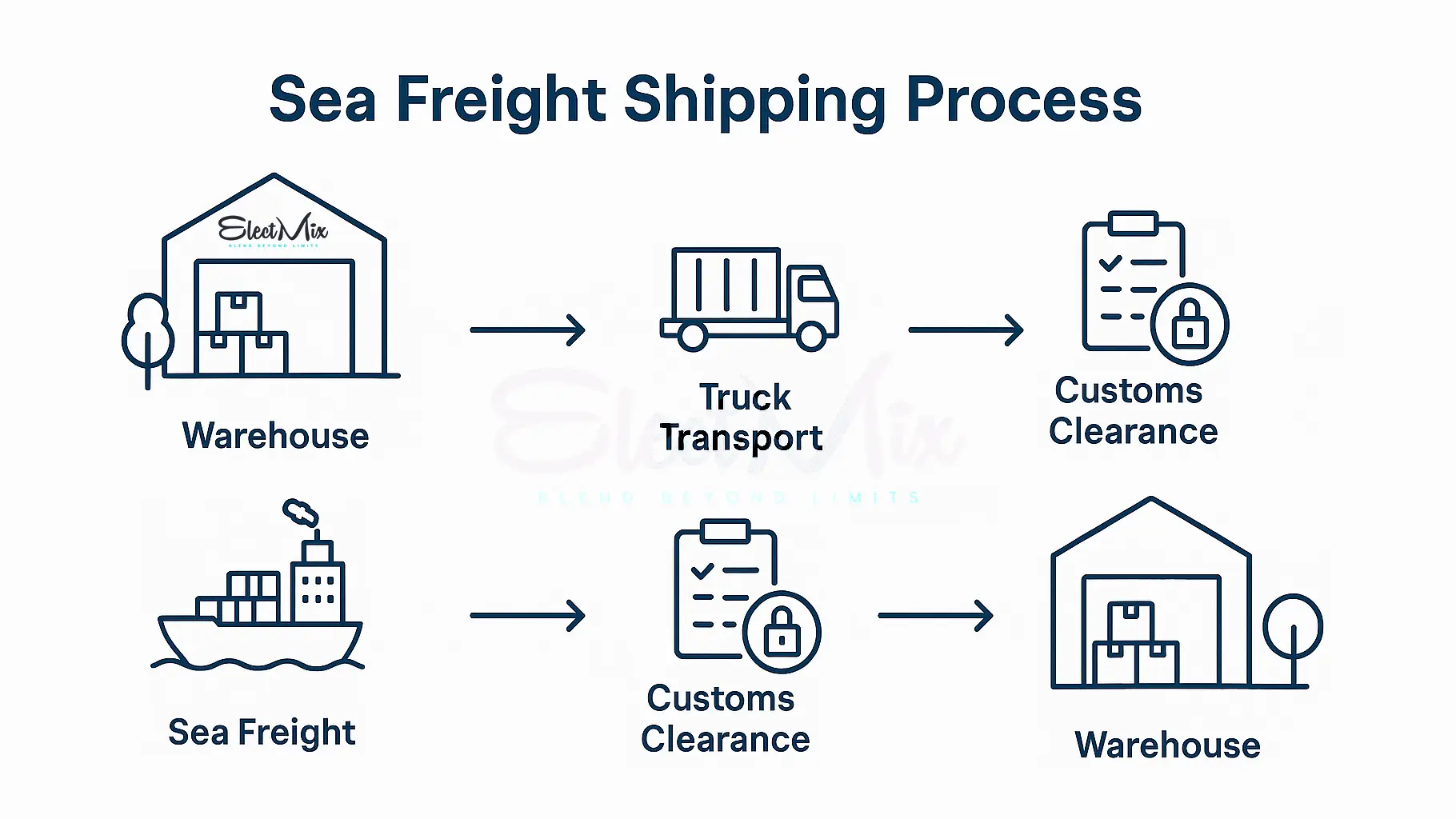
Choosing the right shipping term when exporting commercial blenders from China is more than just a cost comparison. It influences almost every move from the factory to your doorstep. The three most used Incoterms are FOB, CIF, and DDP.
These terms make it very clear who pays for what, when the risk passes, and how much red tape is involved. Each one of these terms has their own requirements and duties, all the way down to who handles customs and insurance.
For instance, with FOB, the seller is responsible for getting your electric hand blender to the port in China. You take on the expense and liability once they get on the ship. CIF just goes a little further. The seller is responsible for the costs of freight and insures the products to 110% of their value in your currency.
You are still responsible for clearing customs on your end. DDP turns all of that on its head. The seller takes care of all the details—shipping, customs, and import duties. You don’t have to do anything but sit back and be delivered to without any additional fees or documentation.
This is why DDP is favored by first-time importers and anybody who prefers a low-touch experience.
Proper paperwork is the make or break for any export coming out of China. Customs clearance can be a matter of every detail lining up, from the commercial invoice to the packing list. Incomplete or inaccurate information delays shipments, incurs additional charges, or worse, can even halt shipments at the port of entry.
Those key documents are the commercial invoice, packing list, bill of lading, export license, and insurance certificate. Now is a good time to verify product code, quantity and value accuracy.
Export Checklist:
- Commercial invoice
- Packing list
- Bill of lading or airway bill
- Export license (if needed)
- Insurance certificate (for CIF)
- Import/export contracts
- Certificates of origin (as required)
Common Documents & Export Checklist
Sourcing your commercial blenders from China is more than just choosing a supplier and ordering blenders. The logistical challenge begins with ensuring that goods remain safe, legal, and on time. This process starts with paperwork and inspections.
One of the most important documents needed for the process is the commercial invoice. It details exactly who is purchasing and exporting, what is included in the shipment, the quantity, what it weighs, and the value of the entire shipment. This document is essential for China customs as well as for import into the buyer’s country.
Each individual shipment now needs a customs registration code PEA1093 from the exporter. This code is required by Chinese law for all exported goods. China takes export control rules seriously, especially with tech or certain kitchen appliances.
So, it’s a good idea to review these rules before you ink any agreement. Certain products will require additional licenses or approvals. This is where ElectMix comes in. They’re familiar with the process and deal with experienced customs brokers.
Further, they can connect their clients with freight forwarders that manage the movement of goods from factory to port. They have U.S. Connections that facilitate this process. We’ll dive more into that process in a future post, but the key is that each step is U.S.-based.
The export process often requires a team – shippers, freight forwarders, customs agents – each responsible for a piece of the work. Incorrect or missing documents or information can result in severe delays in processing applications or even monetary penalties.
That’s why it’s worth your time to work with a manufacturer that has the expertise in exporting. ElectMix walks our partners through every step, from completing the commercial invoice to obtaining the customs code. Their quality control is rigorous and ensures the products adhere to international standards, letting consumers sidestep frightening shocks.
Conclusion
Chinese blender manufacturers provide great value and selection to consumers looking for the best. Whether you’re looking for tiny test orders or tailored characteristics, there’s genuine variety here. Brands such as ElectMix manage checks and documents efficiently, allowing transactions to progress efficiently. Thus, buyers can choose what works best for them, whether that’s choosing DDP for door-to-door service or arranging their own freight sorting. Certifications align with UAE regulations, further reducing risk. OEM, ODM, flexible MOQs—so many possibilities—buyers can tailor orders to meet their requirements. Looking to get your supply moving a little faster? Pick one that has good, reliable lead times. If you’re looking to get into or expand within this exciting space, don’t hesitate to contact a proven supplier. Request a quote or sample to start the process today!
Frequently Asked Questions
What is the typical MOQ when ordering from a blender manufacturer in China?
The MOQ, or Minimum Order Quantity, is typically 600 units for commercial blenders sourced from a manufacturer in China. Some manufacturers will be able to haggle on MOQs, especially for new clients or sample orders of powerful blenders.
Which certifications are important for blenders imported from China?
Relevant certifications CE, CB, GS, and RoHS are essential for ensuring electrical safety requirements and environmental standards in kitchen appliances like commercial blenders. Always double-check certification requirements for your destination market before ordering import blenders.
How long does production usually take for custom blender orders?
Our lead times for manufacturing commercial blenders can vary anywhere from 30-60 days, based on order volume and level of customization. Starting from the early stages of planning will prevent unnecessary delays and allow for delivery on time.
What is the difference between OEM and ODM services?
OEM refers to the fact that the manufacturer produces quality blenders, such as commercial blenders and personal blenders, according to your precise specifications. ODM provides a range of ready-made kitchen appliances, which you can brand under your name, significantly reducing product development time.
How does ElectMix ensure product quality?
ElectMix implements strict in-house inspections and third-party quality checks for its commercial blenders, minimizing quality defects and ensuring that every single blender meets international quality standards before shipping.
What are the main shipping terms: FOB, CIF, and DDP?
FOB (Free On Board) responsibility extends to kitchen appliances until they’re on board the vessel. CIF (Cost, Insurance & Freight) Shipping includes insurance for commercial blenders to the named port of destination. DDP (Delivered Duty Paid) encompasses all shipping charges to your final destination, including duties and taxes.
Which documents are needed for importing blenders from China?
These necessary documents consist of the commercial invoice, packing list, bill of lading, certificate of origin, and applicable product certifications for kitchen appliances like commercial blenders and personal blenders. Make sure to check your country’s import requirements which you must adhere to.
ElectMix Team provides global e-commerce sellers and distributors with insights on commercial blending solutions, OEM customization, and profitable market opportunities.


