 Skip to content

- What Defines Heavy Duty?
- Power and Performance Insights
- Design and Durability Factors
- Essential Attachments and Accessories
- Heavy Duty Use Cases
- Maintenance for Longevity
- Safety First Considerations
- Milkshake Machines: A Staple for Beverage Businesses
- Beyond Blending: Related Tools
- Conclusion
- Frequently Asked Questions
- What makes a stick blender “heavy duty”?
- What power level should we look for in a heavy-duty stick blender?
- Are heavy-duty stick blenders suitable for commercial use?
- What attachments are essential for a heavy-duty stick blender?
- How do we maintain a heavy-duty stick blender for longevity?
- Can we use a heavy-duty stick blender for making milkshakes?
- What safety features should we look for in a heavy-duty stick blender?
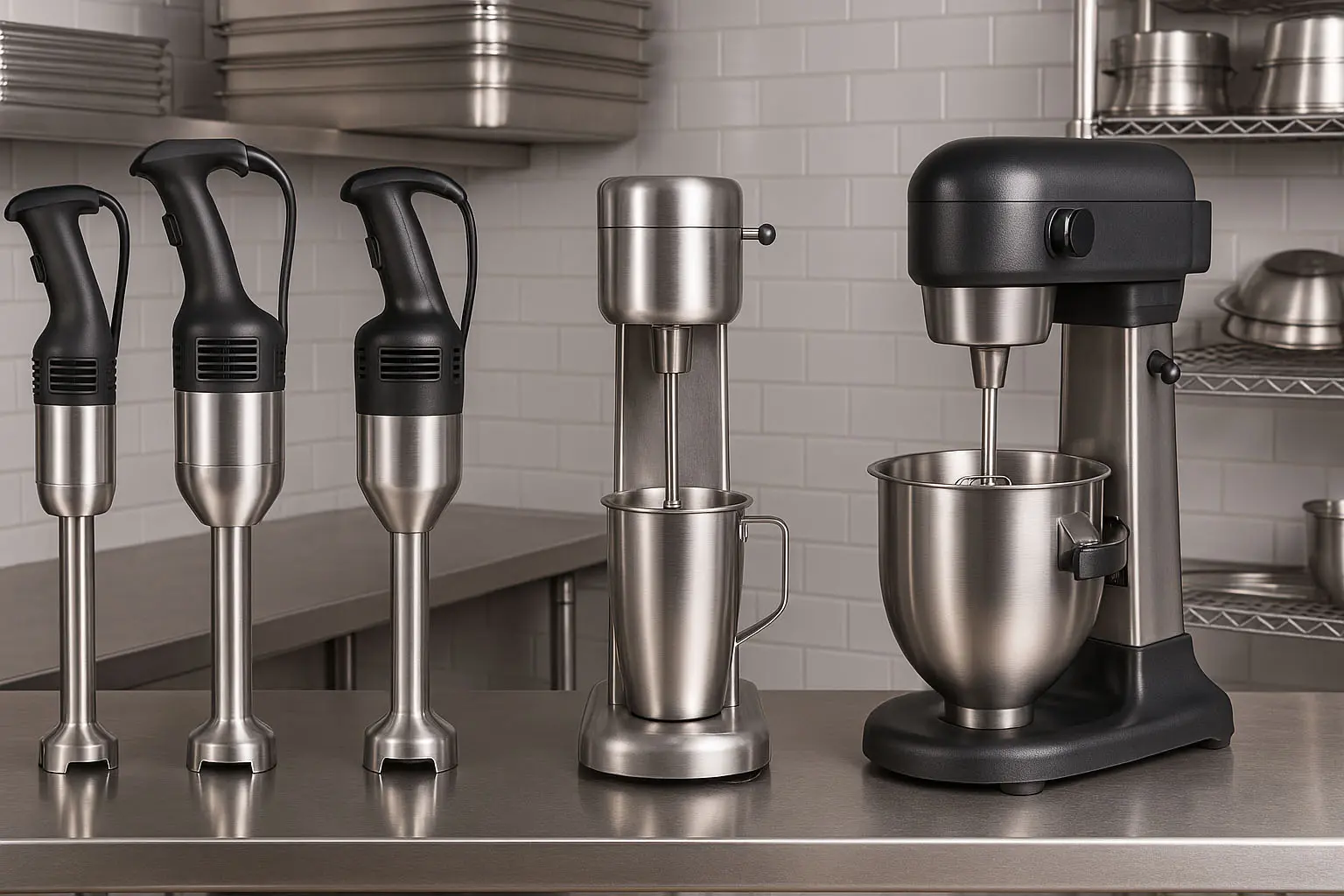
A commercial stick blender is a powerful, fast, and efficient stick blender created to help puree, mix, and emulsify large quantities in minimal time and effort. These blenders are equipped with high torque motors and heavy duty stainless steel shafts.
They’re the ideal tool for the most demanding commercial kitchen and enthusiast home cooks tackling ingredient challenges. Perfect for batch cooking soups, sauces, and smoothies, tough enough to take on the most demanding food applications without skipping a beat.
With their ergonomic designs for comfort and extended use, they’re the perfect blend of efficiency and reliability for even the most demanding culinary creations.
What Defines Heavy Duty?
The stick blender definition outlines a type built for heavy duty, industrial jobs. These professional grade blenders have been scientifically designed for high-volume commercial and professional kitchens. Unlike typical consumer-grade machines made for occasional use in the home, these blenders are made to stand up to rigorous, day-in and day-out performance.
Here are the main things that distinguish them.
1. Key Features Beyond Standard Models
Heavy-duty stick blenders are feature rich. Experience the benefits of variable speed controls, detachable shafts to handle multiple tasks, and ergonomic designs that provide ease of use during long hours.
For example, on some models you can go from blending to pureeing to emulsifying—all without different attachments. Battery-powered models include thorough safety precautions, including auto-shutoff and double-insulated handles, so no matter how long your session lasts, you’re protected.
These features transform the blender from a simple kitchen tool to a versatile culinary workhorse.
2. Understanding Motor Power Ratings
Motor power is probably the clearest defining metric, with typical ranges for eMTBs in the 300 to 1,000 watt or higher range. A 500-watt motor can just as easily pulverize hearty bisques.
Motors with higher ratings handle thicker blends such as dough or frozen ingredients effortlessly. That rapid technology significantly reduces time in prep and delivers a more uniform outcome, making this technology critical to production environments where few mistakes are allowed.
3. Typical Build Materials Used
Durability comes from premium materials such as stainless steel for shafts and blades with reinforced polymers for the housing. Corrosion resistant stainless steel is engineered to withstand high temperatures, perfect for creating smoothies from hot liquids.
At the same time, food-safe plastics help keep the overall weight down, making them easier to maneuver without sacrificing strength.
4. Designed for High-Volume Tasks
These high throughput blenders are built with productivity in mind. They are much bigger batch, doing up 10 gallons or more, depending on model.
This capacity is especially important in environments such as restaurant and catering operations, where quick and high volume service is a must.
5. Durability and Longevity Innovations
Sealed motors and cooling technologies are frequent innovations that keep them from overheating during extended use. Replaceable components, like blades and shafts, make it easy to keep the machine going longer, decreasing downtime and maintenance costs.
6. Efficiency in Professional Settings
Time is always a premium in professional kitchens, and heavy-duty stick blenders do not waste time. High-torque motors paired with precision blades emulsify sauces or whip creams in seconds, reducing the number of steps in a workflow.
7. Comparing Noise Levels Differences
Sophisticated insulation and variable motor designs reduce sound performance to quiet its levels. Though no blender is truly quiet, these innovations improve the experience of using heavy-duty models in bustling commercial kitchens without compromising on performance.
8. Price Versus Long-Term Value
While the initial investment appears significant, the performance, longevity, and lower maintenance cost usually provide a return on investment. As you use the tool, that initial investment goes down and down, making it a smart investment for working professionals.
Power and Performance Insights
To better understand the power and performance of a heavy-duty stick blender, explore important specifications such as motor wattage and speed adjustment. Additionally, look at its ability to hold stability under load. Collectively, each of these factors works in concert to shape a blender’s performance. They impact all kitchen tasks, from making soups silky smooth to pulverizing frozen produce.
Why Motor Wattage Matters
Motor wattage is the often the go-to initial impression of a blender’s power. Wattage by itself does not ensure quality, performance or simplicity. For comparison, the Mueller Ultra-Stick 500W 9-Speed has a 500-watt motor. This power is perfect for doing all of your blending tasks with ease.
In performance tests, this model scored nearly as well as Braun Multiquick. It required more time to achieve the same degree of smoothness. Wattage isn’t everything, especially when you take into account other elements such as blade design and the overall build quality.
That’s just it—the Braun Multiquick stands out on its powerful 500-watt motor. Its turbo boost feature puts performance into overdrive, with grinding, whipping and blending made easy. This demonstrates that motor power is most effective when combined with intentional engineering.
Variable Speed Control Benefits
Blenders that allow you to choose variable speed, such as the Cuisinart Smart Stick Variable Speed Hand Blender, give you more versatility while you blend. This feature gives you the precision you need to tackle sensitive jobs, such as folding in airy batters. You can take on tougher tasks, like pulverizing frozen fruit for smoothies.
In that same time, we found that the Cuisinart Smart Stick was able to fully puree a chunky vegetable soup. Such remarkable performance goes to show how quickly it can form in response to different patterns and thicknesses. This level of control decreases splattering and provides for more uniform blends especially in emulsifying applications.
A variable speed immersion blender can create stable emulsifications in two minutes, whether it’s a dressing or hollandaise sauce. It provides unrivaled efficiency and cooking precision to culinary professionals.
Consistent Blending Under Load
When it comes to heavy-duty blending, consistency under load is the name of the game. A powerful blender needs to deliver high performance no matter what you’re blending — from dense soups to solid frozen ingredients. The Braun Multiquick turns out to be the most consistent performer.
Its rubber-coated grip gives added comfort while helping you to keep a sure grip during prolonged use. This factor of usability pairs nicely with its ability to churn out solidly performing models, despite the tougher recipes.
Design and Durability Factors

For heavy-duty stick blenders, patented design and durability productivity features are what separate their usability and performance from others on the market. A sturdy enough design allows a stick blender to handle intense, repetitive jobs day in and day out while remaining comfortable for hours on end. Let’s take a look at three key features that add to its design and durability.
Ergonomics for Extended Use
Comfort is not an extravagance—it’s a requirement, particularly when you are using a stick blender for extended stretches of time. You’ll want your handle to be ergonomically shaped so it fits comfortably and organically in your hand, which lowers strain and fatigue.
A rubberized grip further enhances comfort and security while using it. It’s designed to hold the blender securely, even when your hands are slippery or greasy. Besides how the weight is distributed—though that’s an important factor, too.
A well-balanced blender just feels lighter and easier to lift around. Pureeing a thick soup in one go in a big batch pot takes a while. Soft-touch controls and a lightweight, ergonomic design go a long way toward making it a joy to use.
Shaft Length Considerations
The length of the shaft is an important design factor in deciding a stick blender’s versatility and efficiency. This is particularly crucial in professional or high-volume kitchens. A long arm, typically 12 inches or more, allows you to access deeper planters and big mixing bowls.
This thoughtful design ensures that your hands stay safely away from hot steam and spatters. This is particularly convenient when cooking large pots of hot soup or large volumes of high acid sauces like salsa.
Stainless steel is often the shaft material of choice. Its quickness to rust, scratches, and dents assure long-lasting beauty. Other models come with interchangeable shafts. That adjustable length/proportional blend end allows you to alternate between full width or tapered ends depending on the type of application you are doing.
Robust Housing and Components
If you expect a stick blender to hold up to professional use, the housing and components should be durable enough to withstand frequent use. Stainless steel blending components offer dependable protection from wear and tear, and a blade design that has a big impact on the consistency of your blending.
Well-designed, very sharp, well-angled stainless steel blades will power right through everything from dense hard root vegetables to smooth soft purees and sauces. Motor strength is essential to a stick blender’s performance.
A blender with a motor range from 200-1,200 watts will give you the versatility you need to tackle many different tasks. Interchangeable bell blades increase versatility, allowing users to switch between bell blades to achieve multiple presentations and adapt to various recipes.
Essential Attachments and Accessories
To maximize the benefit of your heavy-duty stick blender, knowing which attachments and accessories are available is key. These additions dramatically increase the blender’s versatility. It turns into a space-saving powerhouse that is able to do so much more than any other kitchen appliance.
Below, we’ll outline a few of the essential attachments and accessories that will greatly enhance your blending experience.
Whisk Attachments for Versatility
Whisk attachments bang for the buck. These versatile attachments are ideal for tasks that need whip-like precision and subtle mixing. They’re ideal for beating cream, aerating egg whites, or folding together muffin batters.
This one is a bit of a gimme since most models already have this accessory built-in. We were surprised to see that the Vitamix Immersion Blender includes a whisk attachment. This unique feature combined with its design makes it ideal for aerating egg whites and whipping pancake batter fluffy.
Similarly, the Dash Chef Series Immersion Blender and the KitchenAid Variable Speed Immersion Hand Blender offer whisk attachments, allowing for easy preparation of meringues, sauces, and dressings. The All-Clad Immersion Blender adds even more versatility to the kitchen arsenal.
On board there’s both a whisk and blending wand, so you can jump between mixing and whipping in no time flat. These models even come with a whisk attachment, underscoring the functionality of the design. Yet, they appeal to the ambitious home cook and the professional chef.
Chopper Bowls for Prep Work
Chopper bowls add speed and muscle to prep work, allowing you to chop or mince without labor-intensive knife work. These attachments especially come in handy for tasks like dicing vegetables, chopping nuts, or even grinding fresh herbs.
The Nutribullet Immersion Blender includes a 25-ounce chopper bowl to enhance your food prep. It comes with a 42-ounce jug and an anti-slip mat to hold everything in place while you blend. Similarly, the KitchenAid model offers a 24-ounce chopper attachment, while the Vitamix provides a 20-ounce chopper bowl, giving ample capacity for small to medium prep tasks.
An included 3-cup chopping bowl offers the versatility of an extra prep tool that works well for small kitchens or single-serve/meal-prep chopping. These composite chopper bowls offer an efficient way to cut food prep time without sacrificing accuracy.
Wall Mounts for Storage
Wall mounts are a smart touch, making sure your stick blender and accessories don’t get all tangled up and knotted in a drawer. Not every model comes with wall mounts, but some brands focus on storage features to help ensure your kitchen stays organized.
Breville immersion blenders, which have a long list of accessories available, generally pack in some clever storage solutions, but it depends on the model. A wall mount will not only free up a ton of counter space, but it will guarantee that your blender is always within reach when you need it.
Heavy Duty Use Cases
Professional heavy-duty immersion blenders thrive in high-volume kitchens, taking on tough jobs at lightning speed. Beyond professional applications, they are becoming indispensible even in home kitchens. Their rugged flexibility paired with high-performance features and capabilities means they tackle everything from the most dynamic applications to the toughest environments without issue.
Three Heavy-Duty Use Cases
Below, we’ll drill into three key use cases to showcase their power and why they are critical.
Ideal for Commercial Kitchens
In bustling commercial kitchens, durability and efficiency are the name of the game. The POSWEENR immersion blender, with its 11-inch immersion depth, makes it especially great for blending larger volumes of food in tall pots and pans. This depth allows chefs to mix right in stockpots or other deep containers.
In doing so, they can reduce the number of liquid transfers and reclaim precious time during high-demand service hours. The ultra-sharp 4-prong stainless steel blades purée the toughest ingredients to perfection in seconds. Be it seeds or tubers, the ferocious motor thrashes them in a pinch.
This helps create a uniform texture, something that’s especially important when making sauces, batters, or soups in bulk for thousands. Immersion blenders frequently include specialized attachments such as blending arms and bowl clamps. These are extremely helpful for cooks who have to rapidly pivot from task to task like whipping cream or emulsifying dressings.
The Breville All-in-One Immersion Blender includes a food processor attachment. This adaptability is one of its sharpest features, allowing it to thrive in high-pressure environments.
Perfecting Soups and Sauces
Especially when dealing with soups and sauces, you want high precision in texture and smooth consistency. The POSWEENR immersion blender has the least powerful, 225-watt motor of any model we tested. My goodness it pureed a batch of soup into a velvety smoothness in just 90 seconds.
This is a reminder that wattage is not the only measure of performance. Its ergonomic handle and wide power range give unmatched comfort during long use. This feature allows you to try out completely new recipes without the stress.
Blending right in the pot really cuts down on the mess and clean up, too. This lets you focus on getting your flavors right without a hassle. Be it a creamy tomato bisque or a decadent hollandaise, immersion blenders make the task simple without sacrificing quality.
Handling Thick Mixtures Easily
For heartier mixtures such as a hummus, mashed potatoes, or pancake batters, more durable heavy-duty equipment will be needed. The POSWEENR’s mixture of high torque and sharp blades quality assures these mixtures are applied evenly without straining the motor.
We found that immersion blenders with motor power between 225 and 600 watts reliably achieved perfectly smooth textures. They turned out to be remarkably versatile, working across an array of recipes. This renders them dependable instruments for both dense and liquid-based primers.
Maintenance for Longevity
Proper maintenance is key to extending the life of your heavy-duty stick blender while ensuring it performs at its best. Make intense cleaning and detailed inspection a part of your maintenance routine. With a little care in storage, you’ll be enjoying all of its benefits for many years to come, without stress or premature deterioration.
Here are some straightforward tips to ensure you get the best out of blender maintenance.
Clean Your Blender Properly
This is an important cleaning step to take after every use. Buildup of food particles can lead to bacteria growth, so it’s important to clean your stick blender after each use. Begin by removing all detachable components, like the mixing shaft and attachments.
Thoroughly rinse all of these components and wash them with warm, soapy water. Pay special attention to the areas where food debris is likely to accumulate, like the blade edges and the shaft joints.
For the electric motorized handle, do not immerse it underwater. Rather, clean it off with a damp cloth so you don’t risk moisture getting inside its electrical components. Monthly, perform a thorough cleaning and sanitation.
Let the removable bits soak in equal parts warm water and white vinegar. This specially-designed solution cuts through sticky residues, boosts deodorizing and keeps your blades sharp.
Keep components out of the dishwasher unless the manufacturer indicates a component is dishwasher-safe. Hand washing is less abrasive and does less to damage shoes.
Inspect Parts Regularly
Regular inspections often allow you to catch problem areas in their early stages before they develop into serious, expensive repair concerns. Inspect the blade assembly periodically to keep the blade sharp and nix-free. Dull blades will put unnecessary stress onto the motor and impact overall performance.
Make sure to check the shaft connection to ensure it locks into the motor base when in use. Further, check seals or gaskets on any appliances or fixtures for cracks or brittleness, which can result in leaks or water damage.
If your blender has a cord, look for fraying or exposed wires, which can lead to shock. Repairing or replacing damaged components as quickly as possible will help protect safety and mobility.
Store Safely When Not Used
Avoiding moisture & heat is crucial. Always store your stick blender in a dry, cool place. Don’t wrap the cord tightly around the handle, which can damage the internal wiring.
To provide additional protection, remove any detachable pieces and keep them in a separate, safe container to avoid scratching or damaging the surface.
Safety First Considerations
Whether you’re using heavy-duty stick blenders in a commercial kitchen or your household, putting safety first is not just a smart precaution—it’s the law. The same applies to concrete. These powerful tools can handle dense mixtures and big volumes, but their power calls for equally potent safety measures.
Knowing the safety protocols and adhering to them can avoid overheating and allow for safe operation. This firsthand knowledge will save you time and money and elemental stress of a potential accident.
Overheat Protection Mechanisms
Heavy-duty stick blenders usually tackle super dense ingredients or run for longer times, making them prone to overheating. Safety built-in overheat protection mechanisms can be used to protect it from damage and keep it safe.
Most dependable brands, such as Vitamix and Hamilton Beach, provide thermal overload protection as a standard. This feature automatically shuts down the device in the event that the motor overheats. This advanced safety feature prevents appliance overheating from an unattended cooktop, protecting the user from severe burns.
To prevent unnecessary activation of these mechanisms, cool hot liquids or semi-solids for 3 to 5 minutes before blending. Do not process particularly dense foods longer than three minutes continuously. That keeps the strain off the motor and lowers the risk of it overheating.
For any specialized steps on your specific model blender, it’s important to always check the manufacturer’s manual to know best practices.
Secure Locking Systems
This feature is an indispensable main safety function. It holds the blender parts secured while you use the blender. A loose blade attachment or unsecured motor body can result in spill, equipment damage, or even personnel injury.
Professional grade stick blenders will sometimes have keying mechanisms, which only allow the motor to run if everything is properly connected and in place. For commercial kitchens, investing in high-quality brands that focus on the design of their locking systems saves time, money, and the safety of your employees.
For starters, double-check that everything is correctly aligned and locked before powering up the blender. Finally, when routinely maintaining the equipment, make it a habit to inspect seals and fittings for wear and replacement.
Safe Handling Best Practices
Proper driver behavior is just as critical to safety as all the built-in safety technology. Remember to always turn off and unplug the blender before cleaning or using a scraper to prevent injury or accidents.
This simple practice, when followed, protects workers from getting hurt by sudden blade action. Gripping the blender tightly adds stability and caution. Whenever possible, use both hands to improve control—especially in emergency situations!
From the perspective of practitioners working to save lives, every one of these habitual behaviors pays off in a big way. One of our road department employees admitted that he never wore one until he got hired on his department’s payroll.
Even more alarming, this negligent practice may have led to fatal outcomes. Just like in the example of blender safety, it can be easy to overlook shortcuts that lead to dangerous situations.
Milkshake Machines: A Staple for Beverage Businesses

Milkshake machines are staples in milk beverage businesses, making laborious preparation steps fast and easy, and bringing consistent results. These durable machines are an asset to any operation. They’re perfect fit for bustling hotspot restaurants or convenience shops, maintaining superior quality in each delicate treat.
Structure and Operation Principles
Milkshake machines are engineered as to balance productivity with strength. Additionally, all units come equipped with a durable stainless-steel chassis, ensuring wear-and-tear resistance, perfectly tailoring them for any commercial environment.
They work with spindles that spin at variable speeds through high-performing motors, capable of mixing everything from watery to dense ingredients. Having a two or three-speed motor allows you to adjust blending to the speed that best suits your ingredients.
From thick ice cream to lighter, more frothy liquids, you get the right texture every time. Variable speed controls and programmable timers increase accuracy in preparation. They produce standardized cycles, guaranteeing the same texture and taste from one order to the next.
Many models even come equipped with easy-to-clean designs, cutting down maintenance time and ramping up efficiency of operation—a crucial asset in bustling environments.
Milkshake Machine Types (Single, Dual, Triple Spindle)
Milkshake machines come in three primary configurations: single, dual, and triple spindle. In smaller-scale operations, single-spindle machines really shine. Their small footprint and user-friendly operation make them ideal for those businesses getting lesser volume.
Conversely, dual-spindle machines are ideal for larger, mid-sized establishments where two milkshakes can be made at once. In peak-demand settings such as dessert bars and other high-volume points like “QSR” beverage centers, triple-spindle machines provide outstanding value.
They let you mix several milkshakes at once, increasing your operation’s efficiency. Specifically, most commercial milkshake machines — over 90% — are configured with multiple spindles in order to handle the high volume activity of a specialty beverage environment.
Operations that offer fully customizable, layered milkshakes offer a fantastic benefit from these multi-spindle machines. They increase service speed with consistent high-quality standards.
Example: High-Volume Cafés & Dessert Bars
High-volume operations, such as an energetic coffee house or energized dessert counter, typically use milkshake machines because of their adaptability. These machines are capable of creating so much more than classic milkshakes.
Many are utilized to develop alcoholic beverages, like Irish cream shakes or coconut rum milkshakes, widening menu range. Hamilton Beach Professional brands provide dependable, long lasting performance.
Taylor products employ proprietary heat treatment systems to keep dairy products at the perfect temperature. This perfect blend of dependability and versatility means that businesses can whip up customers’ favorite treats in no time.
Beyond Blending: Related Tools
When it comes to kitchen appliances, a heavy duty stick blender is an indispensable tool for all of your blending and pureeing needs. It isn’t the miracle cure-all panacea that everyone seems to think it is. Whatever the task, you may find other tools to be more effective. By knowing the options, you can make sure you’re doing the right work, with the right equipment, for the best results.
When to Choose Milkshake Machines
Milkshake machines are great at mixing up drinks with a rich, silky consistency. Unlike immersion blenders, which involve a process that you operate, milkshake machines employ a fixed-in-place spindle and a blending cup. This ergonomic design is what makes them so efficient and effective for commercial or high volume use like in cafes, diners, etc.
For instance, preparing a malted milkshake or a protein-rich smoothie becomes seamless with their robust build and consistent speed settings. While stick blenders can handle smaller tasks, they often leave behind unblended ice cubes, even after extended use. This makes milkshake machines a better choice for drink preparation.
Understanding Industrial Mixer Types
These industrial mixers are designed and engineered to go big and tough for bulk mixing. They have four different designs, including planetary, spiral and vertical cutters, with each mixer type designed for different applications.
Take planetary mixers, for example—they’re incredibly versatile mixers that can mix doughs, batters, and even whip cream to perfection. Designed with big batches of dough in mind, spiral mixers incorporate dough evenly while aerating to the perfect degree.
Vertical cutter mixers are unmatched when it comes to chopping, blending, and emulsifying. They are ideal for high-speed food industrial warfare! Industrial mixers are extremely useful machines, but their bulk and expense place them at the level of commercial kitchens, not individual households.
Selecting Mixers for Specific Tasks
The first step in selecting the best mixer for your project is determining how you plan to use it. For quick actions, like beating cream to finish a sundae, an immersion blender is ideal. The Bella Immersion Hand Blender is a budget-friendly choice at just about $25.
Get ready to manage it with caution, as it can both splatter and create suction. The best stick blenders for making silky smooth soups and purees usually have motors between 225 and 600 watts. Keep in mind that higher wattage does not automatically mean better performance.
Testing reveals that some budget models, like the Hamilton Beach, outperform pricier options but may overheat quickly. Stick blenders typically tend to leave a lot of pulp, compromising yield, something to think about for larger runs.
Conclusion
Selecting the best heavy-duty stick blender makes all the difference in a professional kitchen. It’s more than just soup—it’s what you save in prep time, muscle on heavy-duty jobs, and results, repeatable results. That’s why a dependable motor and heavy-duty construction are key when power and tough performance are essential. Attachments such as whisks or chopping tools come in handy too, giving even more versatility to one instrument that can do the task of so many. Regular cleaning and inspection for wear can help them last longer, saving you money over time.
Whether whipping up milkshakes in a café or tackling soup prep in a busy kitchen, the right blender works harder so you don’t have to. Look carefully at what you really need and select accordingly. Looking to take your kitchen skills to new heights?
Frequently Asked Questions
What makes a stick blender “heavy duty”?
A commercial-grade stick blender model will have a high-performance motor, such as 500 watts or higher. It’s constructed with high quality materials such as stainless steel making it powerful enough to blend the thickest soup and puree massive batches.
What power level should we look for in a heavy-duty stick blender?
If you want a heavy-duty stick blender, choose one with a motor that’s at least 500 watts. More wattage means it can tackle chunky ingredients and longer blending times without risking burnout.
Are heavy-duty stick blenders suitable for commercial use?
Heavy-duty commercial stick blenders are perfect for commercial kitchens. They’re heavy duty, designed to stand up to their powerful performance in commercial environments making short work of large quantity food prep jobs.
What attachments are essential for a heavy-duty stick blender?
Whisk attachments, blending arms and chopping bowls are all common essential attachments. These increase the blender’s versatility for cooking activities other than blending, such as whipping, chopping, or emulsifying.
How do we maintain a heavy-duty stick blender for longevity?
Be sure to clean it completely every time, especially the blender blades and other attachments. Never submerge the motor portion of the blender in water. Perform frequent checks for signs of wear and tear. Don’t forget to care for them according to the manufacturer’s instructions.
Can we use a heavy-duty stick blender for making milkshakes?
You betcha! Heavy-duty stick blenders are indispensable for milkshakes. Their strength guarantees that ice cream, milk and all your other mix ins get blended together perfectly for a thick and creamy shake.
What safety features should we look for in a heavy-duty stick blender?
Consider safety features for a heavy-duty stick blender, such as non-slip grips, safety locks, and splash guards. These features especially prevent accidents during use, particularly in bustling high-pressure kitchen environments.

ElectMix Team provides global e-commerce sellers and distributors with insights on commercial blending solutions, OEM customization, and profitable market opportunities.


